
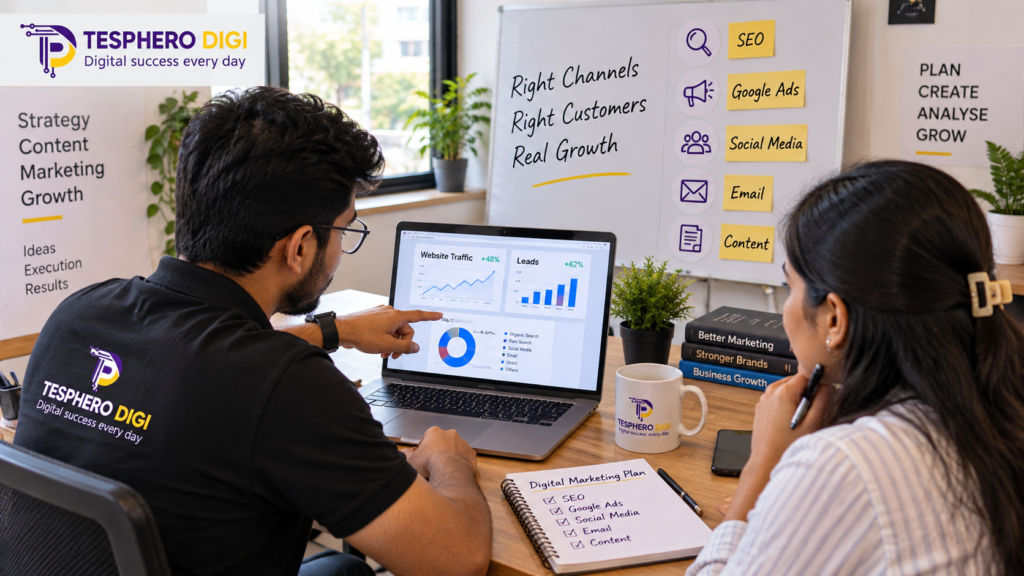
The right marketing channel starts with understanding your customers, goals and real performance data.
Choosing the right digital marketing channels can make a major difference in how your business reaches and converts customers. However, many businesses make one common mistake. They try to be active everywhere. They post on every social platform, run ads, send emails, and work on SEO at the same time. As a result, their budget and attention get divided without a clear purpose.
The better approach is not to ask, “Which digital marketing channel is the best?”
Instead, ask:
“Where do my customers spend time, what are they looking for, and which channel can help me reach them at the right moment?”
A local service business may get strong results from Google Search. Meanwhile, a fashion brand may find Instagram more useful for discovery. A B2B company may depend more on LinkedIn, SEO, and email. Therefore, the right marketing mix depends on your audience, goals, budget, and buying journey.
This guide will help you understand the main digital marketing channels and choose the ones that make sense for your business.
- Understanding the Right Digital Marketing Channels
- What Are Digital Marketing Channels?
- Why Choosing the Right Channel Matters
- Start With Your Business Goal
- Understand Your Target Audience
- Comparing the Right Digital Marketing Channels
- SEO and Organic Search
- Paid Search Advertising
- Social Media Marketing
- Paid Social Media Advertising
- Email Marketing
- Content Marketing
- Choosing the Right Digital Marketing Channels for Your Business
- Match the Channel to the Customer Journey
- Look at How Customers Already Find You
- Don’t Choose Channels Because Competitors Use Them
- Consider Your Budget and Resources
- Your Website Still Matters
- Organic and Paid Marketing Can Work Together
- Test Before You Scale
- Measure Business Results, Not Vanity Metrics
- Give Channels Enough Time to Produce Useful Data
- Common Mistakes When Choosing Marketing Channels
- A Simple Digital Marketing Channel Checklist
- How Tesphero Digi Can Help
- Frequently Asked Questions
- About the Author
Understanding the Right Digital Marketing Channels
What Are Digital Marketing Channels?
Digital marketing channels are the online platforms and methods businesses use to reach potential customers.
Common channels include:
- Search Engine Optimisation (SEO)
- Google Search Ads
- Social media
- Social media advertising
- Email marketing
- Content marketing
- Video marketing
- Marketplace advertising
- Influencer marketing
Each channel works differently.
For example, someone searching Google for “commercial interior designer near me” may already have a clear need.
However, someone scrolling through Instagram may not be actively searching for an interior designer. A good project video or before-and-after post could still create interest.
So, these two channels reach people in different states of mind.
That difference matters when you plan your marketing.
Why Choosing the Right Channel Matters
Every marketing channel requires resources.
You need time to create content. Advertising requires money. SEO needs consistent work. Social media needs regular posts and engagement. Email needs a useful contact list and relevant communication.
Therefore, trying to do everything at once can become expensive.
More importantly, it can make your marketing difficult to measure.
Imagine a small business spending ₹50,000 every month across five channels without knowing which one generates real enquiries.
The problem is not always the budget.
The problem may be how the budget is divided.
A focused strategy can help you understand where your customers come from. Then, you can invest more in channels that support your business goals.
Start With Your Business Goal
Before selecting a platform, define what you want marketing to achieve.
Do you want more website traffic?
Do you need leads?
Are you trying to increase online sales?
Perhaps your priority is local visibility.
Maybe you have launched a new brand and need more people to know about it.
Different goals may require different channels.
For example, a business that needs immediate enquiries may test paid search advertising.
On the other hand, a company that wants steady organic visibility may invest in SEO and useful website content.
A new consumer brand may focus more heavily on social media and visual content.
Therefore, start with the business outcome, not the platform.
Understand Your Target Audience
You cannot choose the right digital marketing channels without understanding who you want to reach.
Start with simple questions.
Who usually buys from you?
Where are they located?
Are you targeting consumers or businesses?
What problem are they trying to solve?
How much research happens before they buy?
Where do they search for information?
Which online platforms do they use?
These questions help narrow your options.
For example, a business selling professional services to company decision-makers may find LinkedIn relevant.
In contrast, a lifestyle brand aimed at younger consumers may benefit more from visual social platforms.
However, demographics alone are not enough.
You also need to understand customer intent.
A person watching a Reel and a person searching Google for a service may both be potential customers. Yet, their readiness to buy can be very different.
Comparing the Right Digital Marketing Channels
SEO and Organic Search
SEO helps your website become more visible when people search for relevant information, products, or services.
For example, suppose you operate a home interior business in Indore.
Potential customers may search:
“interior designer in Indore”
“modular kitchen designer near me”
“home renovation services Indore”
If your website appears for useful searches, SEO can bring potential customers to your business.
However, SEO usually takes time.
You need a technically sound website, useful pages, relevant content, and ongoing improvements.
Therefore, SEO may be a strong option when customers actively search online before buying, and you want to build long-term visibility.
When SEO may make sense
SEO can be useful when:
- Customers search Google for your product or service.
- Your business has a website.
- You want to build organic visibility over time.
- Customers research before contacting you.
- You can consistently improve your website and content.
SEO should not be viewed as free marketing. It still requires time, skill, and resources.
However, the traffic does not depend on paying for every click in the same way as search advertising.
Businesses that want to understand how Google Search works can also explore Google’s official SEO documentation and best-practice guides.
Paid Search Advertising
Paid search advertising can place your business in front of people searching for specific products or services.
Google Ads is one common example.
The key advantage is intent.
If someone searches for “AC repair near me,” they probably have an immediate problem.
A relevant ad can connect the customer with a service provider at that moment.
However, paid search needs careful management.
Poor keyword selection can waste money.
A weak landing page can reduce enquiries.
Incorrect targeting can attract irrelevant clicks.
Therefore, running ads is only one part of the process.
The full journey matters:
Search → Ad → Landing Page → Enquiry → Follow-up → Sale
If one part is weak, campaign performance can suffer.
Google Ads is one common example. Businesses can also explore the official Google Ads resources to understand how search advertising works and what campaign options are available.
Social Media Marketing
Social media can help businesses build visibility, familiarity, and engagement.
However, not every business needs to be equally active on every social platform.
The right platform depends on your audience and content.
For example, Instagram can work well for businesses that can show their products, projects, people, or transformations visually.
LinkedIn can be useful for professional and B2B communication.
Video-focused platforms can help brands explain products, demonstrate expertise, or answer customer questions.
The key is to understand why people would follow your business.
Posting only promotional graphics every day rarely gives customers a strong reason to stay interested.
Useful social content may include:
- Educational tips
- Behind-the-scenes moments
- Product demonstrations
- Customer questions
- Before-and-after examples
- Industry insights
- Team stories
Social media should help people understand and remember your business.
Social media is not only a place to promote offers. It can also help people recognise and understand your brand over time. To explore this further, read our guide “How Social Media Marketing Can Help Businesses Build a Stronger Brand.”
Paid Social Media Advertising
Organic social media and paid social advertising are related, but they are not the same.
Organic posts mainly reach followers and other users through platform distribution.
Paid advertising lets businesses target broader or more specific audiences.
For example, a brand may use paid social campaigns to promote a product, generate leads, or reach people who have already visited its website.
However, paid social advertising works best when the creative matches the platform.
A traditional sales banner may not perform like a natural product demonstration, customer story, or short video.
Therefore, creative testing is important.
The audience, message, offer, and landing experience also need to work together.
Email Marketing
Email is often overlooked because it is not as visually exciting as social media.
However, it can be valuable when a business already has customer or lead relationships.
For example, email can be used for:
- Product updates
- Useful guides
- Offers
- Appointment reminders
- Customer education
- Lead follow-up
- Repeat purchases
The important point is permission and relevance.
Sending unwanted messages to random email addresses is not a useful email strategy.
Instead, businesses should build a relevant contact base and send information people have a reason to receive.
Email can become especially useful when customers take time to make a decision.
It allows the business to stay connected after the first website visit or enquiry.
Content Marketing
Content marketing supports several other digital channels.
A useful blog can help SEO.
A guide can be shared through email.
A detailed article can become several social posts.
A video can answer a common customer question.
Therefore, content marketing is often less of a separate channel and more of a support system for multiple channels.
The goal should not be to publish content simply because a calendar says you need another post.
Instead, create content around real customer questions.
For example:
“What does this service cost?”
“How does it work?”
“Which option is right for me?”
“What mistakes should I avoid?”
“How is Product A different from Product B?”
Useful content can help customers make better decisions while also showing your business expertise.
Quick Comparison: Which Digital Marketing Channel Does What?
| Channel | Often Useful For | Speed | Main Strength | Important Consideration |
|---|---|---|---|---|
| SEO | Organic visibility and search traffic | Usually gradual | Captures relevant search demand | Requires consistent work |
| Search Ads | Leads and high-intent searches | Can be faster | Reaches active searchers | Clicks can become costly |
| Social Media | Awareness and brand building | Gradual | Builds familiarity and engagement | Needs regular useful content |
| Paid Social | Awareness, leads and retargeting | Can be faster | Audience targeting and creative reach | Requires testing |
| Follow-up and customer retention | Depends on list | Direct communication | Needs a relevant contact base | |
| Content Marketing | Education and trust | Gradual | Supports several channels | Requires useful, consistent content |
However, this table is only a starting point. A channel that works well for one company may not produce the same result for another. Therefore, use your business data to guide the final decision.
Choosing the Right Digital Marketing Channels for Your Business
Match the Channel to the Customer Journey
Customers rarely move from discovering a business to buying instantly.
The journey may look something like this:
Awareness → Research → Comparison → Decision → Purchase → Repeat Business
Different channels can support different stages.
Social media may introduce your brand.
A blog may answer a question.
Google Search may bring the customer back when they have a stronger need.
Reviews may help them compare options.
Email may support follow-up.
Therefore, avoid expecting one channel to perform every marketing job.
A good strategy often uses a small number of channels that work together.
Look at How Customers Already Find You
Your existing customers can provide valuable clues.
Ask new customers:
“How did you hear about us?”
Then compare their answers with your website and campaign data.
Perhaps many people discover your brand on Instagram but search Google before contacting you.
Maybe customers read your blogs before submitting an enquiry.
Alternatively, Google Ads may generate many leads, but only a small number become customers.
These details matter.
A channel should not be judged only by clicks, followers, or impressions.
You need to understand what happens after those numbers.
Don’t Choose Channels Because Competitors Use Them
Competitor research is useful.
Copying competitors blindly is not.
Suppose three competitors are heavily active on Instagram.
That tells you the platform may be relevant. However, it does not prove that Instagram generates profitable business for them.
You don’t know their budget, customer acquisition cost, or conversion rate.
Therefore, use competitor activity for ideas, not as final proof.
Your own results should guide your decisions.
Consider Your Budget and Resources
A marketing channel needs more than money.
It also needs time, content, and people.
For example, a business may want to start YouTube marketing.
But can the team consistently plan, record, and edit useful videos?
Another company may want to invest in SEO.
Does its website have the right pages? Can the business create useful content and wait for organic growth?
Similarly, paid advertising needs budget for both media and ongoing optimisation.
Therefore, select channels that you can support properly.
Doing two channels well can be more useful than doing six channels poorly.
Your Website Still Matters
Even when customers discover you through social media or advertising, they may visit your website before making contact.
They want to know:
Who are you?
What exactly do you offer?
Where are you located?
Can they trust your business?
How can they contact you?
A confusing or outdated website can weaken the performance of other channels.
For example, an ad may successfully generate a click. However, if the landing page is slow, unclear, or difficult to use on mobile, the visitor may leave.
Marketing can bring visitors to your website, but the website still needs to turn interest into action. If you’re getting traffic without enough enquiries, read “Why Your Business Website Is Not Generating Enough Leads.”
Organic and Paid Marketing Can Work Together
Businesses sometimes treat SEO and paid marketing as an either-or decision.
It does not always need to be.
Paid campaigns can help businesses reach potential customers more quickly.
Meanwhile, SEO can build organic visibility over a longer period.
The right balance depends on the business.
A new company may use paid advertising while building its organic presence.
An established website may already receive useful organic traffic and use paid campaigns for selected products or services.
Therefore, think about how the channels can support each other.
If you’re deciding how to divide your budget between organic and paid growth, our guide “SEO vs Paid Marketing: Which Strategy Is Better for Your Business?” explains the differences in more detail.
Test Before You Scale
You do not need to put your entire marketing budget into a new channel immediately.
Start with a clear test.
Define the goal.
Choose the audience.
Create the message.
Set a reasonable budget and time period.
Then measure what happens.
For example, don’t simply say:
“Instagram Ads didn’t work.”
Ask:
Which campaign objective did we use?
Who saw the ads?
Which creative performed better?
How many people clicked?
How many became leads?
Were the leads relevant?
How many became customers?
What did each customer cost to acquire?
These questions provide much more useful information.
Measure Business Results, Not Vanity Metrics
Likes can be useful.
Followers can matter.
Traffic is important.
However, these numbers do not automatically mean the business is growing.
Imagine Campaign A generates 1,000 clicks and 10 enquiries.
Campaign B generates 300 clicks and 25 enquiries.
If you judge only by traffic, Campaign A looks stronger.
Yet, Campaign B may be more valuable.
Therefore, connect marketing metrics with business outcomes.
Depending on your goal, useful metrics may include:
For awareness: reach, impressions, video views and branded searches.
For website performance: relevant traffic, engagement and important actions.
For lead generation: qualified leads, cost per lead and conversion rate.
For e-commerce: purchases, conversion rate, average order value and customer acquisition cost.
For retention: repeat purchases, email engagement, and returning customers.
The right metric depends on what you are trying to achieve.
Give Channels Enough Time to Produce Useful Data
Not every channel works at the same speed.
Paid campaigns can start generating data quickly.
SEO usually needs more time.
Social media can require consistent publishing before patterns become clear.
Email performance also depends on the quality and size of your audience.
Therefore, avoid changing strategy every few days.
At the same time, don’t keep spending indefinitely on something that shows no useful signs.
Set a reasonable testing period and clear success measures before starting.
Then review the data.
Common Mistakes When Choosing Marketing Channels
One common mistake is trying to be everywhere.
Another is selecting platforms because they are trending.
Some businesses focus heavily on followers but never track leads or sales.
Others run ads without improving their website or landing page.
Another problem is expecting SEO to generate instant results.
Meanwhile, some companies stop paid campaigns too early because the first creative did not perform.
The opposite can also happen. Businesses keep spending on campaigns without checking lead quality.
Finally, many companies treat every channel separately.
In reality, customers may interact with several channels before making a decision.
Therefore, your marketing strategy should consider the full customer journey.
A Simple Digital Marketing Channel Checklist
Before choosing a channel, ask:
- Who is my ideal customer?
- What problem am I helping them solve?
- Where do they spend time online?
- Do they actively search for my service?
- Is my goal awareness, leads, sales, or retention?
- What budget can I realistically invest?
- Do I have the resources to manage this channel?
- Is my website ready for traffic?
- What action should customers take?
- How will I measure results?
- How long will I test the channel?
- What result would justify spending more?
If these questions do not have clear answers, selecting a platform may be premature.
How Tesphero Digi Can Help
Choosing digital marketing channels becomes difficult when every platform seems important.
However, your business does not need to chase every new marketing trend.
At Tesphero Digi, the approach starts with understanding the business, target audience, and marketing goal. Then, the relevant digital channels can be evaluated based on how customers actually discover, research, and choose the business.
Depending on the requirements, this may include SEO, social media marketing, paid campaigns, website improvement, and content strategy.
The aim is not simply to increase activity.
Instead, the goal is to build a clearer digital marketing approach where each channel has a reason to exist.
Final Thoughts
The right digital marketing channels are not necessarily the most popular ones.
They are the channels that connect your business with the right customers at useful moments.
Start with your audience.
Then, define your business goal.
Understand how customers search, discover, and compare businesses like yours.
After that, select a few relevant channels and test them properly.
Most importantly, measure what happens beyond clicks and followers.
A smaller, focused marketing mix can often provide more useful insights than being active everywhere without a clear strategy.
Your business does not need every digital marketing channel.
It needs the right channels working together for the right reason.
Frequently Asked Questions
About the Author
Tesphero Digi works with businesses that want a clearer, more effective digital presence. The work can include SEO, social media marketing, paid campaigns, content strategy, and website-focused improvements based on the business’s needs.
Rather than treating every digital channel as equally important, we focus on understanding the audience, business goal, and customer journey first. To learn more about our approach and digital marketing services, visit the About Tesphero Digi.
Contact Tesphero Digi
Using more marketing platforms does not always mean better marketing. Therefore, if your business is investing time or money online but you are unsure which channels deserve more attention, contact Tesphero Digi. We can help you build a more focused digital marketing approach around your audience and business goals.
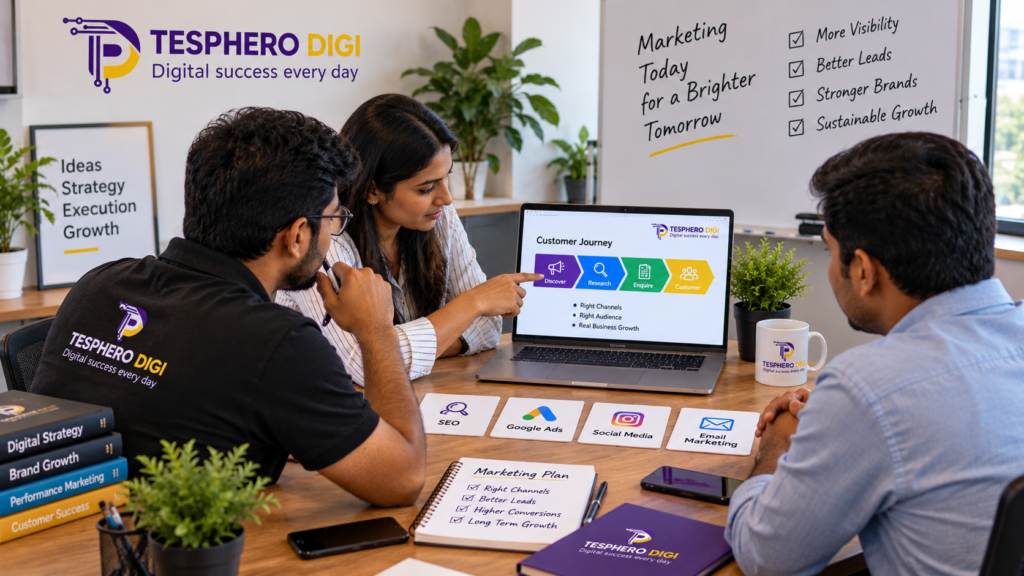
A focused marketing strategy connects the right channels to different stages of the customer journey.