
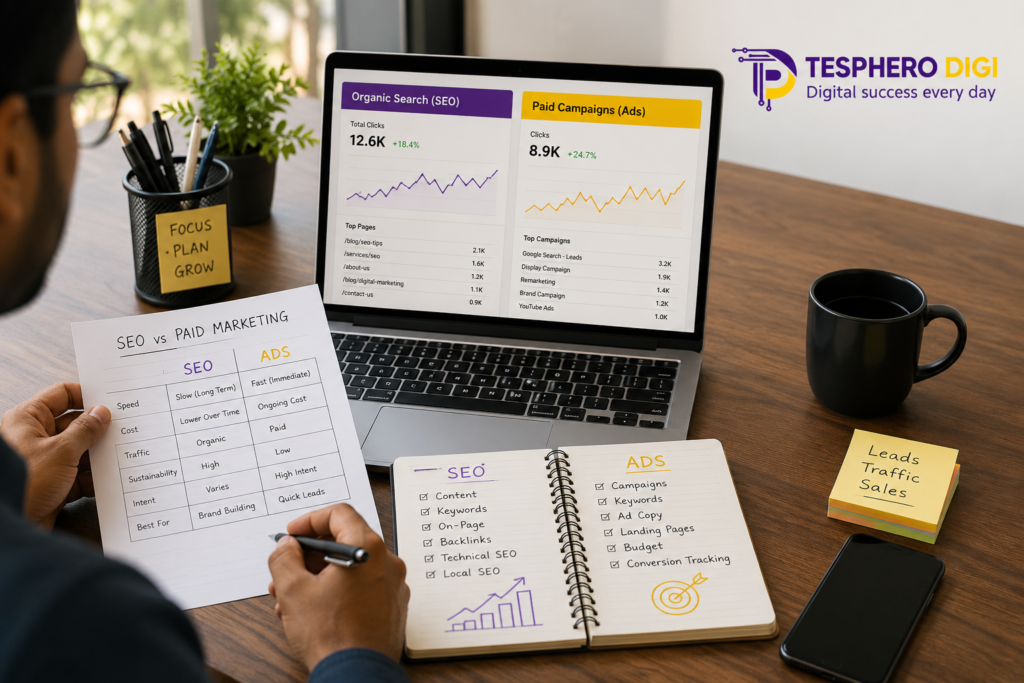
SEO and paid marketing solve different growth problems.
You want more customers from Google.
One person tells you, “Invest in SEO. It will help you grow organically.”
Another says, “SEO takes too long. Run paid ads and start generating traffic immediately.”
Both can be right.
The problem begins when a business treats SEO and paid marketing as competing choices without first understanding what each one is designed to achieve.
Paid marketing can help you reach potential customers quickly. SEO can help build organic visibility that develops over time. However, neither strategy automatically guarantees leads, sales, or business growth.
The better question isn’t:
“SEO or paid marketing—which one wins?”
Instead, ask:
“What does my business need right now, and which strategy can support that goal?”
In this guide, we’ll compare SEO and paid marketing based on speed, cost, lead generation, sustainability, customer intent, and long-term growth. More importantly, we’ll help you understand when to use one strategy—and when using both can make more sense.
Understand What SEO and Paid Marketing Actually Do
What Is SEO?
Search Engine Optimization (SEO) is the process of improving your website and content so that your business can become more visible in relevant organic search results.
Suppose you run an interior-design business in Indore.
A potential customer searches:
“Interior designer in Indore”
If your website appears prominently in the organic results, that visibility may bring the person to your website without you paying for that individual click.
SEO can involve several areas, including website structure, keyword targeting, content, technical improvements, internal linking, local SEO, and building the overall relevance and authority of a website.
The important word here is time.
SEO usually isn’t an instant traffic switch.
Search visibility can take time to develop. Competition, website condition, content quality, market demand, and many other factors can influence results.
Therefore, SEO is better viewed as a long-term digital growth strategy rather than a quick campaign.
Businesses that want to understand how Google approaches website discovery and search visibility can also refer to Google Search Central. Its official documentation provides guidance on creating helpful, accessible and search-friendly websites. SEO results still depend on many factors, so the resource should be used for understanding best practices rather than expecting guaranteed rankings.
What Is Paid Marketing?
Paid marketing allows businesses to pay platforms to place advertisements in front of selected audiences.
Search advertising is one common example.
Suppose someone searches Google for a service you provide. A relevant paid search campaign may allow your advertisement to appear for that search, depending on campaign settings, competition, and other advertising factors.
Paid marketing can also include social media advertising, remarketing, display campaigns, and other formats.
The biggest difference is speed.
You don’t necessarily need to wait months to start receiving visibility.
Once a suitable campaign is created and active, advertisements can begin reaching potential customers relatively quickly.
However, that visibility comes with a direct media cost.
When advertising stops, the paid traffic generated by those campaigns generally stops as well.
SEO Builds an Asset; Paid Marketing Buys Immediate Reach
This is one of the easiest ways to understand the difference.
With SEO, you invest in your website.
You improve important service pages and publish useful content for your audience. At the same time, local relevance becomes stronger, while technical issues on the website are identified and fixed.
Over time, these improvements can contribute to stronger organic visibility.
Paid marketing works differently.
You allocate an advertising budget to reach audiences through a platform.
As a result, paid campaigns can provide faster visibility while SEO can build a stronger organic foundation over time.
Neither approach is automatically better.
They solve different problems.
Which One Produces Results Faster?
In most cases, paid marketing has the advantage when speed is the priority.
For example, imagine you are launching a new service next week.
Your website currently has very little organic visibility.
Waiting for SEO alone may not support the immediate launch.
A paid campaign could help introduce the service to relevant audiences sooner.
SEO, meanwhile, may require weeks or months before meaningful improvements become visible, depending on the website and competition.
However, speed should not be confused with profitability.
Getting traffic quickly doesn’t mean the traffic will automatically convert into customers.
Your offer, targeting, landing page, pricing, trust signals, and sales process still matter.
Which Strategy Costs More?
This question doesn’t have a simple answer.
SEO isn’t “free marketing.”
Even though you don’t normally pay Google for every organic click, effective SEO still requires resources.
These may include strategy, content creation, website improvements, technical work, and ongoing optimization.
Paid marketing has a more direct cost structure because advertising spend is part of the campaign.
For example, your business may allocate a monthly media budget alongside campaign-management costs.
Therefore, comparing them as “free SEO versus expensive ads” is misleading.
A better comparison is:
What are we investing, and what business value is that investment creating?
SEO vs Paid Marketing — What Should Your Business Compare?
Choosing between SEO and paid advertising should not be based on which strategy is currently more popular.
Start with your business situation.
1. Speed: How Soon Do You Need Visibility?
This is often the first major difference.
SEO usually needs time.
Paid advertising can generate visibility much sooner.
If you’re promoting a time-sensitive offer, launching a new product, or trying to generate demand quickly, paid marketing may be useful.
On the other hand, a business that wants to strengthen its Google presence over the next several years should not ignore SEO simply because it takes longer.
Think about short-term demand and long-term visibility separately.
You may need both.
2. Sustainability: What Happens When You Stop Spending?
Suppose your paid campaign is generating regular website visits.
Then you pause the advertising budget.
The traffic from those ads will usually decline immediately because you are no longer buying that exposure.
SEO behaves differently.
A useful page that has earned strong organic visibility may continue receiving search traffic without paying for each visit.
That doesn’t mean rankings are permanent.
Competitors improve their websites. Search behaviour changes. Content becomes outdated. Search engines also change.
SEO still needs ongoing attention.
However, the website improvements and content created through SEO can continue providing value beyond one campaign period.
3. Customer Intent: Who Are You Trying to Reach?
Not all traffic has the same value.
Someone searching:
“best accounting software for small business”
may still be researching.
Someone searching:
“accounting software demo”
could be much closer to taking action.
Both SEO and paid search can target different stages of customer intent.
SEO can create content for informational, comparison, and transactional searches.
Paid search can focus advertising budget on selected high-intent queries.
Meanwhile, paid social campaigns may reach people who are not actively searching but match a relevant audience profile.
Therefore, don’t judge marketing only by traffic volume.
A smaller number of relevant visitors can be more valuable than thousands of visitors with little purchase intent.
4. Control: Paid Marketing Usually Gives You More Immediate Control
Paid advertising can offer businesses significant control over campaign settings.
Depending on the platform and campaign type, you may be able to control factors such as audience, geography, budget, advertising schedule, and landing page.
SEO offers less immediate control.
You can optimize your website, but you cannot simply instruct a search engine to rank a page first organically.
This makes paid marketing particularly useful for testing.
Suppose you’re unsure which of three service offers customers respond to most strongly.
A well-designed paid campaign may help you collect useful data faster.
Those insights can later support broader marketing decisions.
5. Trust: Organic Visibility Can Support Credibility
Customers often research businesses before making a decision.
They may discover an advertisement first and then search the company name.
They might visit the website.
Read reviews.
Check service pages.
Look at social media.
Compare competitors.
This means marketing channels don’t operate in isolation.
A business running strong advertisements but having a weak website may lose potential customers after the click.
Likewise, a business with excellent organic content may miss immediate opportunities if competitors dominate paid placements for important searches.
Your overall digital presence matters.
6. Conversion: Neither SEO Nor Ads Can Fix a Weak Website
This is one of the most important points in the comparison.
Imagine paid ads bring 1,000 relevant visitors to your website.
But the website loads slowly.
The service isn’t clearly explained.
There is little proof of experience.
The contact form is confusing.
The call-to-action is difficult to find.
Traffic isn’t the main problem anymore.
The website is.
SEO can face the same issue.
Ranking higher doesn’t automatically turn visitors into leads.
Before investing aggressively in either channel, review whether your website can answer basic customer questions:
What do you offer?
Who is it for?
Why should someone choose you?
What should the visitor do next?
Marketing brings people to the door. Your website still has to convince them to enter.
Bringing more visitors to your website will have limited value when the website itself does not give them enough reason to take action. If you’re receiving traffic but still struggling with enquiries, read our guide “Why Your Business Website Is Not Generating Enough Leads” to identify some of the common website issues that can affect lead generation.
7. Measurement: Look Beyond Clicks and Impressions
High traffic looks impressive in a report.
So do thousands of ad impressions.
Neither necessarily means the business is growing.
Businesses should connect marketing metrics with actual outcomes.
Depending on the business, useful measurements may include qualified enquiries, calls, form submissions, booked appointments, purchases, customer acquisition cost and revenue.
For SEO, you may also monitor organic visibility and traffic trends.
For paid marketing, campaign costs and conversion performance become especially important.
The goal is not to collect the biggest numbers.
The goal is to understand which activity is contributing to meaningful business results.
So, Which Strategy Should Your Business Choose?
Now we reach the main question.
Should your business invest in SEO or paid marketing?
The answer depends on what you’re trying to achieve.
Choose SEO When Long-Term Search Visibility Matters
SEO may deserve greater priority when customers regularly search online for the products or services you provide.
It can also make sense when you want to build useful website content, strengthen local search visibility, or reduce long-term dependence on paid traffic.
For businesses operating in competitive markets, starting SEO earlier can be valuable because meaningful organic growth may take time.
However, SEO should be approached realistically.
No responsible agency can guarantee a permanent number-one Google ranking.
The goal should be to improve the website’s relevance, usefulness, technical quality, and visibility for searches that matter to the business.
Choose Paid Marketing When Speed Matters
Paid campaigns may be particularly useful when you need visibility quickly.
Perhaps you’re launching a new service.
Maybe you have a seasonal campaign.
You might be entering a new location.
Or perhaps you need to test demand before investing heavily in a long-term marketing strategy.
Paid advertising can also help businesses test messages, offers, and landing pages.
The data generated through these campaigns may reveal which audiences and messages respond more strongly.
Still, campaigns need proper monitoring.
Simply adding more budget to a poorly performing campaign rarely solves the underlying problem.
Digital visibility becomes even more valuable when customers receive a consistent impression of your business across different channels. To understand the broader role social platforms can play in that process, read “How Social Media Marketing Can Help Businesses Build a Stronger Brand.”
For Many Businesses, SEO + Paid Marketing Can Work Better Together
The choice does not always need to be SEO versus paid marketing.
It can be SEO plus paid marketing.
Imagine a service business entering a competitive market.
Paid search could create immediate visibility for high-intent searches.
At the same time, SEO work could improve core service pages and build useful content around customer questions.
Over time, organic visibility may grow.
Meanwhile, paid campaigns can continue supporting priority services, new offers, or competitive keywords where immediate exposure is valuable.
The two channels can also provide useful insights to each other.
Paid campaign data may reveal search terms or offers worth exploring through SEO.
Organic search data can identify topics and services attracting customer interest.
Used together, the strategies can become complementary rather than competitive.
Don’t Split Your Budget 50/50 Without a Reason
Using both strategies does not mean dividing your marketing budget equally.
A new business may initially allocate more resources toward paid acquisition while building its SEO foundation.
An established website with strong organic traffic may put more investment into SEO while using paid campaigns selectively.
An e-commerce company could use paid campaigns heavily during a product launch.
A local service business may place greater emphasis on local SEO.
Your allocation should follow business goals—not a fixed formula.
A Simple Way to Decide
Before choosing your strategy, answer these questions:
- How quickly do we need leads or sales?
- Are customers actively searching for what we offer?
- How competitive are the searches that matter to us?
- What monthly marketing budget can we sustain?
- Is our website ready to convert traffic?
- Do we need immediate demand, long-term visibility, or both?
- Can we properly track leads and conversions?
Your answers will usually make the direction much clearer.
Common Mistakes Businesses Make
One common mistake is stopping SEO because results aren’t immediate.
Another is running paid ads without proper conversion tracking.
Some businesses send every advertisement to the homepage rather than creating a relevant landing experience.
Others focus on traffic while ignoring lead quality.
Businesses may also invest in SEO without improving weak service pages or publish large amounts of content without a clear search strategy.
Another costly mistake is treating SEO and advertising as isolated from the website itself.
All three need to work together.
Traffic + weak website = missed opportunities.
How Tesphero Digi Can Help
Choosing a digital marketing strategy should start with the business goal rather than the marketing channel.
At Tesphero Digi, we help businesses evaluate their digital presence and build strategies around factors such as target customers, competition, website performance, lead-generation requirements, and growth priorities.
Depending on the requirement, this may include Search Engine Optimization (SEO), Google Ads, social media marketing, website development, content strategy, and broader digital marketing support.
For a new business, the priority may be creating visibility and establishing the right digital foundation.
An existing business may need better-quality leads.
Meanwhile, another company may already receive traffic but struggle to convert visitors into enquiries.
Each situation requires a different approach.
The objective isn’t to choose SEO because “organic is better” or paid advertising because “ads are faster.”
The objective is to invest in the channels that make sense for your business goals—and make those channels work together where appropriate.
Final Thoughts
SEO and paid marketing are not enemies.
They are different tools.
Paid marketing can help businesses create visibility quickly, test campaigns, and reach selected audiences.
SEO can strengthen your website, improve organic search visibility, and support long-term digital growth.
However, neither strategy works in isolation.
A strong marketing plan also needs a useful website, clear positioning, relevant offers, and proper conversion tracking.
So don’t ask:
“Should we stop SEO and run ads?”
Or:
“Should we stop advertising and focus only on organic traffic?”
Instead, ask:
“What combination of visibility, speed, and long-term growth does our business need?”
Once you know that, choosing between SEO, paid marketing—or a combination of both—becomes much easier.
Frequently Asked Questions
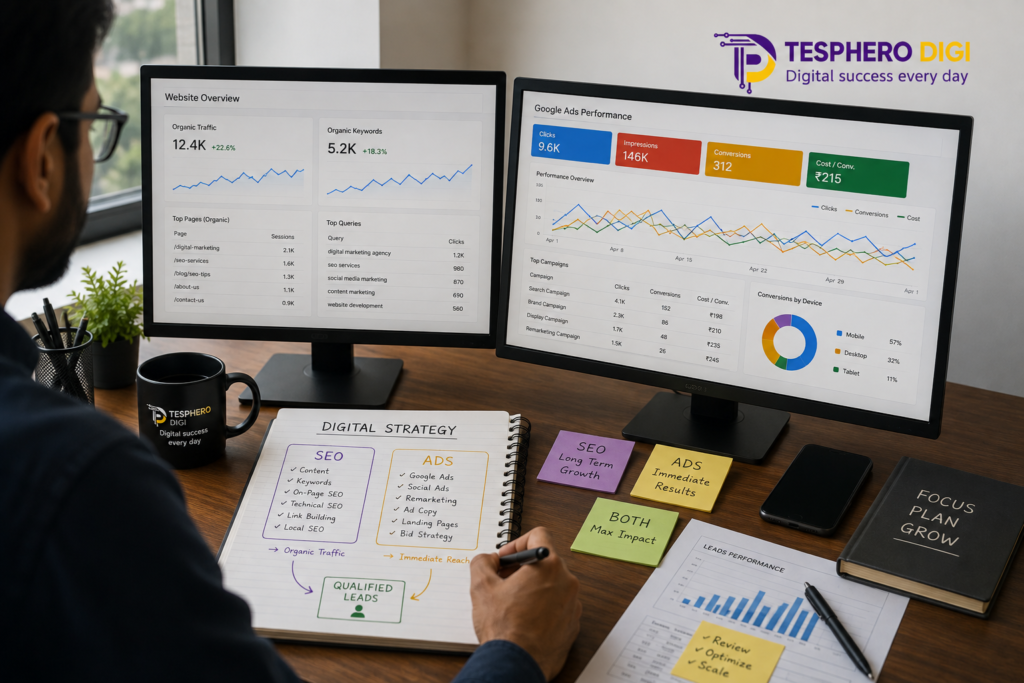
For many businesses, SEO and paid marketing work best as complementary strategies.
About the Author
Tesphero Digi helps businesses build a more structured digital presence by connecting marketing activity with practical business goals. Its work covers areas such as SEO, paid advertising, social media marketing, website development, content, and lead-generation strategy.
Rather than treating every digital channel as a separate activity, the focus is on understanding how websites, search visibility, advertising, and content can work together to support business growth. To learn more about our approach, services, and digital marketing solutions, visit the About Tesphero Digi.