
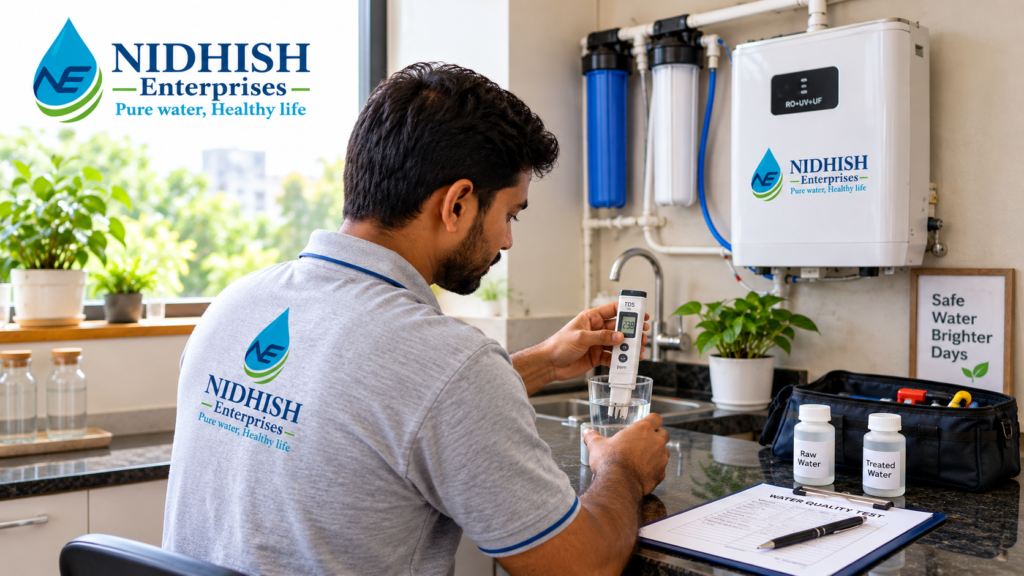
Choosing between RO, UV and UF starts with understanding the incoming water.
RO vs UV vs UF is one of the most common comparisons people make when choosing a water purifier for their home or business.
So, asking “Which purifier is best?” may not be the right starting point.
A better question is:
“What is actually present in my water, and which treatment does it need?”
The answer can change based on your water source, TDS level, hardness, microbial risk, and daily water use. In addition, homes and commercial spaces may have very different requirements.
This guide explains the difference between RO, UV, and UF in simple terms. It will also help you understand why testing your water before choosing a system can lead to a better decision.
Table of Contents
- Understanding RO vs UV vs UF Water Purification
- Start With Your Water, Not the Purifier
- What Is RO Water Purification?
- What Is UV Water Purification?
- What Is UF Water Purification?
- How RO, UV and UF Are Different
- Why TDS Matters When Considering RO
- How to Choose RO vs UV vs UF Water Purification
- RO vs UV vs UF Water Purification for Homes and Businesses
- Common Mistakes When Choosing a Water Purifier
- How Nidhish Water Solutions Can Help
- Frequently Asked Questions
- About the Author
- Contact Nidhish Water Solutions
Understanding RO vs UV vs UF Water Purification
1. Start With Your Water, Not the Purifier
Many people start their search by looking at purifier brands.
That is usually too early.
First, understand your water source.
Does your property receive municipal water? Do you depend on borewell water? Is tanker water also used? Perhaps your water comes from more than one source during the year.
Each source can have different characteristics.
For example, some groundwater sources may contain higher levels of dissolved minerals. On the other hand, microbial contamination can be a concern in certain water conditions.
Therefore, the right treatment depends on the quality of the incoming water.
A purifier should solve a known problem. It should not simply be chosen because a certain technology sounds more advanced.
2. What Is RO Water Purification?
RO stands for Reverse Osmosis.
An RO system pushes water through a special semi-permeable membrane. As a result, it can reduce many dissolved substances present in the water.
RO is commonly considered when the incoming water has high TDS or other dissolved contaminants that the selected system is designed to reduce.
However, RO should not automatically be used for every water source.
Its suitability depends on the quality of the raw water and the treatment goal.
RO systems also produce a reject-water stream during purification. Therefore, system efficiency and reject-water management should be considered when selecting and operating an RO plant or purifier.
For homes, this may involve a relatively small system.
Commercial users may require much larger RO plants based on daily demand and water quality.
3. What Is UV Water Purification?
UV stands for Ultraviolet purification.
Unlike RO, UV does not primarily work by removing dissolved salts.
Instead, water passes through a chamber where it is exposed to ultraviolet light. With suitable design and operating conditions, UV can inactivate many microorganisms.
Therefore, UV can play an important role where microbial treatment is required.
However, water quality matters here too.
Cloudy or highly turbid water can affect UV performance because particles may interfere with UV exposure. For this reason, suitable pre-treatment may be needed before the UV stage.
The UV lamp and related components also require maintenance.
So, installing a UV unit does not mean it can be ignored afterward.
4. What Is UF Water Purification?
UF stands for Ultrafiltration.
UF systems use a membrane with very small pores. Water passes through this membrane while certain suspended particles and microorganisms are physically retained.
Unlike RO, UF generally does not remove dissolved salts in the same way.
This difference is important.
Suppose your main problem is high dissolved mineral content. A UF membrane alone may not solve that issue.
However, UF can be useful as part of a treatment process when its filtration capability matches the water problem.
It may also be combined with other technologies.
Again, the right configuration depends on the incoming water.
5. How RO, UV and UF Are Different
| Feature | RO | UV | UF |
|---|---|---|---|
| Main purpose | Reduces many dissolved substances | Inactivates microorganisms | Filters fine suspended particles and certain microorganisms |
| Reduces TDS | Yes, depending on system | No | Generally no |
| Uses membrane | Yes | No | Yes |
| Uses UV light | No | Yes | No |
| Reject water | Usually yes | No | Usually no |
| Best considered when | Dissolved impurities need treatment | Microbial treatment is needed | Fine physical filtration is needed |
| Pre-treatment may be needed | Yes | Yes | Yes, depending on water quality |
| Maintenance | Membrane and filters | UV lamp and filters | Membrane and filters |
However, this comparison is only a starting point. Water quality can vary from one source to another. Therefore, the right system should be selected after checking the incoming water, treatment goal, and daily requirement.
6. Why TDS Matters When Considering RO
TDS stands for Total Dissolved Solids.
It is commonly measured in milligrams per litre (mg/L), often displayed as ppm on consumer TDS meters.
A TDS reading gives an indication of the total amount of dissolved substances in water. However, it does not tell you exactly which substances are present.
This distinction matters.
Two water samples can have similar TDS readings but different chemical compositions.
Therefore, a TDS meter can provide useful basic information, but it should not always be treated as a complete water-quality test.
Where water quality is uncertain, or treatment decisions are important, proper testing can provide more useful information.
How to Choose RO vs UV vs UF Water Purification
7. Check the Water Source First
Your water source can provide useful clues about what to test.
For example, borewell water may have a different mineral profile from treated municipal water.
Tanker water can vary based on its source.
In addition, some properties switch between municipal, borewell, and tanker supplies.
That makes testing even more useful.
Instead of assuming that all water in one city or neighbourhood is the same, check the water reaching your property.
For businesses, testing can become even more important because water use may be much higher.
8. High TDS Does Not Automatically Tell the Whole Story
People often hear:
“TDS high hai, RO laga do.”
That may sometimes lead in the right direction, but TDS alone does not provide the full picture.
A TDS meter measures overall dissolved solids. It does not identify every individual substance or tell you whether microbial contamination is present.
Therefore, treatment decisions may require more information.
The right tests depend on the water source and intended use.
This is especially important for commercial systems, where an incorrect treatment design can affect operating cost, membrane life, and water quality.
9. When Might RO Be Considered?
RO may be considered when testing shows that dissolved substances need to be reduced and the selected membrane system is suitable for those contaminants.
It can be useful for certain high-TDS water sources.
However, several factors should be checked before selecting an RO system.
These include incoming water quality, required output quality, daily water demand, operating pressure, and pre-treatment needs.
Reject water should also be considered.
For commercial plants, recovery rate and operating costs also matter.
As a result, choosing an RO plant only by its litres-per-hour capacity can be a mistake.
10. When Might UV Be Considered?
UV may be considered when microbial treatment is needed, and water conditions allow it to work effectively.
However, UV does not replace every other treatment process.
If water contains sediment or turbidity, filtration may be needed before UV treatment.
Similarly, UV does not solve high TDS in the way RO can.
Therefore, the system needs to match the problem.
Maintenance also matters.
UV lamps have a service life, and performance depends on proper operation. So, regular checks should be part of the maintenance plan.
11. When Might UF Be Considered?
UF can be useful when fine physical filtration is needed.
It can help remove certain suspended particles and microorganisms, depending on membrane specifications and system design.
However, UF generally leaves dissolved salts in the water.
Therefore, it should not be selected as a direct replacement for RO when the treatment goal is to reduce high dissolved solids.
UF may also serve as one stage in a larger system.
For example, a commercial treatment setup may use multiple filtration stages before the final water reaches its required quality.
12. Do You Need RO + UV + UF Together?
Not necessarily.
A purifier with more stages is not automatically better.
Every additional stage has a purpose, cost and maintenance requirement.
Therefore, ask why each stage is included.
Does the incoming water require RO?
Why is UV being added?
What role does UF play?
What pre-treatment is needed?
If the seller cannot explain these points clearly, you may not have enough information to make a good decision.
In some cases, a combination system can make sense.
In others, it may add unnecessary cost or complexity.
The best system is not the one with the most technologies. It is the one designed for the actual water problem.
13. Hard Water and RO Are Not the Same Discussion
Hardness often creates confusion when people compare water-treatment systems.
Hard water contains certain dissolved minerals, mainly calcium and magnesium compounds.
It can cause scale on taps, bathroom fittings, heaters, pipelines, and equipment.
However, drinking-water purification and whole-building hardness treatment are not always the same requirement.
For example, a home may use a drinking-water purifier at the kitchen point while also needing a separate solution for hard water used in bathrooms or appliances.
Similarly, hotels, factories, and commercial properties may need specialised treatment before water reaches certain equipment.
Therefore, the complete water requirement should be considered.
Hard water can affect taps, pipelines, heaters, and other equipment across a property. Therefore, treating drinking water alone may not solve every hardness-related problem. To understand this issue in more detail, read our guide “Hard Water Problems in Indore: How Water Softeners Can Protect Your Home and Business.”
14. Don’t Ignore Pre-Treatment
A water purifier is often discussed as one machine.
In practice, treatment may involve several stages.
Sediment filtration can help remove larger particles.
Activated carbon may be used for certain taste, odour, or chlorine-related treatment needs.
Other pre-treatment may be required depending on hardness, iron, turbidity, or other water characteristics.
RO membranes, UV chambers, and UF membranes can perform better when the incoming water meets the conditions expected by the system.
Therefore, good system design begins before the final purification stage.
RO vs UV vs UF Water Purification for Homes and Businesses
15. Choosing a System for a Home
For a home, start by asking where the water comes from.
Next, check its quality.
Then estimate how much purified drinking water the household uses each day.
A family using municipal water may have different treatment needs from a household that depends on borewell or tanker water.
In addition, the source may change during certain months.
Don’t select a purifier only because a neighbour uses the same model.
Their incoming water may be different.
Instead, choose the technology after understanding your own water conditions.
16. Choosing a System for an Office
Office requirements can differ from household needs.
More people may use the system throughout the day.
As a result, capacity and storage become important.
An undersized purifier may work continuously and still struggle to meet demand.
A much larger system, however, may add unnecessary cost.
Therefore, estimate the number of users and peak consumption.
Also consider where the purified water will be stored and dispensed.
For larger offices, service response time and maintenance planning can matter just as much as the initial equipment cost.
Purification is only one part of planning drinking water for a commercial space. Cooling capacity, user demand, and dispensing requirements also matter. For more guidance, read “How to Choose the Right Water Cooler for Offices, Schools, Factories and Commercial Spaces.”
17. Schools Need Consistent Water Availability
Schools can have high demand during short periods.
For example, many students may need drinking water during breaks.
Therefore, system capacity should account for peak use rather than only average daily consumption.
Water storage and dispensing points also need attention.
In addition, regular maintenance is essential because a system can only perform as intended when filters, membranes, and other components are kept in suitable condition.
For schools, water treatment should be part of a wider drinking-water management plan.
18. Commercial RO Systems Need Proper Sizing
Restaurants, hotels, hospitals, factories and other commercial spaces can have very different water requirements.
A restaurant may need treated water for drinking and food preparation.
A hotel can require much larger volumes.
Meanwhile, an industrial process may have specific water-quality requirements that are completely different from normal drinking-water needs.
Therefore, commercial RO plants should not be selected only by comparing prices.
Daily demand matters.
Peak demand matters too.
Raw-water quality, storage, recovery, reject water, maintenance, and operating costs should also be considered.
19. Maintenance Can Change Real-World Performance
Even a well-designed system requires maintenance.
Filters become loaded with dirt.
Membranes can foul or scale.
UV lamps age.
Storage tanks need cleaning.
Pumps and valves may also require attention.
Therefore, ask about maintenance before buying.
How often should filters be checked?
What signs indicate a problem?
Are replacement parts easily available?
Who will service the system?
For a business, also ask what happens when the system stops working.
Downtime can affect employees, customers, and operations.
Maintenance becomes even more important when a business depends on purified water every day. A system failure can affect normal operations as well as water availability. Our guide “What Happens When Your Business Water System Fails? The Real Cost of RO Downtime” explains why service planning should be considered before a breakdown happens.
20. Compare Total Cost, Not Just Purchase Price
The cheapest purifier is not always the lowest-cost option over time.
Consider the full ownership cost.
This may include filter replacement, membrane replacement, UV lamp replacement, electricity, servicing, and water use.
Commercial RO systems can also have costs related to pre-treatment and reject-water management.
Therefore, compare systems based on both purchase price and ongoing expenses.
A correctly sized system may cost more initially but make more sense over its working life.
21. Water Testing Should Come Before Guesswork
Water often looks clear even when its quality requires attention.
Taste alone is not a complete test either.
Therefore, avoid making treatment decisions only by looking at the water.
A basic TDS reading can be a useful starting point. However, broader testing may be required depending on the source and intended use.
For drinking-water quality information in India, the Bureau of Indian Standards (BIS) provides standards and related information that can be useful as an educational reference.
Treatment equipment should still be selected according to actual test results and applicable requirements.
Common Mistakes When Choosing a Water Purifier
One common mistake is assuming that RO is always the best technology.
Another is choosing a purifier only by its number of filtration stages.
Some buyers rely entirely on TDS without checking other water-quality factors.
Others ignore pre-treatment.
Maintenance cost is also easy to overlook.
For commercial systems, incorrect capacity selection can create another problem.
A small system may struggle with demand. On the other hand, an unnecessarily large plant may increase capital and operating costs.
Finally, don’t assume that water that looks clean needs no testing.
Water treatment should be based on what the water contains, not only on what it looks like.
A Simple Water Purifier Selection Checklist
Before choosing a system, check:
- Water source: Municipal, borewell, tanker, or mixed supply.
- Water test: Understand relevant quality parameters.
- TDS: Use it as one indicator, not the whole answer.
- Treatment goal: Know what needs to be reduced or controlled.
- Daily demand: Calculate how much treated water you need.
- Peak demand: Important for offices, schools, and businesses.
- Pre-treatment: Check whether the main system needs protection.
- Storage: Make sure purified water can meet peak use.
- Maintenance: Understand filters, membranes, lamps, and service needs.
- Running cost: Consider more than the purchase price.
- Reject water: Important when RO is used.
- Service support: Especially important for commercial installations.
These checks make comparison much easier.
How Nidhish Water Solutions Can Help
Choosing between RO, UV, and UF can become confusing when different sellers recommend different technologies.
At Nidhish Water Solutions, the approach starts with understanding the water source, quality, and actual requirement.
A home may need a compact drinking-water solution.
An office could need higher storage and output.
Meanwhile, a school may require a system designed around peak usage. A factory or commercial facility may need a larger treatment setup with suitable pre-treatment.
Therefore, the right solution can vary from one property to another.
Nidhish Water Solutions works with residential and commercial water-treatment requirements, including RO systems and related water-treatment solutions.
The goal is simple: understand the water problem first, then select a suitable treatment approach.
Final Thoughts
The RO vs UV vs UF Water Purification debate does not have one winner for every home or business.
RO, UV, and UF perform different jobs.
RO can reduce many dissolved substances.
UV focuses on microbial inactivation.
UF provides fine physical filtration for certain particles and microorganisms.
Sometimes one technology may be suitable.
In other cases, a combination may make more sense.
Therefore, don’t start with the question:
“Which purifier has the most stages?”
Start with:
“What is in my water?”
Then ask:
“What treatment does it actually need?”
That approach can help you choose a system that fits your water, usage, and budget instead of paying for technology you may not need.
Frequently Asked Questions
About the Author
Nidhish Water Solutions works with homes, offices, schools, businesses, and commercial facilities to understand their water-treatment needs and explore suitable solutions. The approach starts with the water source, quality, and daily demand rather than recommending the same system for every customer.
From RO systems and commercial water-treatment solutions to related purification and water-management requirements, the aim is to make system selection easier to understand. To learn more about our approach and water-treatment services, visit the About Nidhish Water Solutions.
Contact Nidhish Water Solutions
Different water sources can require different treatment. Therefore, choosing between RO, UV, and UF without understanding your water can lead to unnecessary cost or an unsuitable system.
Contact Nidhish Water Solutions to discuss your water source, daily requirements, and treatment needs before selecting a residential or commercial water purification system.
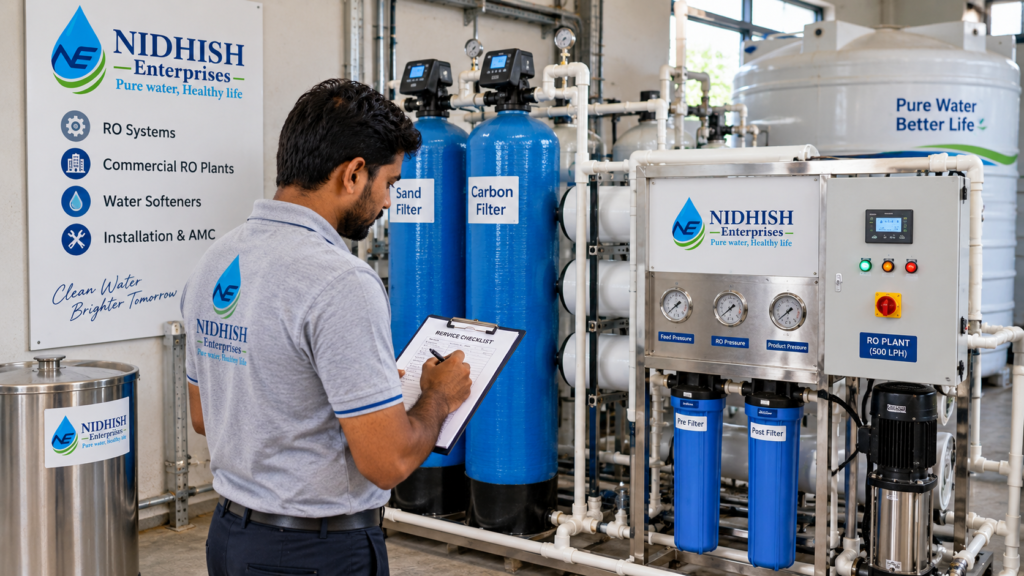
A well-designed water system should match water quality, demand and long-term maintenance needs.