
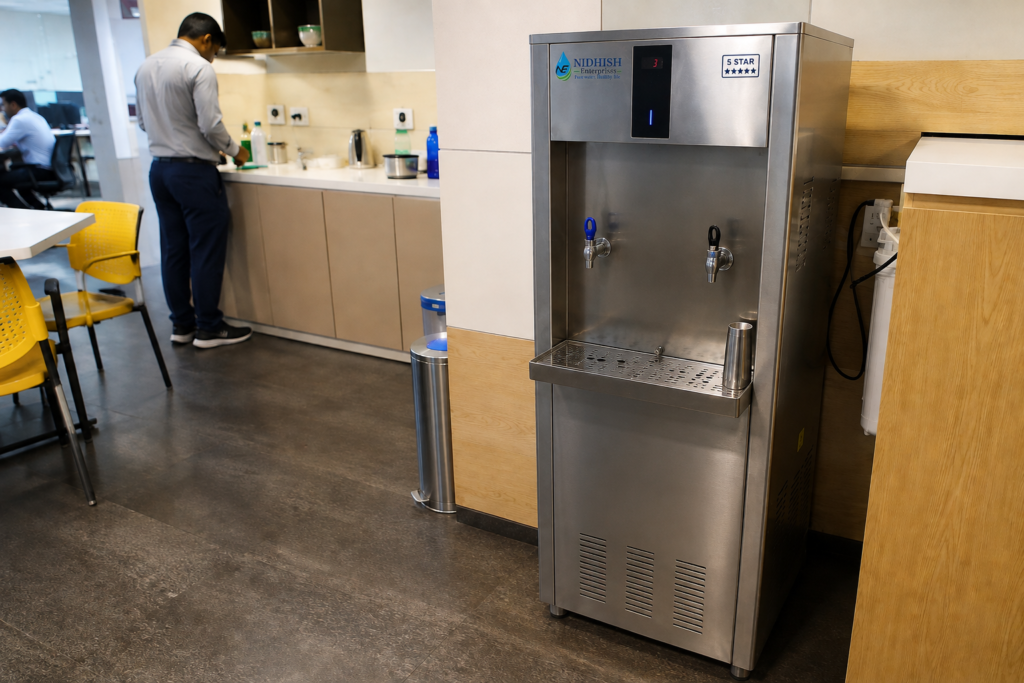
Water-cooler capacity should match the way people actually use it.
A water cooler is one of those pieces of equipment that most people don’t think about—until it stops meeting the requirements.
For a small office, a basic unit may work perfectly well. Put the same water cooler in a busy school, factory, or commercial facility, and the experience can be completely different.
Water runs out quickly. Cooling struggles during peak hours. People have to wait. Storage capacity feels insufficient. Maintenance becomes frequent.
The problem isn’t always the quality of the machine.
Sometimes, the water cooler simply wasn’t selected according to the actual usage.
When choosing a commercial water cooler, capacity, cooling performance, water source, number of users, installation conditions, and maintenance requirements all matter.
So instead of asking, “Which water cooler is best?”, start with a more practical question:
“Which water cooler is right for this particular space and its daily demand?”
Let’s understand how to make that decision.
Start With Usage, Not the Machine
1. Understand How Many People Will Use It
The first factor is obvious but often underestimated.
How many people will regularly use the water cooler?
An office with 20 employees has a very different requirement from a school with hundreds of students or a factory where several workers may approach the drinking-water point during the same break.
Don’t only think about total users.
Think about usage patterns.
An office may have relatively distributed water consumption throughout the day.
In a school, demand can rise sharply during recess.
In a factory, many employees may need drinking water at the same time during scheduled breaks or shift changes.
A water cooler that works comfortably for 100 people over several hours may still struggle if a large number of those users arrive within a short period.
This is why capacity should be evaluated according to both total demand and peak demand.
2. Understand Cooling Capacity vs Storage Capacity
These two specifications can sound similar, but they describe different things.
Storage capacity generally refers to how much water the unit can hold in its storage tank.
Cooling capacity indicates how much water the machine can cool over a given period under specified conditions.
Both matter.
Imagine a water cooler with adequate storage but insufficient cooling performance.
During heavy usage, users may eventually receive water that isn’t as cool as expected because the system needs time to cool incoming water.
On the other hand, strong cooling performance with inadequate storage may also be inconvenient in a high-demand environment.
Therefore, don’t select a unit only because the tank looks large.
Ask about both capacities and evaluate them against expected usage.
3. Consider Where the Cooler Will Be Installed
The installation environment can influence what kind of water cooler you need.
An air-conditioned corporate office and a factory floor are very different environments.
For an office, factors such as compact design, noise, and appearance may matter.
A school may require a durable system that can handle frequent use.
A factory may need equipment suitable for heavier usage and a more demanding working environment.
A commercial establishment may prioritise both performance and professional appearance.
Before purchasing, inspect the intended installation area.
Consider available floor space, ventilation, drainage, electrical connection, and water inlet.
Also make sure users can access the cooler comfortably without creating unnecessary congestion.
Choosing the installation location before choosing the machine can prevent practical problems later.
4. Check Your Water Source
A water cooler cools water.
It should not automatically be assumed to solve every water-quality problem.
Before installation, understand where the incoming water is coming from and whether additional treatment is required.
Depending on the source and test results, a facility may need a separate purification or treatment system.
For example, a commercial facility may combine a drinking-water cooler with an appropriate RO or other treatment system where water conditions require it.
The treatment decision should be based on the actual water-quality requirement rather than assumptions.
This distinction is important:
Cooling and purification are two different functions.
If your facility requires both, the complete system should be planned accordingly.
Cooling the water is only one part of planning a drinking-water system. If your facility is also dealing with hardness, scale, or mineral buildup, read our guide “Hard Water Problems in Indore: How Water Softeners Can Protect Your Home and Business” to understand why water quality should be assessed separately.
Before selecting any drinking-water treatment or cooling system, it is useful to understand the quality of the incoming water. The Bureau of Indian Standards (BIS) provides standards related to drinking-water quality that can serve as a useful general reference when evaluating important water-quality parameters. However, a water cooler is primarily designed to cool water; it should not be treated as a substitute for appropriate purification or water treatment where that is required. Water testing and the actual source of water should guide the choice of treatment system.
5. Think About Build Quality and Daily Use
Commercial equipment can experience much more frequent use than household equipment.
Buttons, taps, faucets, and other components may be operated hundreds of times in busy environments.
This makes build quality important.
Stainless-steel water coolers are commonly considered for commercial environments because they can offer durability and are relatively straightforward to maintain when properly designed and serviced.
However, material alone shouldn’t determine the purchase.
Also evaluate construction quality, internal components, accessibility for cleaning and servicing, and the availability of replacement parts.
A water cooler is something your employees, students, workers, or visitors may depend on every day.
Choose accordingly.
Different Spaces Need Different Water Cooler Planning
A common mistake is assuming that one commercial water cooler specification can work everywhere.
The actual requirement changes considerably depending on the type of facility.
Choosing a Water Cooler for an Office
Office water consumption is usually easier to estimate because the number of employees is relatively stable.
Start with the number of regular employees, then consider visitors and peak periods.
For smaller offices, a compact water cooler with suitable capacity may be sufficient.
For larger corporate spaces, one high-capacity unit may not always be the most convenient solution. Depending on the building layout, multiple drinking-water points may provide better accessibility.
Think about:
- Number of employees
- Number of floors or departments
- Pantry locations
- Visitor traffic
- Available installation space
- Peak drinking-water demand
Location matters too.
If 100 employees need to walk to one corner of a large office every time they need water, the system may technically have enough capacity but still provide a poor user experience.
Choosing a Water Cooler for a School
Schools require a different approach.
A large number of students may use drinking-water facilities during relatively short break periods.
This creates high peak demand.
Durability and accessibility therefore become particularly important.
The installation should also be appropriate for the age group using it.
Schools should think about the number of students, break timings, number of drinking-water points, hygiene, cleaning requirements and ease of supervision.
For larger campuses, distributing capacity across multiple locations may be more practical than depending on a single unit.
The aim shouldn’t simply be to install a water cooler.
It should be to provide convenient access to suitable drinking water when students actually need it.
Choosing a Water Cooler for a Factory
Factories can have some of the most demanding requirements.
Employees may work across multiple shifts, environmental temperatures may be higher, and drinking-water demand can increase significantly during hot weather or physically demanding work.
Peak usage during shift changes and breaks should be considered carefully.
A factory may need to evaluate:
- Total workforce
- Number of shifts
- Working conditions
- Distance between work areas
- Peak break-time usage
- Water quality
- Required storage and cooling capacity
- Maintenance accessibility
For larger industrial facilities, multiple water points can sometimes be more practical than relying on one central cooler.
Equipment selection should also consider the actual site conditions rather than being based purely on catalogue specifications.
Choosing for Hospitals, Hotels and Other Commercial Spaces
Commercial facilities can have more variable demand.
Hotels may need drinking-water solutions for staff, kitchens, service areas or other operational spaces.
Hospitals and healthcare facilities may have different requirements depending on the intended users and location.
Showrooms, warehouses, coaching institutes, retail establishments and public-facing businesses may experience changing footfall throughout the day.
In these situations, estimate both regular users and visitors.
A system that is suitable for staff alone may become insufficient when customer or visitor usage is added.
Don’t Select Capacity Based Only on Headcount
Suppose two facilities each have 200 users.
Facility A is an office where water consumption is spread throughout the day.
Facility B is a factory where many employees use the water cooler simultaneously during scheduled breaks.
Should both automatically use the same system?
Not necessarily.
Peak demand changes the requirement.
This is why a proper recommendation should consider how many people use water at the same time, not simply how many people are present in the building.
Energy Consumption Also Matters
Commercial water coolers may operate for long hours every day.
Over time, electricity consumption becomes part of the operating cost.
When comparing suitable units, consider cooling efficiency and expected operating hours alongside purchase price.
A cheaper machine isn’t always the most economical choice over its full service life.
However, energy performance should be considered together with capacity. Selecting an undersized system simply to reduce power consumption can create poor performance during peak demand.
The objective is to find an appropriate balance between capacity, performance, and operating efficiency.
Plan for Hygiene and Cleaning
Drinking-water equipment needs regular cleaning.
High-use environments make this especially important.
The cooler’s exterior, taps, and accessible water-contact areas should be maintained according to the manufacturer’s recommendations and the facility’s hygiene procedures.
A machine that is difficult to access or service may eventually receive less attention than it should.
When evaluating equipment, therefore, ask:
“How easy will this be to clean and maintain after six months of regular use?”
That question is just as important as how the machine looks on installation day.
Think Beyond Purchase Price
Once you’ve estimated the capacity and installation requirements, there is another important consideration:
What happens after the water cooler is installed?
A commercial water cooler is expected to operate regularly, often for several hours every day.
Long-term reliability therefore matters.
Check Service and Spare-Part Availability
Even a good machine may eventually need routine servicing or component replacement.
Before purchasing, find out whether qualified service support and suitable spare parts are reasonably accessible in your area.
For a household appliance, a short delay may be inconvenient.
For a school or factory serving hundreds of people, water-cooler downtime can create a much bigger operational problem.
Service availability should therefore be part of the buying decision—not something considered only after a fault occurs.
Don’t Ignore Preventive Maintenance
Waiting until a water cooler stops working is rarely the best maintenance strategy.
Regular inspection can help identify issues related to cooling performance, taps, electrical components, cleanliness, and other operational areas before they become larger problems.
The exact maintenance schedule depends on the equipment, usage, and manufacturer’s recommendations.
High-use commercial environments may require more frequent attention than a small office.
The important principle is simple:
Installation is the beginning of equipment ownership, not the end.
Common Water Cooler Buying Mistakes
Businesses often make avoidable mistakes by choosing only on price, underestimating peak demand, or buying based on storage capacity without understanding cooling capacity.
Other problems arise when the water source isn’t considered, installation space isn’t checked, or after-sales support is ignored.
A low purchase price can look attractive initially, but frequent breakdowns or inadequate performance can make the equipment more expensive over time.
A Practical Selection Approach
Before finalising a commercial water cooler, evaluate the requirements in this order:
Users → Peak Demand → Water Source → Cooling & Storage Capacity → Installation Site → Build Quality → Energy Use → Maintenance & Service
This approach keeps the decision focused on actual requirements instead of brand names or one attractive specification.
For larger schools, factories, and commercial facilities, a site assessment can also help identify whether one large system or multiple drinking-water points would be more practical.
How Nidhish Water Solutions Can Help
Choosing commercial drinking-water equipment becomes easier when the recommendation begins with the site’s actual requirement.
At Nidhish Water Solutions, we help homes, offices, schools, factories, and commercial facilities evaluate water-treatment and drinking-water solutions according to their usage and water conditions.
Depending on the requirement, this may include commercial water coolers, RO systems, water softeners, and other water-treatment solutions, along with service and maintenance support.
The objective isn’t to recommend the largest machine available.
It’s to identify a system that can realistically handle the site’s water demand and operating conditions.
Not sure which water-cooler capacity is suitable for your facility? Contact Nidhish Water Solutions to discuss your usage, water source, and installation requirements.
Final Thoughts
The right water cooler for an office may not be right for a school.
The right system for a school may not be enough for a factory.
And a commercial space with variable visitor traffic may have completely different requirements again.
That’s why water-cooler selection should begin with usage.
Understand the number of users, peak demand, water source, installation environment, and required cooling capacity. Then consider durability, operating efficiency and long-term service support.
Don’t simply ask:
“How many litres is this water cooler?”
Ask:
“Can this system consistently meet our actual drinking-water requirement?”
That question can help you make a much more practical investment.
Frequently Asked Questions
About the Author
Nidhish Water Solutions provides water-treatment and drinking-water solutions for homes, offices, schools, factories, and commercial facilities. The team works across solutions such as commercial water coolers, domestic and commercial RO systems, water softeners, and maintenance services, with an emphasis on matching equipment to actual water conditions and usage requirements.
Rather than approaching water treatment as a one-size-fits-all purchase, Nidhish Water Solutions focuses on practical system selection, installation, and long-term support. To learn more about our experience and approach, visit the About Nidhish Water Solutions.
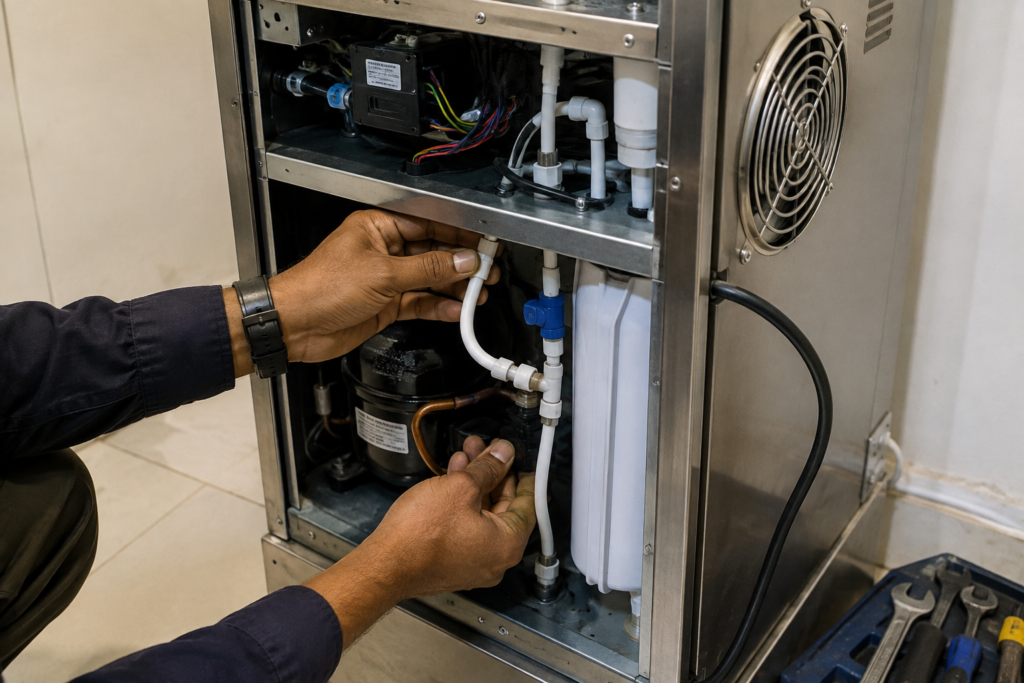
Reliable service and preventive maintenance matter long after installation.