
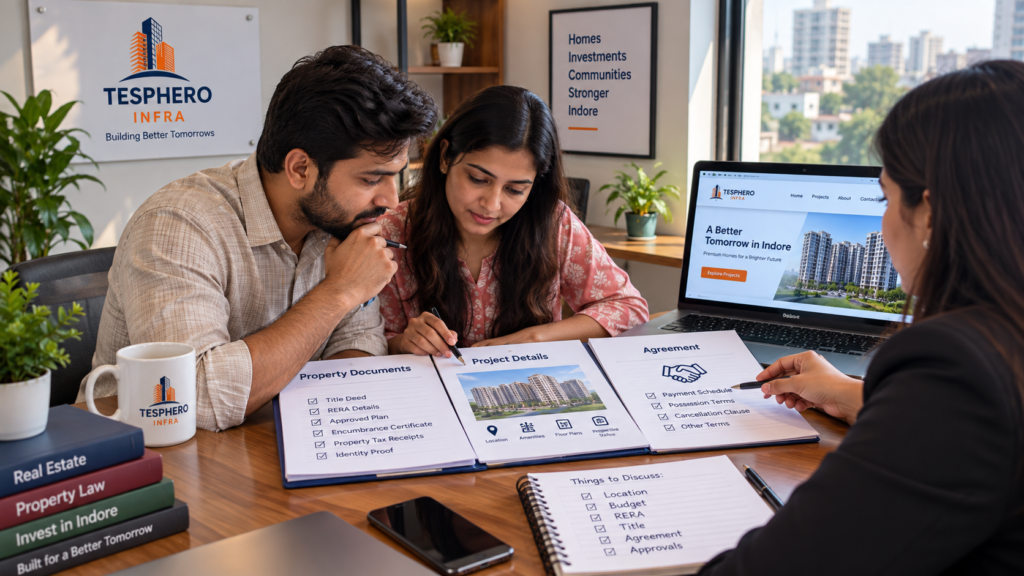
Reviewing property documents before making a major property-buying decision.
Property documents may not seem like the most exciting part of buying a home, but they can be among the most important things to check before paying a large amount of money. When you visit a property in Indore, you might fall in love with the location, floor plan, amenities, or price. However, a beautiful property still needs proper verification behind the scenes. This is where understanding RERA information, property title, ownership records, and relevant approvals becomes critical. Property buyers who take time to review these documents often catch issues early and feel confident about their decision. This guide explains what property documents to check and why each one matters before you complete your purchase.
Table of Contents
- Why Property Documents Matter Before You Buy
- RERA Verification: What Property Buyers Should Check
- Property Title: Why Ownership Verification Matters
- Important Property Documents Buyers Should Verify
- Under-Construction vs Ready Property
- Buying Property in Indore: Local Checks Still Matter
- Read the Agreement Before Property Registration
- Common Property Verification Mistakes to Avoid
- A Simple Property Verification Checklist
- How Tesphero Infra Can Help
Why Property Documents Matter Before You Buy
The property itself is only half the story. What truly protects your investment is the paperwork behind it. Your property documents act like a health report for the transaction. They tell you whether the seller actually owns the property, whether anyone else has claims on it, and whether the property meets all legal requirements.
Think of it this way: you would not buy a used car without checking its registration and history. A property is far more expensive and complex. Therefore, checking documents deserves at least as much attention.
Start Verification Before Paying a Large Amount
Most buyers understand this in theory. However, many still delay their document review until late in the process. This approach carries unnecessary risk. A smart buyer reviews important documents early—before making a large down payment or signing binding agreements.
Why does timing matter? Because discovering a document issue after you have already paid money is far more stressful than catching it beforehand. Early verification gives you time to ask questions, resolve concerns, or walk away if something does not feel right.
Document verification is only one part of a careful property decision. Location, budget, project details, and practical suitability also deserve attention. Therefore, if you are still evaluating a property, read our guide Buying Property in Indore? 7 Things You Should Check Before Making the Final Decision.
RERA Verification: What Property Buyers Should Check
RERA stands for Real Estate Regulatory Authority. In simple terms, RERA is India’s regulatory body for the real estate sector. Its role is to bring transparency and accountability to property projects and developers.
In Madhya Pradesh, the Madhya Pradesh Real Estate Regulatory Authority (MP RERA) manages this function. Where RERA registration is applicable, certain projects are registered with MP RERA, and information may be available for public review.
What Can You Find on the MP RERA Portal?
Buyers considering a project in Madhya Pradesh can use the official Madhya Pradesh Real Estate Regulatory Authority (MP RERA) portal to review available project and promoter information where applicable. Depending on what the portal displays, you may be able to check:
- Project registration details and status
- Developer or promoter information
- Approved project features and timelines
- Declared approvals and documents
- Project-related announcements or updates
- Other information published by the authority
However, the exact information available depends on the project type and what the developer has submitted to the authority. Different projects may show different levels of detail.
Does RERA Registration Mean You Can Skip Other Checks?
No. This is an important distinction. RERA registration is useful and can give you confidence about a project’s legitimacy. However, RERA information should be considered one part of broader property due diligence.
Think of RERA as a helpful starting point, not a complete guarantee. You should still verify title, ownership, agreement terms, applicable approvals, and other documents. Some of these checks may require working with a property lawyer or relevant government authority.
Property Title: Why Ownership Verification Matters
Property title broadly relates to legal ownership and your rights over the property. In simpler terms, title answers the question: “Does the seller actually own this property, and can they legally sell it to me?”
A clear title means the seller has the right to sell. A disputed or unclear title can create legal headaches for years after you buy.
What Should Buyers Look For?
When reviewing documents related to property title, consider checking:
- Whether the seller or developer actually owns the property
- Previous ownership records showing how the property changed hands over time
- Any inconsistencies in names or property descriptions across documents
- Whether anyone else has claims on the property (such as a bank loan or family dispute)
- Whether the property was transferred legally in the past
The exact documents available vary by property. For example, an older property may have many years of ownership records, while a new project may have documents from the developer showing their ownership.
Why Independent Legal Verification Can Help
Property title review often involves legal questions that are beyond most buyers’ expertise. Therefore, many buyers choose to have their documents reviewed by an independent property lawyer or legal professional before completing the transaction.
A lawyer can help you understand what the documents mean, check for any red flags, and explain your rights and responsibilities. This step adds time and cost upfront. However, it can prevent far more expensive problems later.
Important Property Documents Buyers Should Verify
Several key documents deserve your attention before you buy. Let’s look at each one.
Sale Deed or Previous Sale Deed
A sale deed is the main legal document that shows property ownership transfer. For a resale property (where the current owner is selling to you), the sale deed from when the current owner bought the property can help you understand its history.
For new properties, a sale deed does not exist yet because no transfer has occurred. However, you should understand what the sale deed will contain and what terms it will include.
Agreement for Sale or Builder-Buyer Agreement
Before a sale deed is registered, you typically sign an agreement. For ready properties, this is called an Agreement for Sale. For new projects, developers use a Builder-Buyer Agreement.
This document is crucial. You should carefully read:
- The exact property description and area
- The full price and payment schedule
- When you will get possession
- What is included in the property (balcony, parking, amenities, etc.)
- What happens if the developer delays
- What happens if you cannot pay on time
- Any clauses about cancellation or refund
- Maintenance charges and other ongoing costs
Do not sign any agreement you have not fully understood. If something is unclear, ask the developer or seller to explain it. Better yet, have a lawyer review it.
Encumbrance Certificate or Records
An encumbrance certificate (also called an EC) shows whether anyone else has legal claims on the property—such as a bank loan, mortgage, or family dispute. This certificate does not prove a property is completely dispute-free. However, it does show any recorded claims that appear in official records at the time.
Buyers should check whether any encumbrances exist. If they do, understand what they mean and whether they will be cleared before you take ownership.
Approved Building Plans and Layout Plans
New and under-construction properties should have approved building and layout plans from the relevant local authority. These plans show what the property will actually look like.
Compare what the developer is promising with what appears in the approved plans. Do the floor size, unit layout, parking, and amenities match? Inconsistencies between what is promised and what is approved can create problems later.
Completion Certificate or Occupancy Certificate
For ready-to-move or completed projects, an occupancy certificate (sometimes called a completion certificate) from the local authority confirms that the building has been constructed according to approved plans and meets local standards.
This certificate is important because it shows the property is legally complete. However, the exact name and requirements for this certificate can vary by location and property type.
Property Tax and Local Dues Records
Check whether there are any pending property tax payments or local dues on the property. If the seller owes money to the local authority, you may inherit that responsibility after purchase.
Ask the seller for proof that all taxes and dues are paid up to date. Some states or local bodies can provide records showing the current status.
Seller’s Identity and Ownership Details
Verify that names match across all documents. If the seller’s name is “Rajesh Kumar” on one document and “R. Kumar” on another, that inconsistency should be resolved before purchase.
Also check that the property description is the same across documents. Small errors can sometimes be corrected, but large inconsistencies may indicate a problem.
Loan or Mortgage-Related Documents
If there is an existing loan on the property, the bank has a legal claim. Before you take ownership, that loan must typically be paid off and the claim removed.
Ask for documents showing the current loan balance, and get written confirmation that the loan will be cleared before you take possession.
Property Documents Checklist Table
Use this table as a quick reference for key documents to review:
| Document / Check | What It Helps You Review | When It May Be Relevant | What the Buyer Should Do |
|---|---|---|---|
| RERA Information | Project legitimacy, developer details, declared timelines | Where applicable for registered projects | Check official MP RERA portal; verify project status |
| Title/Ownership Records | Who legally owns the property and history of ownership | All properties | Review previous sale deeds and ownership transfers |
| Sale Deed/Agreement | Price, payment terms, property details, buyer and seller obligations | All properties | Read completely; have a lawyer review before signing |
| Approved Building/Layout Plan | What the property will look like and size details | Under-construction and ready properties | Compare promised features with approved plan details |
| Encumbrance Certificate | Whether banks, loans, or legal claims exist on the property | All properties | Check for any recorded claims; ensure they will be cleared |
| Occupancy/Completion Certificate | That the building is legally complete and meets standards | Completed and ready properties | Request from seller or developer |
| Property Tax/Local Dues | Outstanding tax or local payments owed on the property | All properties | Ask for updated records; ensure seller pays before transfer |
| Seller/Developer Identity | That the person selling is actually the legal owner | All properties | Match names and details across all documents |
| Loan/Mortgage Documents | If there is an existing loan that must be cleared | Properties with outstanding loans | Get written confirmation loan will be paid off before possession |
However, this checklist is a starting point, not a complete legal verification. The documents required can vary by property type, location, and transaction. Therefore, consider independent legal verification before completing a purchase.
Property Documents for Under-Construction vs Ready Property
The documents you need to check depend on what stage the property is at.
Buying an Under-Construction Property
For a property that is still being built, focus on:
- RERA registration and project details where applicable
- Builder-Buyer Agreement terms, including payment schedule and promised possession date
- Approved project plans showing the layout and construction timeline
- Developer’s credentials and track record
- Payment schedule and what happens if construction is delayed
- Specifications of what will be included in your unit
- Handover terms describing the property’s condition when you receive it
Be especially careful with the payment schedule and possession terms. Under-construction properties often experience delays. Understand what happens if the developer does not deliver on time.
Buying a Ready-to-Move Property
For a property that is already built and occupied, focus on:
- Title and ownership records showing the current owner’s right to sell
- Previous sale deeds showing the ownership history
- Occupancy or completion certificate proving the building is legally complete
- Property tax and local dues records showing all payments are current
- Encumbrance certificate confirming no legal claims exist
- Agreement for Sale clearly stating price, payment terms, and included features
- Seller’s authority to transact (no dispute with family or other claimants)
For ready properties, you can also physically inspect the property to verify its condition matches the agreement.
Buying Property in Indore: Local Checks Still Matter
Indore’s real estate market is active, with properties in various locations and development stages. Whether you are buying in Central Indore, emerging suburbs, or commercial zones, document checks remain important.
The specific documents you need and the authorities involved can depend on:
- Exact location (which local body has jurisdiction)
- Property type (residential, commercial, industrial)
- Project stage (under-construction or ready)
- Development authority involved (if applicable)
- Intended use (residential living, investment, business)
For example, an approved property in one Indore location may have different approval authorities than a property in another area. Therefore, always check with the relevant local body or property lawyer about what applies to your specific property.
Also verify that the property’s current use matches the approved use. A property approved for residential use should not be used for commercial purposes without proper conversion.
Investors may need to look beyond documentation alone. Purchase price, location, rental potential, ongoing costs, and long-term suitability can also influence an investment decision. For a broader framework, read How to Evaluate a Real Estate Investment Before You Buy in Indore.
Read the Agreement Before Property Registration
Before your property is registered in your name, you will sign an agreement with the seller or developer. This document outlines all the terms of your purchase. Therefore, it deserves careful reading.
What Should Be Clear in the Agreement?
Make sure you understand:
- Your name and the seller’s name (spelled correctly)
- Exact property description and area in square feet
- The agreed price and all payment terms
- When you will receive possession
- What amenities or features are included
- Who pays for what (registration, taxes, maintenance setup)
- What happens if either party defaults
- Any clauses about cancellation or refund
- Maintenance charges and other ongoing costs
- When ownership officially transfers
If anything is unclear or if anything differs from what was verbally promised, get it corrected in writing before signing. Verbal promises have little legal weight if they are not in the written agreement.
Registration Is Important, But Due Diligence Comes First
Registration with the local authority is an essential legal step. When your property is registered, it becomes part of official records showing you as the owner.
However, registration should not be rushed. Complete your due diligence—verify title, check documents, review agreements, and consider legal consultation—before you sign off on registration. Once registered, correcting major issues becomes far more complicated.
Common Property Verification Mistakes Buyers Should Avoid
Learning from others’ mistakes can help you avoid expensive errors.
Checking only price and location. Yes, these matter. However, a great deal in a wonderful location can still become a headache if documents are not verified. Take documents seriously.
Assuming RERA registration means no other checks are needed. RERA information is helpful. However, it does not replace title verification, agreement review, and other due diligence.
Not reading the complete agreement. Many buyers skim the agreement or ask someone else to read it. You should read it yourself and understand every major term before signing.
Relying only on verbal promises. The developer or seller may say, “Don’t worry, we’ll handle that,” or “Everything will be fine.” Verbal promises are not legally enforceable. Get important promises in writing.
Not matching property details across documents. If the property area is listed as 1,200 sq ft in one document but 1,100 sq ft in another, that inconsistency should be explained and corrected.
Ignoring applicable approvals. A property should have all relevant approvals from local authorities. Missing approvals can create legal problems for you later.
Making a large payment before understanding documents. Once you have paid a big amount, you have less leverage to negotiate or walk away. Understand documents first, then pay.
Not checking the seller’s or developer’s details. Verify that the person selling is actually the legal owner. Disputes over ownership can delay or cancel your purchase.
Skipping independent legal review when needed. If you have any doubt about documents or title, hiring a lawyer for a few hours is far cheaper than fixing a major problem later.
A Simple Property Verification Checklist Before You Buy
Print or save this checklist and go through it before you complete your purchase:
- Check available RERA information through official channels where applicable
- Review title documents and ownership history
- Verify seller and property details match across all documents
- Review approved building and layout plans
- Check encumbrance certificate for any claims
- Obtain property tax and local dues records
- Read the complete Agreement for Sale or Builder-Buyer Agreement
- Understand the full payment schedule
- Verify all promised features are in writing
- Check possession and handover terms
- Confirm any existing loan will be cleared before possession
- Consider independent legal verification by a property lawyer
- Keep copies of all important documents for your records
The exact checks may vary depending on the property and transaction. These are starting points, not a complete legal clearance.
How Tesphero Infra Can Help Property Buyers in Indore
Tesphero Infra helps buyers explore property options in Indore based on location, property type, budget, and personal requirements. The team can explain project information, help compare properties, and connect you with suitable options for your needs.
However, legal and title verification should always be completed through appropriate professionals and official records where required. Tesphero Infra can help you explore suitable property options and understand relevant project information. For complex legal questions or title concerns, consult an independent property lawyer.
Frequently Asked Questions
About the Author
Tesphero Infra is a real estate development and advisory company serving homebuyers, investors, and families in Indore, Madhya Pradesh. The team helps buyers explore residential and commercial property options based on location, budget, practical needs, and investment goals. Tesphero Infra believes that informed property decisions begin with clear information and proper verification. While the company provides project details and property information, legal and title verification should always be completed through independent professionals and official records.
Looking for Property in Indore?
If you are exploring residential or commercial property in Indore, Tesphero Infra can help you compare options based on your location, budget, and requirements. Before completing a purchase, make sure the relevant property documents and legal details are independently verified by an appropriate professional. Contact Tesphero Infra to learn more about available properties and your options.

A careful property decision includes both practical needs and document verification.