
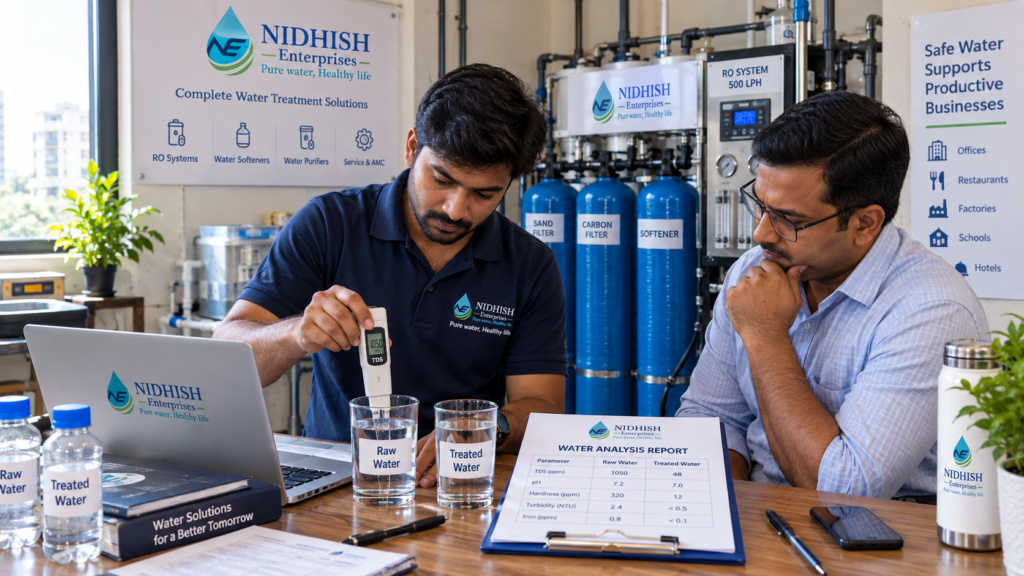
Testing incoming water helps identify the treatment a commercial RO system may need.
Choosing the Right RO System for your office, restaurant, or business starts with understanding your water quality, daily water demand, and treatment requirements. Different businesses have different needs, so one RO system may not suit every application. Therefore, checking the water source, required capacity, operating costs, and maintenance needs can help you make a better decision.
That is why simply buying a bigger RO system is not always the right answer.
Water source, quality, daily consumption, peak demand, storage, available space, and maintenance all matter. For example, a system that works well for a small office may struggle in a restaurant during busy hours. Similarly, a high-capacity plant may be unnecessary for a workplace with limited demand.
The first step, therefore, is not choosing a machine. It is understanding your water and your actual usage.
This guide explains how to compare commercial RO systems in a practical way. It also covers capacity, water quality, pre-treatment, storage, maintenance, and common buying mistakes.
Table of Contents
- Why the Right RO System Matters
- Start With Your Water Quality
- Calculate Your Daily Water Requirement
- Choose the Right RO Capacity
- Understand Pre-Treatment Requirements
- Plan Storage and Peak-Hour Demand
- RO Requirements for Different Businesses
- Compare Maintenance and Running Costs
- Common Mistakes to Avoid
- How Nidhish Enterprises Can Help
Why Choosing the Right RO System for Business Matters
A commercial RO system is not simply a larger version of a household purifier. Business requirements can be very different.
An office may have predictable drinking-water demand. However, a restaurant can have sharp peaks during lunch and dinner. A school may need more water during short breaks. Likewise, a factory can have demand spread across several shifts.
The incoming water can also vary.
One property may receive municipal water. Another may depend on bore well water. Some businesses use tankers or more than one source. As a result, two businesses with similar staff strength may still need different treatment systems.
A suitable RO system should balance three things: water quality, required output, and practical operating conditions.
If one of these is ignored, the system may be poorly matched to the business.
Bigger Is Not Automatically Better
It is easy to assume that more capacity means a better system. However, unnecessary capacity can increase equipment cost and take up more space.
On the other hand, an undersized system may struggle to keep up with demand.
Therefore, capacity should be based on realistic consumption and peak usage. Future growth can also be considered, but it should not become an excuse to oversize the system without reason.
Start With Water Testing Before Choosing an RO System
Before discussing RO capacity, understand the incoming water.
This is one of the most important steps.
Water can contain dissolved minerals, hardness, suspended particles, and other substances. Groundwater quality can also vary by location. The Central Ground Water Board monitors groundwater quality and publishes water-quality reports and datasets, which reinforces why water source and local conditions matter rather than assuming all groundwater is the same.
Do Not Judge Water by Taste Alone
Clear-looking water is not necessarily the same as water with suitable chemical or microbiological quality.
Similarly, taste alone cannot tell you everything about the source.
A water test can provide a much better starting point. Depending on the application, relevant parameters may include TDS, hardness, pH, turbidity, iron, chloride, fluoride, nitrate, and microbiological parameters.
BIS drinking-water specifications cover a broad range of physical, chemical, and microbiological considerations rather than relying on TDS alone.
Therefore, avoid selecting a commercial purifier only from one TDS-meter reading.
What Does TDS Tell You?
TDS stands for Total Dissolved Solids.
A TDS reading can provide useful information about the amount of dissolved material in water. However, it does not identify every individual substance or establish microbiological safety by itself.
So, TDS is useful, but it is only one part of water assessment.
If you want to understand how different purification technologies work, read “RO vs UV vs UF Water Purification: Which Technology Is Right for Your Water?” It explains why treatment should be matched to the actual water problem rather than selected only by technology name.
Calculate How Much Water Your Business Actually Needs
Once you understand the source water, calculate demand.
Do not begin with a random plant capacity such as 100 LPH, 250 LPH, or 500 LPH simply because it is commonly advertised.
First, ask where the treated water will be used.
Is it only for drinking? Will it also be used in food preparation? Does the business fill water dispensers? Are there several floors or departments? How many people use the water every day?
These questions help build a more realistic estimate.
Look at Daily Demand
Start with the approximate number of users.
Then consider operating hours and usage patterns.
For example, an office with 40 employees will have a different requirement from a restaurant serving hundreds of customers. Even if both operate for similar hours, the way they use water is very different.
Also include visitors, customers, staff shifts, kitchen demand, and other relevant uses.
Do Not Forget Peak Demand
Daily total consumption is only part of the calculation.
Suppose a business needs 500 liters of treated water across an entire day. That does not automatically mean demand arrives evenly every hour.
A school may need large amounts during breaks. A restaurant may experience demand around meal times. Meanwhile, an office may see peaks in the morning and afternoon.
Therefore, capacity and storage should work together.
How to Choose the Right RO Capacity
Commercial RO capacity is often expressed in LPH, or liters per hour.
A 100 LPH system, for example, is designed around a certain production rate under specified operating conditions. However, actual output can depend on feed-water conditions, pressure, membrane condition, temperature, and system design.
For this reason, do not consider the LPH number in isolation.
A Simple Capacity Example
Imagine a workplace needs about 600 liters of treated water during its operating day.
One option may be to produce water gradually and store it in a suitable tank. Another may require faster production because demand is concentrated into shorter periods.
The correct choice depends on the operating pattern.
Therefore, instead of asking:
“Should I buy a 100 LPH or 250 LPH RO?”
Ask:
“How much treated water do I need, when do I need it, and how much storage is practical?”
That question leads to a better system design.
Allow for Practical Operating Conditions
An RO plant does not exist in perfect laboratory conditions.
Feed-water pressure can change. Filters become dirty. Membranes need maintenance. Power interruptions can occur. Source-water quality may also vary.
So, system selection should include a practical operating margin without dramatically over-sizing the plant.
Why Pre-Treatment Can Be Just as Important as the RO
A common mistake is focusing entirely on the RO membrane.
In reality, the water entering the membrane matters a great deal.
Depending on source-water quality, a commercial system may require one or more pre-treatment stages.
These can include sediment filtration, activated carbon filtration, hardness treatment, iron removal, or other processes based on test results.
Hard Water Can Affect the System
Hardness can contribute to scale formation.
Over time, scaling may affect membranes and other equipment. Therefore, businesses with hard feed water may need suitable pre-treatment before RO.
The correct approach depends on the water analysis and system design.
If hardness is already creating visible problems at your property, our guide “Hard Water Problems in Indore: How Water Softeners Can Protect Your Home and Business” explains the issue in more detail.
Pre-Treatment Should Match the Problem
Adding every possible filter is not necessarily better.
For example, a business should not install an iron-removal stage merely because another property uses one. Similarly, a water softener should be selected because the water and application justify it.
First, identify the problem. Then select the treatment.
This keeps the system more practical and easier to maintain.
RO System Selection Checklist
| Factor | What to Check | Why It Matters |
|---|---|---|
| Water source | Municipal, bore well, tanker, mixed source | Source affects treatment needs |
| Water quality | TDS, hardness and relevant test parameters | Helps determine treatment stages |
| Daily demand | Approximate liters required each day | Helps estimate capacity |
| Peak demand | When maximum water is needed | Affects capacity and storage |
| Operating hours | Hours available for production | Helps plan system size |
| Pre-treatment | Filtration or conditioning required | Can protect downstream equipment |
| Storage | Treated-water tank capacity | Helps manage demand peaks |
| Space | Installation and service access | Important for practical maintenance |
| Service needs | Filter, membrane, and component access | Affects long-term operation |
| Future demand | Realistic expected growth | Can reduce premature replacement |
However, this table is only a starting point. Every commercial site has different water and usage conditions. Therefore, final system selection should follow a proper assessment.
Storage Is Part of RO System Planning
Storage often gets less attention than the RO plant itself.
However, it can make a major difference.
A properly planned treated-water tank allows the system to produce water during lower-demand periods. Stored water can then support short periods of higher demand.
As a result, the RO plant does not necessarily have to match the highest instantaneous demand on its own.
Keep Treated-Water Storage Hygienic
Storage should not become the weak point of the system.
Tank material, covering, cleaning access, plumbing, and distribution should all be considered. The aim is to protect treated water after purification.
Also, avoid selecting an unnecessarily large tank only to create a bigger buffer. Water turnover and hygiene still matter.
The Right RO System Depends on Your Business
There is no single commercial RO configuration for every organization.
The use case matters.
RO System for an Office
An office usually needs drinking water for employees, visitors, meetings, and pantry use.
Therefore, consider:
- number of employees
- visitors
- working hours
- number of floors
- water coolers or dispensers
- peak break times
- available installation space
For smaller workplaces, a compact commercial solution may be enough. Larger offices may benefit from central treatment with suitable storage and distribution.
RO System for a Restaurant
Restaurant water planning needs extra attention because water may support several activities.
Depending on the operation, treated water may be used for drinking, beverages, food preparation, ice, or other suitable applications.
Demand can also change sharply during busy periods.
Therefore, restaurants should evaluate both water quality and peak-hour consumption.
A breakdown during service hours can also disrupt operations. That makes serviceability and maintenance planning especially important.
RO System for a School or Educational Facility
Schools often have concentrated demand.
Many students may need drinking water during a short break. Therefore, storage and dispensing capacity can be just as important as purification output.
The system should also be practical to clean and maintain.
RO System for a Factory
Factories can vary widely.
A small manufacturing unit may only require drinking water for employees. A larger site may have several shifts and many users.
Also, do not confuse drinking-water treatment with process-water treatment. Industrial processes can have very different water-quality requirements.
RO System for Hotels and Other Commercial Properties
Hotels can have changing occupancy and multiple water-use points.
Therefore, demand calculations should reflect actual application rather than simply room count.
The same principle applies to hostels, hospitals, showrooms, gyms, and other commercial properties.
Commercial RO Requirements at a Glance
| Business Type | Main Planning Priority | Common Question to Answer |
|---|---|---|
| Office | Users and daily drinking demand | How much water is needed during work hours? |
| Restaurant | Quality plus peak demand | Can supply keep up during busy service? |
| School | Short high-demand periods | Is storage sufficient for break times? |
| Factory | Shift-wise demand and application | Is water only for drinking or another process? |
| Hotel | Variable occupancy and usage | How does demand change through the day? |
| Commercial facility | Multiple users/locations | How will treated water be stored and distributed? |
Again, these are general planning considerations. Actual requirements depend on the site.
Maintenance Matters as Much as Purchase Price
The initial price of an RO plant is only one part of the decision.
Filters need replacement. Membranes need monitoring. Pumps and valves can require service. Tanks and connected equipment also need appropriate maintenance.
Therefore, compare total operating requirements, not only purchase price.
Ask About Consumables
Before buying, ask which consumables the system uses.
Also check their expected replacement conditions and availability.
Replacement timing can vary with source-water quality and usage. Therefore, fixed schedules should not be treated as universal.
Make Sure the Plant Is Easy to Service
Installation should leave enough space around important components.
A system squeezed into an inaccessible corner may become harder to inspect and service.
Meanwhile, commercial businesses should also think about what happens if the system stops unexpectedly.
Our previous guide, “What Happens When Your Business Water System Fails? The Real Cost of RO Downtime,” explains why maintenance planning and service response matter for commercial operations.
Consider Water Efficiency Too
RO treatment typically produces a treated-water stream and a reject/concentrate stream.
The proportion can vary based on system design, feed-water quality, pressure, recovery settings, and other operating factors.
Therefore, avoid assuming that every RO plant has the same recovery or reject-water ratio.
Businesses should ask the supplier about expected recovery under their actual conditions.
Where practical and appropriate, reject water may have non-potable reuse applications. However, suitability depends on its quality and the intended use.
Do not reuse it blindly.
What Should You Check Before Buying a Commercial RO System?
Before finalizing a system, ask these questions:
- What is the source of our incoming water?
- Has the water been tested?
- What problem are we trying to treat?
- How much treated water do we need daily?
- When does peak demand occur?
- What RO capacity is appropriate?
- How much treated-water storage is required?
- Does the feed water need pre-treatment?
- Is there enough installation and maintenance space?
- Which filters and membranes will require replacement?
- How easy is routine servicing?
- What happens if demand increases later?
- How will treated water reach the points of use?
A supplier should be able to explain why a particular configuration is being recommended.
If the only explanation is “bigger plant is better,” ask more questions.
Common Mistakes Businesses Should Avoid
Choosing RO Capacity Only by Employee Count
Headcount is useful, but it does not tell the complete story.
Visitors, shifts, kitchens, peak demand, and other uses can change consumption.
Buying Without Testing the Water
Without knowing the source-water condition, treatment becomes guesswork.
Therefore, testing should come before equipment selection.
Looking Only at TDS
TDS is useful, but it is not a complete water-quality report.
BIS drinking-water specifications include multiple physical and chemical parameters, while microbiological requirements are also part of drinking-water assessment.
Ignoring Pre-Treatment
The RO membrane should not be expected to solve every feed-water problem by itself.
Proper pre-treatment can be an important part of system design.
Ignoring Storage
Even a correctly sized RO plant can feel inadequate if peak demand and storage were not planned properly.
Choosing Only by Purchase Price
A cheaper system is not automatically more economical.
Consumables, service, power, maintenance, component quality, and downtime can affect long-term cost.
Forgetting About Service Access
Commercial equipment needs maintenance.
Therefore, leave enough room for technicians to inspect and replace components.
Test the Water, Then Design the System
Commercial water treatment works best when decisions follow a logical order:
Water source → Water test → Usage requirement → Treatment design → Capacity → Storage → Installation → Maintenance plan
Starting with a machine model reverses that process.
For businesses that want a formal reference point for drinking-water quality, the Bureau of Indian Standards (BIS) publishes IS 10500, the Indian Standard for drinking-water specifications. The standard covers requirements and methods related to drinking-water quality.
The standard is useful as a reference, but a business should still assess its own source water and intended use.
How Nidhish Enterprises Can Help
Choosing the right RO system for business becomes easier when the discussion begins with water conditions and actual demand.
Nidhish Enterprises works with homes, offices, restaurants, schools, factories, and other commercial users on water-treatment requirements. The approach can include understanding the source water, required capacity, pre-treatment needs, storage, installation conditions, and ongoing service requirements.
Every site is different. Therefore, the goal should not be to recommend the same RO plant to every customer.
Instead, the system should match the water source, usage pattern, available space, and practical operating needs.
For commercial businesses, this can also mean planning the system so routine maintenance is easier and future requirements are considered from the beginning.
Final Thoughts
The right RO system for business is not necessarily the largest, most expensive, or most complicated system.
It is the one that fits the water and the requirement.
Start by testing the incoming water. Next, estimate realistic daily and peak demand. Then, consider RO capacity, pre-treatment, storage, installation space, and maintenance.
An office, restaurant, school, factory, and hotel can all need different solutions. Therefore, avoid choosing equipment only from an LPH number or TDS reading.
A well-planned system should be practical to operate and maintain. More importantly, its treatment stages should have a clear reason for being there.
When the system is designed around actual conditions, commercial water management becomes much easier.
Frequently Asked Questions
About the Author
Nidhish Enterprises provides water-treatment solutions for residential, commercial, and institutional requirements. Its work includes RO systems, commercial water-treatment solutions, water softeners, water coolers, and related service support. Rather than treating every site the same way, the focus is on understanding water quality, usage, capacity, and practical operating needs. For businesses, this can help create a more suitable approach to water purification, storage, and maintenance. To learn more about available solutions, contact Nidhish Enterprises for a discussion about your water-treatment requirements.
Need an RO System for Your Business?
If you are planning an RO system for an office, restaurant, school, factory, hotel, or another commercial property, start with the water—not the machine.
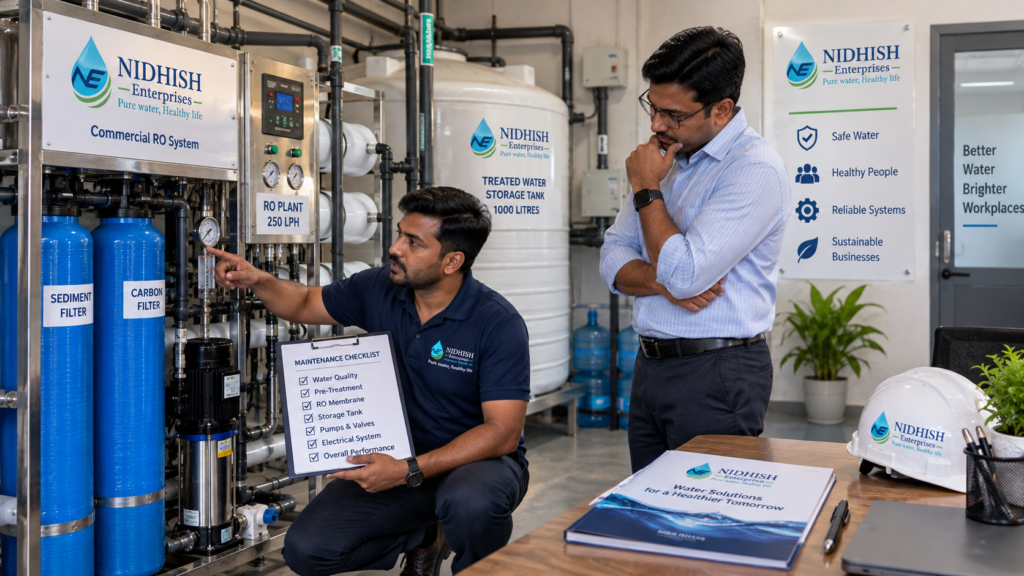
A commercial RO system should be planned for both daily operation and long-term maintenance.