Why Regular RO Maintenance Matters for Water Quality and System Performance
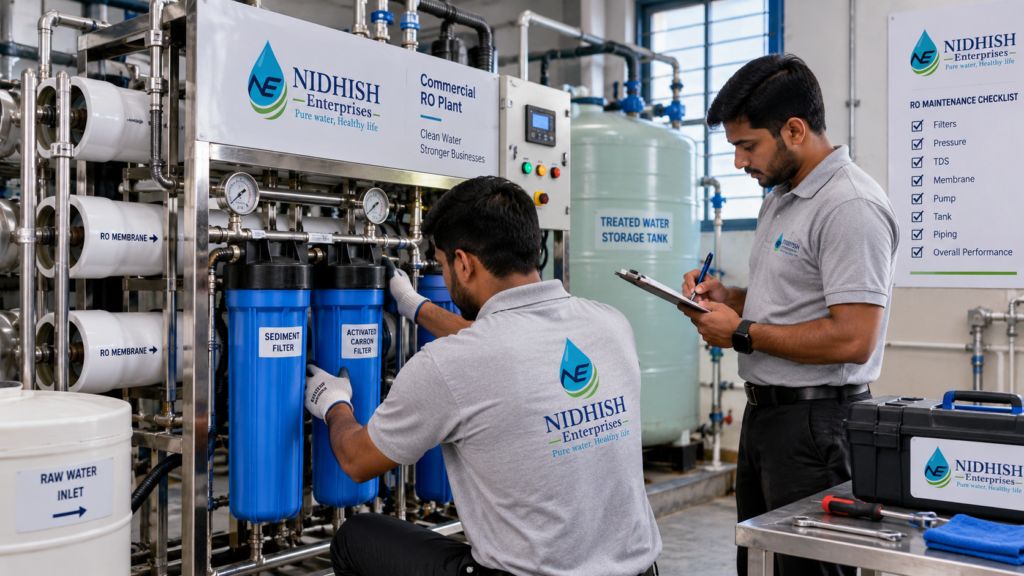
Regular RO Maintenance helps an RO system deliver consistent water quality while supporting reliable day-to-day performance. Whether you use an RO system at home, in an office, restaurant, school, factory, hospital, or another commercial space, the system needs proper care after installation. Many users pay close attention while selecting an RO system. However, maintenance often receives less attention once the unit starts working normally. That can become a problem. Filters collect impurities over time. Membranes face continuous load. Storage tanks need hygiene checks. Pumps, valves, pipes, and other components may also develop issues with regular use. As a result, an RO system that worked well when new may gradually lose efficiency if nobody maintains it properly. Regular servicing does not mean replacing every component frequently. Instead, it means inspecting the system, monitoring its performance, cleaning where required, and replacing consumable parts according to actual condition, water quality, usage, and manufacturer guidance. Let us understand why this matters. Table of Contents Why Regular RO Maintenance Matters An RO system performs several tasks before treated water reaches the user. Depending on the system design, water may pass through sediment filtration, activated carbon filtration, the RO membrane, post-treatment stages, and other components. Commercial systems may also include pumps, pressure gauges, dosing arrangements, storage tanks, and additional pretreatment. Each component performs a specific function. Therefore, one neglected stage can affect other parts of the system. For example, a sediment filter helps reduce suspended particles before water reaches later treatment stages. When that filter becomes heavily loaded, water flow or pressure conditions may change. Similarly, pretreatment problems can place additional stress on the RO membrane. Regular inspection helps identify such issues before they grow into larger operational problems. More importantly, maintenance should match the actual system rather than follow a one-size-fits-all approach. 1. Understand What Happens Inside an RO System Over Time Water treatment equipment works continuously against substances present in the incoming water. These may include dissolved salts, suspended particles, hardness-related minerals, chlorine, organic matter, and other contaminants depending on the source. Consequently, components do not remain in the same condition forever. Sediment can accumulate inside filters. Scale may develop under certain operating conditions. Membranes can foul. Connections may loosen or leak. Meanwhile, storage areas can require cleaning and hygiene attention. The speed of these changes depends on several factors: A household RO purifier and a commercial RO plant may therefore need very different maintenance routines. Source Water Makes a Difference Bore well water, municipal water, tanker water, and other sources can have different characteristics. Even the same source may change over time. For that reason, businesses should not assume that a maintenance schedule suitable for one location will automatically work at another. Understanding the incoming water is an important starting point. 2. Filters Need Timely Attention Pre-filters protect later stages of an RO system. A sediment filter, for example, helps remove suspended particles before they move further through the treatment process. Activated carbon stages can perform other important treatment functions depending on system design. However, filters have a limited working life. As they collect impurities, their condition gradually changes. What Happens When Filters Become Loaded? A heavily loaded filter may restrict water flow. In addition, the system may have to operate under less favorable conditions. Commercial installations can also experience reduced output or pressure-related problems. Ignoring filters for too long may create unnecessary stress elsewhere in the system. Therefore, technicians should inspect them at suitable intervals and replace them when their condition or the system requirements indicate that replacement is necessary. Avoid Fixed Assumptions You may hear advice such as: “Change every filter after exactly six months.” That may work as a general reminder for a particular product. Still, it should not replace the manufacturer’s instructions or an assessment of actual operating conditions. A system treating challenging source water may need attention sooner. In contrast, another installation may operate under different conditions. Regular RO Maintenance should respond to the system’s real workload. 3. The RO Membrane Plays a Critical Role The membrane sits at the heart of the reverse osmosis process. Pressure pushes feed water through the membrane, while the system separates a portion of dissolved substances from the treated-water stream. Because this component performs such an important job, membrane condition directly affects system performance. Membrane Performance Can Change Several factors can influence a membrane over time. These may include scaling, fouling, unsuitable feed-water conditions, poor pretreatment, incorrect pressure, or simply prolonged operation. A commercial operator might notice changes in: One unusual reading does not always identify the exact problem. Therefore, a trained technician should examine the system rather than replace the membrane based on guesswork. Membrane Replacement Should Follow Condition RO membranes do not all fail after an identical number of months. Water quality and operating conditions matter. Good pretreatment can help protect the membrane. Conversely, unsuitable feed water can increase stress on it. That is another reason routine monitoring matters. 4. Regular RO Maintenance Helps Protect Water Quality RO maintenance is not only about keeping a machine running. Water quality remains the main purpose of the system. India’s Bureau of Indian Standards identifies IS 10500 as the specification for drinking water. The standard covers requirements and methods of sampling and testing for drinking water. BIS BIS documentation covers parameters such as color, odour, pH, taste, turbidity, total dissolved solids, hardness, iron and several other chemical and microbiological requirements. BIS For businesses that provide drinking water to employees, customers, students, guests, or other users, relying only on appearance is not enough. Clear-looking water does not tell you everything about its quality. Testing Provides Better Information Where appropriate, water testing can help businesses understand both source water and treated water. The required tests will depend on the application and local conditions. For official reference, businesses can review the Bureau of Indian Standards drinking-water information. BIS states that IS 10500 covers drinking water intended for human consumption from different sources. BIS Testing also helps technicians make better maintenance decisions instead of relying entirely