
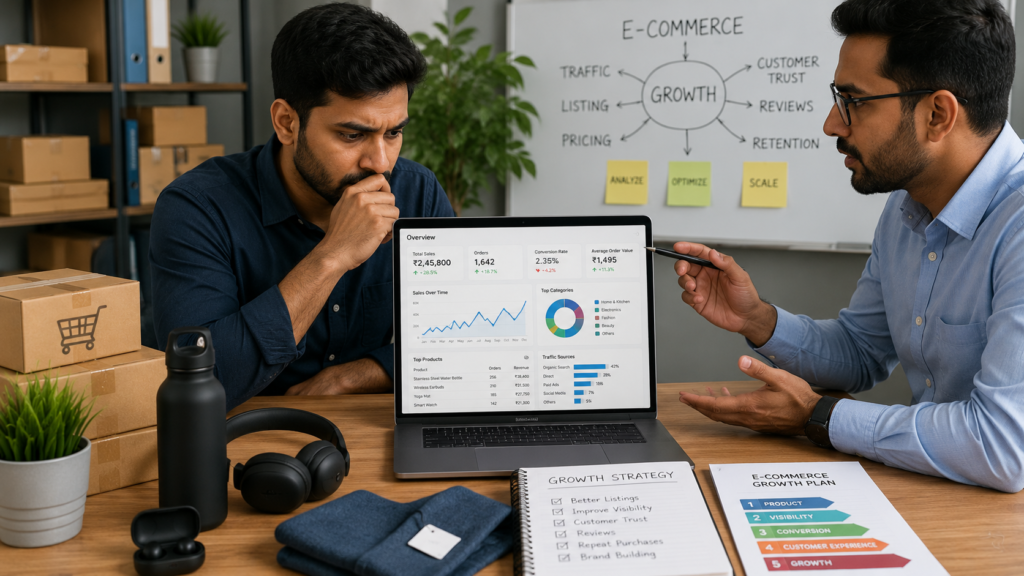
Growing an e-commerce business takes more than just listing products. The right strategy, customer understanding, visibility, and consistent optimisation are what turn online selling into sustainable growth.
Starting an e-commerce business has never been easier.
A seller can create an online marketplace account, list products, run advertisements, and start receiving orders. While getting started may be relatively simple, consistently growing an e-commerce business is a completely different challenge.
Many sellers experience a similar pattern.
They launch their products with excitement. The first few orders come in. They invest in advertising and try different offers. But after some time, growth starts slowing down.
Orders become inconsistent.
Advertising costs increase.
Competition becomes stronger.
And the seller starts wondering:
“Why is my business not growing even though I’m doing everything I can?”
The answer is often not one single problem.
In many cases, sellers are missing the bigger picture of e-commerce growth.
Selling online is not just about putting a product on a marketplace and waiting for customers to buy it. Sustainable growth requires the right combination of product strategy, visibility, listing quality, pricing, customer trust, marketing, operations, and continuous improvement.
If you’re building an online business from the ground up, you can also explore our guide on Building a Successful E-commerce Business: A Complete Guide to Sustainable Growth.
1. They Focus on Selling Products Instead of Building a Business
One of the biggest mistakes sellers make is focusing only on individual sales.
Their thinking becomes:
“How can I get more orders today?”
But sustainable e-commerce growth requires a broader question:
“How can I build a business that consistently attracts, converts, and retains customers?”
Getting one order is a transaction.
Building a repeatable system that generates sales is a business.
Successful sellers think beyond individual orders. They look at:
- Product demand
- Customer expectations
- Brand positioning
- Marketplace visibility
- Conversion rates
- Customer reviews
- Repeat purchases
- Profit margins
- Long-term growth
When sellers focus only on daily orders, they may make short-term decisions that don’t support long-term growth.
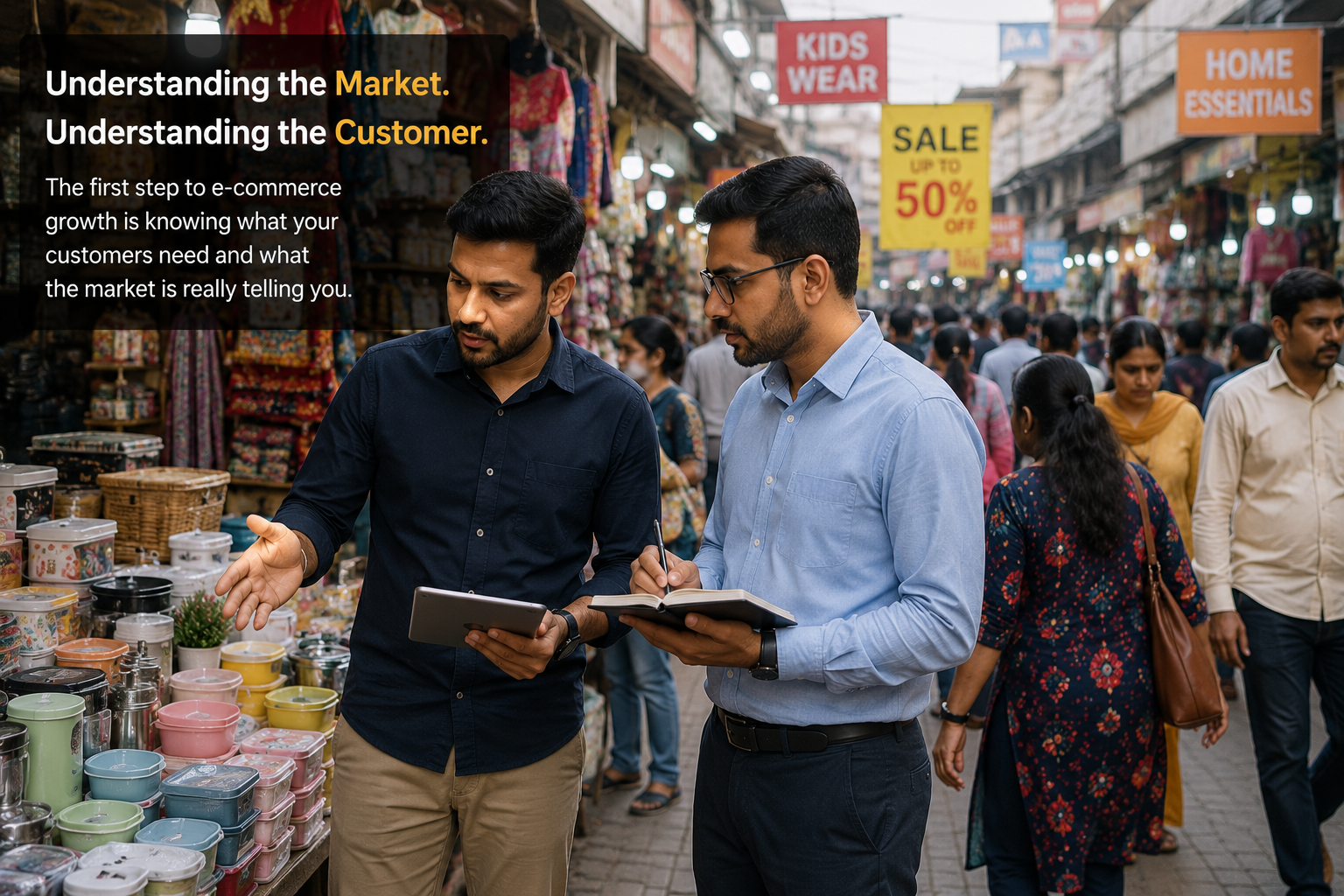
2. They Choose Products Without Understanding the Market
A product may be good, but that doesn’t automatically mean it will sell successfully online.
Before launching a product, sellers should understand:
- Who is the target customer?
- What problem does the product solve?
- Is there enough demand?
- Who are the competitors?
- What price range do customers expect?
- What makes this product different?
- Can the business make a sustainable profit?
Many sellers enter a category simply because they see other sellers making sales.
But by the time they enter, the category may already be highly competitive.
The problem isn’t always the product itself.
Sometimes, the problem is a lack of market understanding and positioning.
A strong e-commerce strategy begins before the product is listed.
3. They Underestimate the Importance of Product Listings
A marketplace listing is often the first interaction between your product and a potential customer.
Think of it as your digital salesperson.
If the listing doesn’t communicate the product clearly, customers may simply move on to another option.
A strong product listing should answer basic questions quickly:
- What is the product?
- Who is it for?
- What problem does it solve?
- What are its key benefits?
- Why should the customer choose it?
- What makes it different?
This is where many sellers lose potential customers.
They may have a good product, but the title is unclear, the description is weak, or the images don’t explain the product properly.
The result?
The product may receive visibility, but customers don’t convert.
Visibility brings attention. A strong listing turns that attention into sales.
4. They Treat Product Images as Decoration
Product images are not just there to make a listing look attractive.
They help customers understand what they are buying.
In a physical store, customers can pick up a product, examine it, and compare it with alternatives.
Online, images have to do much of that work.
Good product images should help communicate:
- Product appearance
- Size and dimensions
- Features
- Usage
- Benefits
- Packaging
- Important details
Depending on the product, lifestyle images, infographics, close-up shots, and usage demonstrations can help customers make better decisions.
If customers cannot understand the product quickly, they may hesitate to buy—even if the product itself is excellent.
5. They Try to Compete Only on Price
Price is important.
But it should not be the only reason customers choose your product.
When sellers constantly reduce prices to compete, they may increase orders but reduce profitability.
Over time, this can create a difficult cycle:
Lower Price → Lower Margin → Less Budget for Marketing → Slower Growth
Instead of competing only on price, sellers should think about value.
Value can come from:
- Better product quality
- Better presentation
- Stronger branding
- Useful features
- Better packaging
- Faster service
- Reliable customer support
- Better overall experience
Customers don’t always choose the cheapest product.
They often choose the option that feels like the best value for the money.
6. They Don’t Understand Who Their Customer Real
One of the most overlooked factors in e-commerce growth is customer understanding.
A seller may know what they are selling but still not know who is most likely to buy it.
Understanding your customer means knowing:
- Their needs
- Their expectations
- Their buying behaviour
- Their budget
- Their common concerns
- What influences their purchase decision
For example, two products in the same category may target completely different customers.
One may appeal to budget-conscious buyers, while another may target customers looking for premium quality.
The product, pricing, images, messaging, and advertising should all reflect the intended audience.
When sellers try to sell to everyone, their communication often becomes too generic.
A clearer customer profile can lead to better positioning and more relevant marketing.
7. They Expect Advertising to Fix Everything
Advertising can help increase visibility.
But ads cannot fix every problem.
If a product has:
- Weak images
- Poor reviews
- Incorrect pricing
- Unclear product information
- Low customer trust
- Poor conversion
then increasing the advertising budget may not solve the real issue.
It may simply bring more people to a listing that isn’t ready to convert them.
This is why sellers should look at the entire customer journey.
Visibility → Click → Product Page → Trust → Purchase → Experience → Review → Repeat Purchase
Advertising is only one part of this journey.
Before increasing ad spending, sellers should ask:
“If more customers see my product today, are they actually likely to buy it?”
If the answer is no, the underlying problem needs attention first.
8. They Don’t Track the Right Numbers
Many sellers look at only one metric:
Sales.
But sales alone don’t explain why the business is growing—or why it isn’t.
Sellers should also pay attention to metrics such as:
- Product views
- Click-through rate
- Conversion rate
- Advertising performance
- Customer acquisition cost
- Return rate
- Review ratings
- Profit margin
- Repeat purchases
For example, if a product gets many views but very few orders, the issue may be related to pricing, listing quality, trust, or product-market fit.
If the product gets very few views, the problem may be visibility or discoverability.
Data helps sellers move from guessing to making informed decisions.
9. They Ignore Customer Reviews and Feedback
Reviews are more than just ratings.
They are direct feedback from the market.
Customers may tell you:
- What they liked
- What they disliked
- What they expected
- What was confusing
- What could be improved
If several customers mention the same issue, that feedback should not be ignored.
It may reveal an opportunity to improve:
- Product quality
- Packaging
- Instructions
- Product description
- Customer expectations
Successful sellers don’t just collect reviews.
They learn from them.
10. They Don’t Build Customer Trust
Customers are more likely to buy when they feel confident about the seller and product.
Trust can be influenced by:
- Clear product information
- High-quality images
- Genuine reviews
- Professional packaging
- Accurate delivery expectations
- Easy return processes
- Consistent customer service
This is especially important for newer sellers.
A customer may ask themselves:
“Will I receive what I see in the listing?”
“Is the quality really as described?”
“What happens if I have a problem?”
The stronger the trust, the easier it becomes for customers to make a purchase decision.
11. They Don’t Think Beyond One Marketplace
Marketplaces can provide access to a large customer base, but relying entirely on one platform can limit long-term growth.
As the business develops, sellers can explore a broader digital presence through:
- Their own website
- Social media
- Content marketing
- Email marketing
- Customer retention
- Direct brand communication
The goal isn’t necessarily to leave marketplaces.
Instead, sellers can use marketplaces for reach while gradually building a stronger brand presence of their own.
This can help create more control over the customer relationship and long-term brand identity.
12. They Don’t Have a Clear Growth Strategy
Many sellers are busy every day.
They update listings.
They run ads.
They check orders.
They respond to customers.
But being busy doesn’t always mean the business is growing strategically.
A growth strategy should answer questions like:
- Which products should we focus on?
- Which customers are we targeting?
- Which marketplace is most suitable?
- What is our competitive advantage?
- How much should we invest in advertising?
- How can we improve conversion?
- How can we increase repeat purchases?
- When should we expand the product range?
Without a clear strategy, sellers may keep trying random tactics without knowing what is actually working.
13. They Don’t Adapt When the Market Changes
E-commerce is constantly changing.
Customer preferences evolve.
Competitors launch new products.
Marketplace algorithms change.
Advertising costs fluctuate.
New trends emerge.
A strategy that worked six months ago may not produce the same results today.
Successful sellers continuously monitor the market and adapt.
This doesn’t mean changing everything every week.
It means being willing to ask:
“What is working now, and what needs to change?”
Businesses that regularly review their products, customer behaviour, competition, and performance are better positioned to respond to change.
14. They Expand Too Quickly
Growth is exciting.
But expanding too quickly can create new problems.
Some sellers add multiple products before understanding which products actually perform well.
Others enter new marketplaces without having the right operational systems in place.
Before expanding, sellers should consider:
- Is the current product line profitable?
- Is inventory manageable?
- Can customer service handle increased demand?
- Is the supply chain reliable?
- Is there enough cash flow?
- Does the new product fit the existing customer base?
Growth should be sustainable, not just fast.
15. They Don’t Build a Strong Brand
A marketplace seller and a brand are not always the same thing.
A seller focuses on transactions.
A brand focuses on building recognition and trust over time.
Branding can influence:
- Customer trust
- Product perception
- Repeat purchases
- Customer loyalty
- Differentiation from competitors
Even in competitive marketplaces, sellers can build a stronger identity through consistent packaging, visuals, communication, and customer experience.
When customers remember your brand—not just your product—you have a stronger foundation for long-term growth.
16. What E-commerce Sellers Are Really Missing
So, why do many e-commerce sellers struggle to grow?
Often, they are not missing effort.
They are missing a connected strategy.
They may be doing many things individually:
- Running ads
- Uploading products
- Changing prices
- Adding new products
- Checking sales
But these activities may not be connected to a clear growth plan.
Real e-commerce growth comes from connecting the pieces:
Right Product
↓
Right Customer
↓
Strong Product Listing
↓
Better Visibility
↓
Customer Trust
↓
Conversion
↓
Great Customer Experience
↓
Positive Reviews
↓
Repeat Purchases
↓
Sustainable Growth
When these elements work together, growth becomes more predictable and manageable.
How Tesphero Ecom Can Help
Growing an e-commerce business requires more than simply creating a seller account or uploading products.
At Tesphero Ecom, we help businesses build a stronger online presence by supporting different aspects of their e-commerce journey.
Our services include:
- Seller Account Setup
- Product Listing & Optimization
- Marketplace Strategy
- E-commerce Growth Support
- Branding Support
- Product Presentation
- Online Business Guidance
Whether you are starting your online journey or struggling to improve your existing marketplace performance, the first step is understanding what is holding your business back.
The right strategy can help businesses identify gaps, improve their online presence, and create a stronger foundation for sustainable growth.
Final Thoughts
E-commerce growth rarely comes from one magic trick.
It is usually the result of getting many small but important things right—and connecting them into one clear strategy.
A great product needs the right positioning.
A strong listing needs visibility.
Visibility needs conversion.
Conversion needs trust.
And customer satisfaction needs to turn into positive reviews and repeat purchases.
If your e-commerce business is not growing as expected, the answer may not be to simply spend more on advertising or add more products.
Sometimes, you need to step back and look at the entire business.
Ask yourself:
Do I have the right product?
Am I reaching the right customer?
Does my listing communicate value clearly?
Can customers trust my product?
Am I tracking the right data?
Do I have a clear growth strategy?
The sellers who ask these questions regularly are more likely to build businesses that can adapt, improve, and grow over time.
Because sustainable e-commerce growth isn’t just about getting more orders. It’s about building a system that makes consistent growth possible for tesphero.
✍️ About the Author
Tesphero Ecom helps businesses take their products online and build a stronger presence across the e-commerce ecosystem.
From seller account setup and product listing to marketplace strategy, optimization, branding, and growth support, our focus is on helping businesses navigate the challenges of selling online.
We believe every business has different products, customers, and goals. That’s why a successful e-commerce strategy should be built around the business—not a one-size-fits-all formula.
Frequently Asked Questions (FAQs)
🚀 Ready to Build a Stronger E-commerce Business?
If your products are online but your business isn’t growing the way you expected, it may be time to look beyond individual sales and understand the bigger picture.
Your Product Is Only the Beginning. Your Strategy Drives the Growth.
📞 Call Now: +91 97133 34655
🌐 Visit Website: www.tesphero.com