
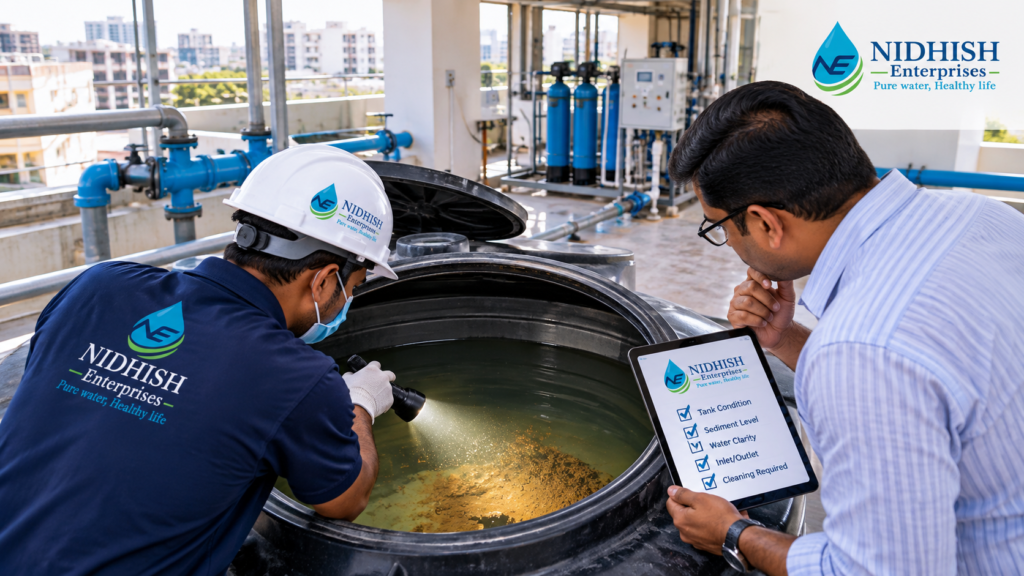
Regular inspection and cleaning of commercial water storage tanks can help identify sediment, deposits, and maintenance issues before they affect the wider water system.
Water Storage Tank Cleaning plays an important role in maintaining commercial water quality because stored water can be affected by sediment, dirt, biofilm, and other contaminants when tanks are poorly maintained. Offices, schools, restaurants, hotels, hospitals, factories, hostels, and other commercial facilities often depend on storage tanks to maintain a steady water supply. Therefore, tank condition should be considered part of the overall water-management system.
Even when incoming water appears clear, storage conditions can influence its quality before it reaches taps, coolers, kitchens, wash areas, or water-treatment equipment.
However, cleaning a tank alone does not guarantee that water is safe for every intended use. Source-water quality, tank design, plumbing condition, treatment systems, and ongoing maintenance also matter.
Table of Contents
- Why Commercial Buildings Use Water Storage Tanks
- How Stored Water Quality Can Change
- Why Water Storage Tank Cleaning Matters
- Sediment and Deposits Inside Storage Tanks
- Biofilm and Microbial Concerns
- Tank Cleaning and Commercial RO Systems
- Signs a Water Tank May Need Attention
- How Often Should Commercial Tanks Be Cleaned?
- What Professional Tank Cleaning Should Consider
- Water Quality Testing and Preventive Maintenance
- Common Tank Maintenance Mistakes
- How Nidhish Enterprises Can Help
- FAQs
1. Why Commercial Buildings Use Water Storage Tanks
Commercial properties may require a large and reliable water supply throughout the day. As a result, many facilities use underground or overhead tanks to store water before distribution.
The stored water may support different applications, including drinking-water treatment, kitchens, washrooms, cleaning, manufacturing processes, cooling systems, or general utility requirements.
Storage provides operational convenience. However, it also creates another stage in the water journey that needs attention.
Water may enter a property in acceptable condition but later come into contact with sediment, poorly maintained tank surfaces, stagnant zones, or contamination entering through an improperly protected tank.
Therefore, businesses should not evaluate water quality only at the original source.
They should also consider what happens between the source and the point of use.
2. How Stored Water Quality Can Change
A storage tank is not simply a container that can be ignored after installation.
Over time, particles carried by incoming water may settle at the bottom. Dust or debris may also enter if covers, vents, inspection openings, or surrounding areas are not adequately maintained.
In addition, stagnant areas and deposits can create conditions that make water-management problems more difficult to control.
The World Health Organization notes that safe drinking-water management requires attention from the water source through to the consumer. Therefore, storage and distribution conditions form part of the broader water-safety picture.
For authoritative guidance on drinking-water quality, businesses can refer to the World Health Organization drinking-water resources.
However, the actual risks inside a specific commercial tank depend on its water source, design, usage, condition, cleaning history, and operating environment.
3. Why Water Storage Tank Cleaning Matters
Regular Water Storage Tank Cleaning can help remove accumulated sediment, visible dirt, deposits, and other unwanted material from tank surfaces.
This matters because the tank may supply water to multiple areas of a commercial property.
For example, one tank may feed a kitchen, office pantry, washrooms, and a commercial RO system. Consequently, poor tank conditions can affect several downstream applications rather than just one tap.
Cleaning also provides an opportunity to inspect the tank itself.
During inspection, businesses may identify problems such as damaged covers, cracks, excessive deposits, poorly protected openings, leakage, or other maintenance concerns.
Therefore, tank cleaning should not be treated only as a cosmetic activity.
It should form part of a broader inspection and water-management routine.
4. Sediment Can Accumulate Inside Commercial Water Tanks
Sediment is one of the most visible reasons to pay attention to storage tanks.
Depending on the incoming water and supply system, suspended particles can gradually settle at the bottom of a tank.
A small amount may not be obvious from water taken near the outlet. However, deposits can become more noticeable over time.
Commercial properties may experience different levels of sediment depending on factors such as:
- Source-water characteristics
- Incoming pipeline condition
- Tank design
- Water turnover
- Local supply conditions
- Previous maintenance
- Pretreatment systems
Heavy deposits should not simply be assumed to be harmless.
At the same time, their appearance alone cannot identify every water-quality problem.
If a business repeatedly experiences unusual sediment, colour, odour, or other water changes, professional assessment and appropriate water testing may be useful.
5. Water Storage Tank Cleaning and Biofilm Concerns
Another issue in water systems is biofilm.
Biofilm generally refers to communities of microorganisms attached to surfaces and surrounded by material they produce. It can develop on wet surfaces under suitable conditions.
A neglected water system can provide surfaces where deposits and biological growth become more difficult to manage.
However, businesses should avoid assuming that every tank has dangerous microbial contamination simply because it has not been cleaned recently.
You cannot reliably identify microbiological safety by appearance alone.
Clear-looking water is not automatically micro biologically safe. Similarly, visible dirt does not tell you exactly which microorganisms, if any, are present.
Therefore, where drinking-water safety is a concern, appropriate testing and professional assessment are more reliable than visual assumptions.
6. Water Storage Tank Cleaning Before Commercial RO Treatment
Storage-tank condition can also matter when water feeds a commercial purification system.
Imagine this sequence:
Water Source → Storage Tank → Pretreatment → Commercial RO → Point of Use
If the storage tank contains significant sediment or other unwanted material, the downstream treatment equipment has to receive that incoming water.
Pretreatment components are designed to manage particular water conditions. Still, poor upstream maintenance can create unnecessary operating challenges.
For example, suspended material may contribute to more frequent attention being required for certain filtration stages, depending on system design and feed-water conditions.
Therefore, maintaining the storage tank can complement proper RO maintenance.
However, tank cleaning does not replace RO servicing, and an RO system does not eliminate the need to maintain upstream storage.
Both serve different purposes.
For more information, internally link:
Why Regular RO Maintenance Matters for Water Quality and System Performance
Suggested anchor: why regular RO maintenance matters
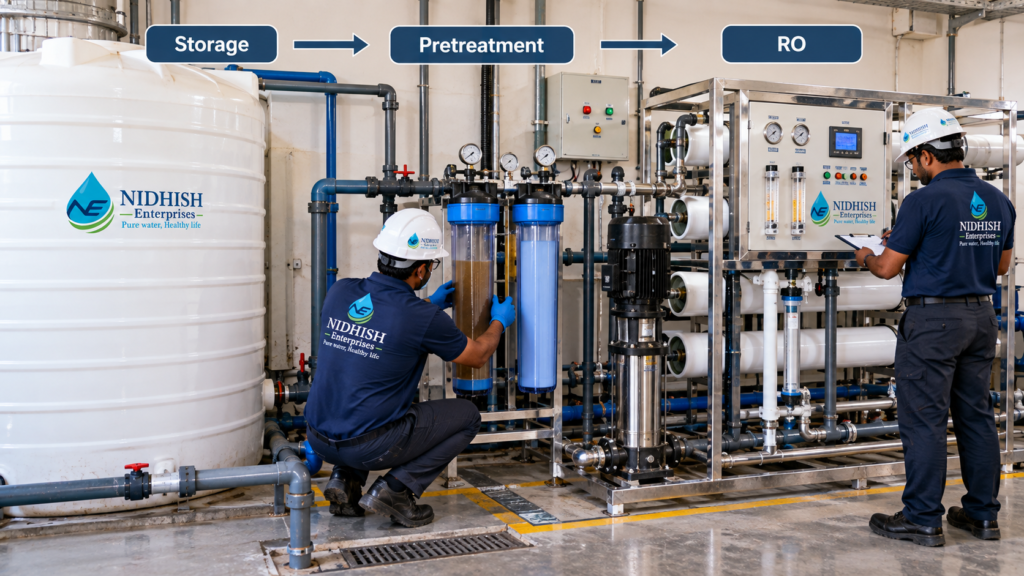
A properly managed water system connects storage, pretreatment, and RO purification, helping businesses maintain more consistent water quality and system performance.
7. Tank Cleaning Is Not a Substitute for Water Treatment
This distinction is especially important.
Cleaning removes physical contamination and deposits from the tank. It does not automatically correct every problem with the incoming water.
For example, tank cleaning alone may not solve issues involving:
- High dissolved solids
- Hardness
- Specific chemical contaminants
- Microbiological contamination in the source
- Poor plumbing
- Inappropriate treatment design
- Contamination occurring after the tank
Likewise, water treatment equipment should be selected according to actual water conditions and intended use.
A TDS reading alone does not provide a complete picture of water quality.
Therefore, businesses experiencing repeated water-quality problems should consider testing relevant parameters rather than replacing filters or adding treatment equipment without diagnosis.
8. Signs Your Commercial Water Tank May Need Attention
Some visible or operational changes can indicate that a tank should be inspected.
For example, you may notice sediment during tank inspection or particles appearing in supplied water.
Water may also develop an unusual colour, taste, or odour.
In other cases, maintenance staff may discover a damaged lid, unprotected opening, visible deposits, algae-like growth, insects around access points, or signs that outside material can enter the tank.
Still, these signs should be treated as indicators, not diagnoses.
An unusual smell can have several possible causes. Similarly, cloudy water does not identify the exact problem by itself.
Professional inspection can help determine whether the issue comes from the tank, incoming supply, plumbing, treatment system, or another part of the water network.
9. How Often Should Commercial Water Storage Tank Cleaning Be Done?
There is no single cleaning interval that suits every commercial property.
The appropriate frequency can depend on:
- Water source
- Tank capacity
- Daily consumption
- Tank construction
- Incoming water quality
- Sediment accumulation
- Previous inspection findings
- Building usage
- Local conditions
- Applicable standards or operational requirements
A busy commercial facility with substantial water demand may have different maintenance needs from a small office.
Similarly, a tank receiving water with frequent sediment may need a different inspection approach from a tank supplied by relatively consistent treated water.
Therefore, businesses should avoid relying on a universal statement such as “every tank must be cleaned after exactly X months” without considering the actual system.
Instead, create a maintenance schedule based on inspection history, water conditions, operational requirements, and professional guidance.
10. What Professional Water Storage Tank Cleaning Should Consider
Commercial tank cleaning should involve more than simply draining the tank and rinsing it quickly.
The exact procedure will depend on the tank and application. However, a professional approach should first consider safe access and the condition of the tank.
Where applicable, the process may include draining, removal of accumulated material, cleaning of accessible internal surfaces, appropriate disinfection procedures, rinsing, inspection, and safe restoration of the system.
Any cleaning or disinfection chemicals must be suitable for the intended application and used correctly.
Worker safety also matters.
Large tanks, underground tanks, or restricted-access spaces may create serious occupational hazards. Businesses should not send untrained staff into confined or potentially hazardous spaces simply to reduce maintenance costs.
Professional teams should follow appropriate safety procedures for the specific tank and site.
11. Water Quality Testing Can Support Better Decisions
Visual inspection provides useful information, but it cannot measure everything.
That is where water testing becomes valuable.
Depending on the intended use and concern, testing can help assess relevant physical, chemical, or microbiological parameters.
For drinking-water applications in India, businesses can also refer to applicable Bureau of Indian Standards information and consult qualified testing professionals.
The official Bureau of Indian Standards is the appropriate starting point for current Indian standards information.
Testing becomes particularly useful when a facility experiences repeated issues even after cleaning.
For example, if unusual odour repeatedly returns, the source may not be the storage tank alone.
Similarly, rapid sediment accumulation may justify investigating incoming water conditions.
Instead of repeatedly treating the symptom, businesses can use inspection and testing to understand the wider system.
12. Water Storage Tank Cleaning as Preventive Maintenance
Reactive maintenance usually begins after someone complains.
Perhaps water looks dirty. A purifier shows reduced performance. Staff notice an unusual smell. Alternatively, a large deposit is discovered during an unrelated repair.
A preventive approach works differently.
Businesses can maintain records of tank inspections, cleaning activities, water-quality observations, testing where appropriate, and downstream treatment servicing.
As a result, the maintenance team gets a clearer history of the system.
This does not guarantee that water-quality or equipment problems will never occur.
However, structured maintenance can make it easier to identify developing issues and respond before they become larger operational problems.
For businesses using commercial purification equipment, internally link:
5 Signs Your Commercial Water Purifier Needs Professional Servicing
Suggested anchor: signs your commercial water purifier needs servicing
13. Common Commercial Water Tank Maintenance Mistakes
One common mistake is waiting until the water visibly looks dirty.
Appearance alone cannot provide a complete water-quality assessment.
Another mistake is cleaning the tank while ignoring its lid, vents, overflow arrangements, surrounding area, or structural condition.
Similarly, some facilities focus entirely on their RO system and forget that the feed water may first spend hours inside a storage tank.
Using random chemicals without proper procedure is another poor approach.
Businesses should also avoid assuming that a freshly cleaned tank automatically means safe drinking water throughout the building. Plumbing, source water, treatment equipment, and points of use can all influence final water quality.
Finally, maintenance should be documented.
A simple record of inspection dates, cleaning, observations, tests, and repairs can support more consistent water management.
14. Why Businesses Should Look at the Complete Water System
Commercial water quality should be approached as a system rather than a collection of isolated machines.
Consider the complete journey:
Source Water → Storage → Pretreatment → Purification → Distribution → Point of Use
A problem at any stage can affect the next stage.
For example, repeated sediment entering a tank may point towards an upstream issue. Poor tank maintenance may affect downstream equipment. Meanwhile, poorly maintained plumbing after treatment can create a different problem.
Therefore, buying a larger RO system is not automatically the solution to every water-quality complaint.
The better approach starts with understanding the source water, usage requirement, storage conditions, treatment system, and distribution network.
You can internally link:
RO vs UV vs UF Water Purification: Which Technology Is Right for Your Water?
Suggested anchor: choose the right water purification technology
15. How Nidhish Enterprises Can Help
Commercial properties often have different water requirements depending on their source water, daily demand, storage capacity, and intended use.
Nidhish Enterprises can help businesses assess their water-treatment and maintenance requirements, including commercial RO systems and related water solutions.
Instead of treating every water problem as the same issue, the first step should be understanding the existing system.
That may include reviewing water source, storage conditions, treatment equipment, operating symptoms, and water usage.
Where necessary, appropriate testing can provide additional information before recommending changes.
This practical approach can help businesses avoid unnecessary component replacement and choose maintenance or treatment based on actual requirements.
Final Thoughts
Water Storage Tank Cleaning is an important part of commercial water management because the condition of stored water can influence downstream water quality and treatment-system performance.
Sediment, deposits, poor tank protection, and inadequate maintenance can create avoidable problems. However, tank cleaning should not be treated as a complete solution to every water-quality concern.
Businesses should look at the full water journey—from the original source and storage tank to treatment equipment, plumbing, and final point of use.
Regular inspection, appropriate cleaning, professional maintenance, and relevant water testing can support better decisions.
Ultimately, a clean tank works best as one part of a properly managed commercial water system.
Frequently Asked Questions
About the Author
Nidhish Enterprises – Pure Water, Healthy Life provides domestic, commercial, and industrial water purification solutions. The team helps customers understand water conditions, system requirements, RO maintenance, and suitable treatment approaches based on practical needs rather than a one-size-fits-all solution.
This article provides general educational information. Water conditions and treatment requirements vary by source, location, intended use, system design, and applicable standards. Where drinking-water safety or contamination is a concern, appropriate professional assessment and laboratory testing should be considered.