
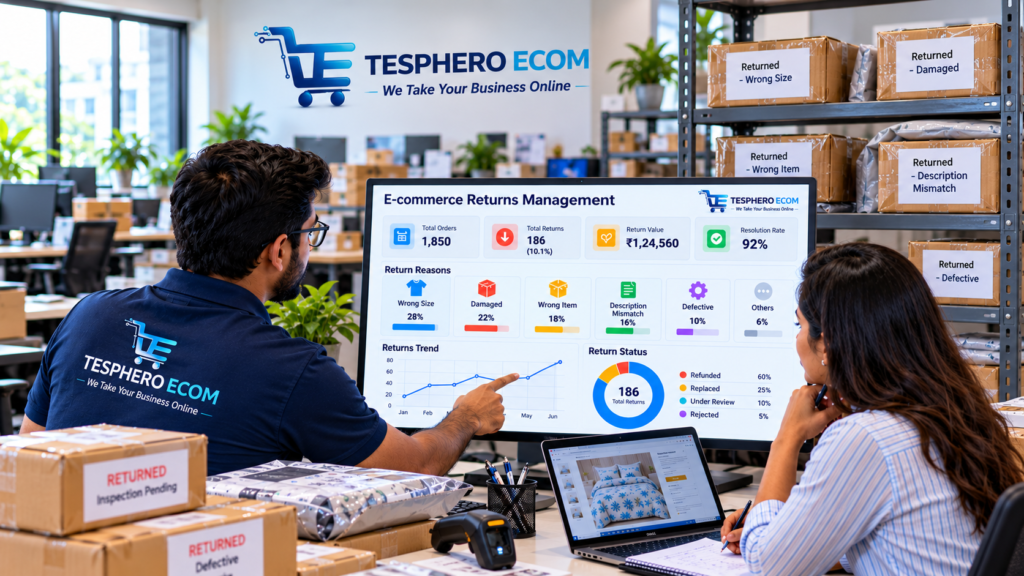
Tracking return reasons and product-level patterns can help e-commerce sellers identify preventable issues and improve their returns management process.
E-commerce Returns Management is an important part of running a successful online business because every return can affect inventory, fulfilment costs, customer experience, and operational efficiency. Returns cannot always be avoided. However, sellers can reduce many preventable returns by improving product information, order accuracy, packaging, quality checks, and customer communication.
However, a good returns process is not simply about accepting or rejecting requests. Instead, sellers need to understand why products are returned, which problems they can control, and how to handle returned inventory.
For growing e-commerce businesses, this becomes even more important as order volumes increase.
Table of Contents
- Additionally, What is E-commerce Returns Management?
- Why Customers Return Products in E-commerce Returns Management
- How Returns Affect an E-commerce Business
- Improve Product Listings to Reduce Returns
- Use Accurate Product Images and Descriptions
- Improve Product Quality Checks
- Reduce Picking and Packing Errors
- Use Packaging Suitable for the Product
- Why Clear Policies Matter in E-commerce Returns Management
- Analyze Return Reasons and Patterns
- Handle Returned Inventory Efficiently
- Build a Better Post-Purchase Experience
- Common Returns Management Mistakes
- How Tesphero Ecom Can Help
- FAQs
1. What Is E-commerce Returns Management?
E-commerce Returns Management refers to the process a seller uses to manage products that customers want to return after an online purchase.
The process can involve several steps.
A customer may first submit a return request. The seller or marketplace then reviews the request according to the applicable return policy. After that, the product may travel back through the logistics network.
Once received, the returned item may need inspection, classification, inventory updates, and further action.
Depending on its condition and the applicable platform or business process, an item may potentially return to syllable inventory, require repackaging, need repair, or be treated differently.
Therefore, returns management involves much more than refunds.
Additionally, it connects customer service, logistics, inventory, product quality, listings, and fulfilment.
2. Why Do Customers Return E-commerce Products?
Before trying to reduce returns, sellers should understand why they happen.
Return reasons vary significantly between categories and businesses. Still, several common situations can contribute to returns.
For example:
- Product does not match the description
- Size or dimensions do not meet expectations
- Wrong colour or variant arrives
- Product gets damaged during transit
- Incorrect item is packed
- Product has a defect
- Customer expectations differ from the actual product
- Important product information was unclear before purchase
- Parts or accessories are missing
- Customer changes their mind, where the applicable policy permits a return
Not every reason is under the seller’s direct control.
However, sellers should separate preventable returns from returns that are difficult to influence.
This makes improvement efforts more practical.
3. How Poor E-commerce Returns Management Can Affect Sellers
A return can create more work than the original order.
The product may need reverse shipping, inspection, repackaging, inventory adjustment, customer communication, and possibly replacement or refund processing depending on the applicable policy.
In addition, returned inventory may not always come back in the same condition in which it was originally dispatched.
As a result, repeated returns can create operational pressure.
They may also reveal deeper problems.
For example, if customers repeatedly return one product because its dimensions are different from what they expected, the issue may be the listing rather than the product itself.
Similarly, repeated “wrong item received” returns may indicate a fulfilment problem.
Therefore, return data can provide useful business feedback.
4. Improve Product Listings to Reduce E-commerce Returns
A customer cannot physically examine an online product before ordering it.
Your listing must fill that information gap.
Start by making important details easy to understand.
Depending on the product, this can include:
- Dimensions
- Material
- Colour
- Capacity
- Compatibility
- Quantity
- Package contents
- Size information
- Usage
- Important limitations
- Care instructions
Do not hide important information inside long paragraphs.
Instead, make essential specifications easy to scan.
For example, if a storage box has a 20-litre capacity, clearly mention the capacity and dimensions rather than expecting customers to judge size from the image.
The goal should not be to make the product sound perfect.
The goal should be to help the right customer understand the actual product.
Your Product Is Good, But Is Your Listing Selling It? 8 Ways to Improve Product Listings
5. Accurate Images Can Support E-commerce Returns Management
Product images strongly influence customer expectations.
If images create an inaccurate impression of size, colour, finish, quantity, or usage, customers may receive something different from what they imagined.
Therefore, use images that explain the product rather than simply decorate the listing.
Depending on the category, useful images may show:
Multiple angles: Show front, back, side, top, and relevant details.
Scale: Show dimensions or provide a realistic size reference.
Important features: Highlight features customers should understand before ordering.
Package contents: Clearly show what customers actually receive.
Usage context: Demonstrate how the product is intended to be used where appropriate.
Avoid editing images so heavily that the actual product looks materially different.
How Product Images and Descriptions Influence Online Buying Decisions
Better expectations before purchase can help reduce avoidable disappointment after delivery.
6. Use Clear and Accurate Product Descriptions
Images attract attention, but descriptions provide context.
A good description should answer practical questions customers may have before ordering.
For example:
What is the product made from?
Who is it intended for?
What are its important dimensions?
What does the package contain?
Are there compatibility requirements?
Does the product require assembly?
What should customers not expect from it?
That final question is often overlooked.
Sellers sometimes focus only on benefits. However, clearly explaining relevant limitations can prevent the wrong customer from purchasing the product.
For example, if an accessory works only with specific models, state that clearly.
Similarly, if a product is sold as a single piece while the lifestyle image contains multiple objects, clarify exactly what is included.
Accuracy can be more valuable than exaggerated marketing.
7. Product Quality Checks Can Help Reduce Returns
A good listing cannot compensate for inconsistent product quality.
Therefore, sellers should also review their quality-control process.
Before inventory enters fulfilment, check relevant aspects such as:
- Visible defects
- Correct variant
- Colour
- Size
- Components
- Accessories
- Packaging condition
- Labeling
- Product functionality where appropriate
The exact checks depend on the category.
For example, an apparel seller may focus on size, stitching, colour, and labeling.
An electronics seller may require different checks.
Meanwhile, a home-product seller may need to pay more attention to dimensions, finish, breakage, or missing parts.
A simple documented checklist can make quality control more consistent as order volume grows.
8. Order Accuracy Matters in E-commerce Returns Management
Sometimes the customer selected the correct product, but the wrong product was dispatched.
This is an operational return.
For businesses handling multiple SKUs, colours, sizes, or similar-looking variants, picking errors can become more common without a clear system.
Consider using SKU-based identification and bar-code or scanning workflows where suitable.
Also, organize inventory so similar variants are easy for fulfilment staff to distinguish.
Before sealing a package, verify key details such as:
SKU → Variant → Quantity → Product Condition → Shipping Label
This small verification step can prevent avoidable errors.
As the business grows, relying only on memory becomes increasingly risky.
A repeatable fulfilment process usually scales better.
9. Packaging Can Reduce Damage-Related Returns
The customer’s experience is not determined only by what happens inside your warehouse.
The product also has to survive transportation.
Therefore, packaging should match the characteristics of the item.
A fragile product may require cushioning and movement control. A liquid product may need appropriate leak protection. Meanwhile, an item with a delicate surface may need protection from scratches.
At the same time, excessive packaging is not automatically better.
The objective is to provide appropriate protection for the product and distribution environment.
Sellers can review damage-related return reasons to understand whether packaging needs improvement.
If the same item repeatedly arrives damaged in a similar way, investigate how it is packed, handled, and transported.
This connects directly with your existing fulfilment content.
How Packaging and Order Fulfilment Can Influence the E-commerce Customer Experience
10. Keep Return Information Clear for Customers
Reducing unnecessary returns should not mean making legitimate returns unnecessarily difficult.
Customers should understand the applicable return process before purchasing.
For marketplace sellers, return conditions can depend on the platform, category, product, seller arrangement, and current marketplace policies.
Therefore, sellers should regularly review the rules that apply to their products.
For sellers using Amazon India, the official seller resources are available through Amazon India Seller Central resources.
If you operate your own website, clearly communicate relevant return conditions and processes to customers.
Avoid vague wording.
Customers should be able to understand what they need to do when a genuine return issue occurs.
Clear expectations can reduce unnecessary confusion for both the customer and support team.
11. Analyze Return Reasons Instead of Only Processing Returns
This is one of the most useful parts of E-commerce Returns Management.
Do not simply close a return after processing it.
Record why it happened.
For example, create categories such as:
- Wrong size
- Wrong item
- Damaged in transit
- Defective product
- Description mismatch
- Colour expectation
- Missing component
- Compatibility issue
- Customer preference
- Other
Then review the data periodically.
Suppose one SKU receives 200 orders and generates significantly more “size smaller than expected” complaints than comparable products.
That is useful information.
You can investigate the listing dimensions, product photographs, size guide, packaging, and customer feedback.
Similarly, repeated transit damage may point towards a packaging or logistics issue.
Return data should therefore become an input for business improvement.
12. Look for Patterns at SKU Level
Overall return numbers can hide important details.
Instead, review returns at the product or SKU level.
Imagine that your store sells 50 products.
Most products may have relatively few returns, while three products account for a large share of preventable problems.
If you only look at the total number, you may miss this pattern.
Therefore, ask:
Which products are returned most often?
What reasons appear repeatedly?
Which variants generate problems?
Did returns increase after a supplier or packaging change?
Are customers repeatedly misunderstanding the same feature?
Do certain products generate both returns and similar customer questions?
These observations can help sellers decide where to act first.
13. Handle Returned Inventory Carefully
Once an item returns, it should not automatically go back into syllable inventory.
First, inspect its condition.
A returned product may be:
- Unopened and potentially syllable
- Opened but otherwise in suitable condition
- Missing packaging
- Missing accessories
- Damaged
- Defective
- Used
- Unsuitable for resale
The appropriate action depends on the product, condition, platform requirements, hygiene considerations, applicable policies, and business processes.
Therefore, businesses should define clear return-inspection categories.
This becomes especially important when order volumes increase.
Without a structured process, returned stock can remain untracked in a warehouse or accidentally mix with fresh inventory.
That creates another source of fulfilment errors.
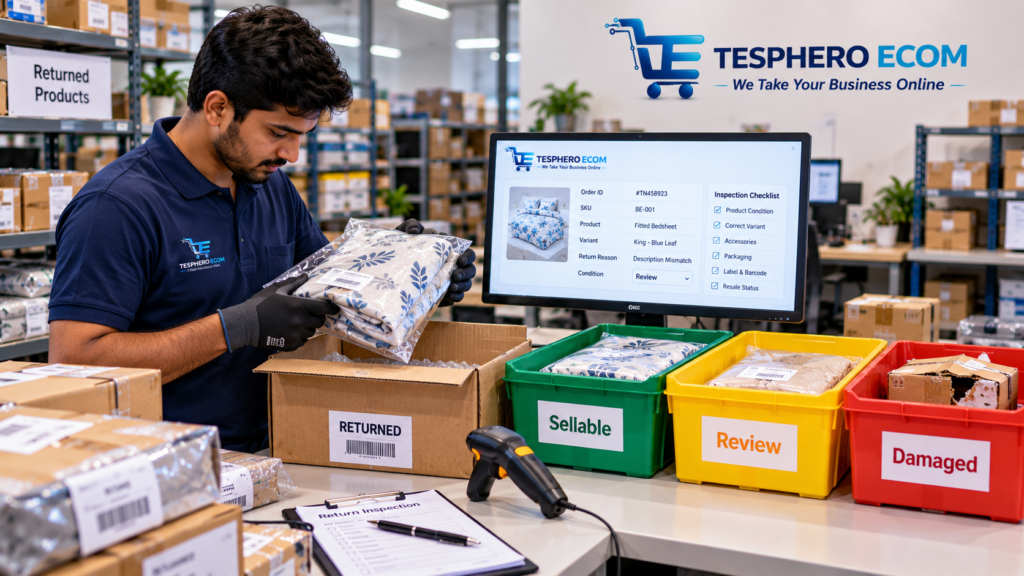
Inspecting returned products before updating inventory helps sellers separate sellable, review, and damaged items while maintaining better stock accuracy.
14. Connect Returns With Inventory Management
Returns and inventory should not operate as completely separate processes.
When a returned item arrives, the inventory status should reflect what actually happened.
For example, an item awaiting inspection should not necessarily appear as immediately available stock.
Likewise, damaged units should not accidentally return to the syllable inventory count.
A simple workflow might look like:
Return Received → Inspection → Condition Classification → Inventory Decision → Appropriate Next Action
This gives the operations team better visibility.
It can also reduce situations where a customer orders an item that appears available in the system but is actually sitting in the returns area waiting for inspection.
E-commerce Inventory Management: How to Prevent Stock Issues as Your Business Grows
15. Improve the Post-Purchase Customer Experience
Returns management is also part of the customer journey.
Customers may already be disappointed when they request a return.
Confusing communication can make the experience worse.
Therefore, where the seller controls the process, provide clear information about what happens next.
Customers may need to know whether they need to package the item, when pickup is expected, what information is required, and what the next step will be under the applicable policy.
Avoid making customers contact support repeatedly for basic updates.
At the same time, sellers should not promise refund, replacement, or pickup timelines that they cannot control.
On marketplaces, parts of the process may be governed by platform and logistics policies.
Clear communication is better than unrealistic promises.
16. Use Customer Feedback to Prevent Future Returns
Customer complaints can reveal information that internal teams miss.
For example, multiple buyers may say:
“The size looked bigger in the images.”
“The connector does not fit my model.”
“I thought two pieces were included.”
“The colour is different from what I expected.”
“The assembly instructions were unclear.”
Each comment provides a clue.
Instead of treating these messages only as customer-service problems, feed useful insights back into the listing and operations teams.
Update unclear images.
Improve specifications.
Clarify package contents.
Add compatibility details.
Improve instructions.
As a result, future customers receive better information before purchasing.
This creates a useful cycle:
Customer Feedback → Identify Problem → Improve Listing or Process → Monitor Future Returns
17. Common E-commerce Returns Management Mistakes
One mistake is treating every return as unavoidable.
Some are unavoidable, but repeated patterns often deserve investigation.
Another mistake is blaming customers before reviewing the listing, product quality, or fulfilment process.
Sellers should also avoid making product images more attractive at the expense of accuracy.
Similarly, weak inventory control can cause returned products to be incorrectly restocked.
Another common problem is changing several things at once without measuring the result.
For example, if you change the product, listing, packaging, and supplier simultaneously, it becomes harder to understand what actually improved the situation.
Instead, identify the likely cause and make targeted improvements.
Finally, do not judge performance from a handful of orders. Look for meaningful patterns over an appropriate period and order volume.
18. Build a Simple Returns Improvement Process
A complicated system is not always necessary.
Sellers can start with a simple five-step process:
Step 1: Record the reason.
Capture a useful reason for each return.
Step 2: Group the data.
Review returns by SKU, variant, reason, and relevant time period.
Step 3: Identify preventable problems.
Separate operational issues from returns that are harder to control.
Step 4: Take targeted action.
Improve the listing, product, packaging, quality control, or fulfilment process depending on the likely cause.
Step 5: Measure again.
Check whether the same return reason decreases after the change.
This turns returns from a purely reactive problem into a source of operational learning.
19. How Tesphero Ecom Can Help
Growing an e-commerce business requires more than uploading products to a marketplace.
Product listings, images, inventory, fulfilment, customer experience, and operational processes all influence how efficiently a seller can grow.
Tesphero Ecom helps businesses strengthen their e-commerce presence with a practical focus on marketplace operations, product presentation, listings, and scalable online selling processes.
For returns, the first step should be understanding where the problem occurs.
Is the listing creating the wrong expectation?
Is the product frequently damaged?
Are incorrect variants being dispatched?
Is the return concentrated around specific SKUs?
Once sellers identify the pattern, they can focus on improvements that address the actual issue rather than making random changes.
Final Thoughts
E-commerce Returns Management should not be viewed only as a process that starts after a customer sends a product back.
Effective returns management begins much earlier.
Accurate product listings can set better expectations. Clear images can explain size and features. Quality checks can identify defects before dispatch. Better fulfilment processes can reduce incorrect orders. Appropriate packaging can help protect products during transportation.
Then, when a return does happen, sellers should record the reason, inspect the returned item, update inventory correctly, and use the information to improve future orders.
You may never eliminate every return.
However, by understanding why returns happen and addressing preventable causes, sellers can build a more organised and customer-focused e-commerce operation.
Frequently Asked Questions
About the Author
Tesphero Ecom – We Take Your Business Online helps businesses build and strengthen their e-commerce presence through marketplace support, product listing optimisation, product presentation, inventory planning, and practical online-selling strategies.
Our content focuses on helping sellers understand the operational side of e-commerce so they can make better decisions as their business grows.