
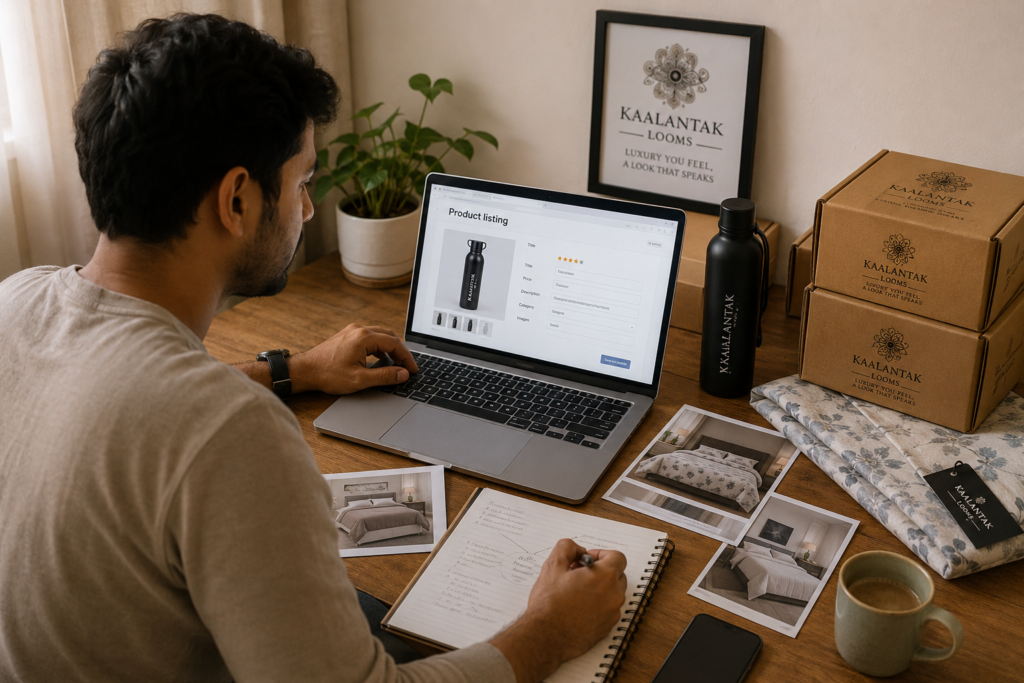
A good product needs a listing that communicates its value clearly.
Your Product May Not Be the Problem
You have a good product.
The quality is right. The packaging is decent. The price is competitive. You may even have a product that customers genuinely like.
But still, sales aren’t coming in as expected.
So, what’s going wrong?
In many cases, the problem isn’t the product. It’s the product listing.
When customers shop on Amazon, Flipkart, Meesho, or another online marketplace, they cannot physically touch your product, check its material, or speak to a salesperson. They make their decision based on what they see on the screen.
Your product images, title, description, specifications, pricing, and reviews together create the first impression.
And that first impression has to do a lot of work.
A customer may see dozens of similar products within seconds. If your listing doesn’t clearly explain why your product is worth considering, they can simply scroll past it.
That’s why product listing optimization is not just about adding keywords. It’s about presenting the right information in a way that helps customers understand the product and feel confident about buying it.
In this blog, we’ll look at 8 practical ways to improve product listings and turn them into a stronger part of your e-commerce strategy.
1. Write a Product Title That Actually Helps the Customer
Your product title is one of the first things a customer notices.
A weak title may simply say:
“Premium Cotton Bedsheet”
It sounds fine, but it doesn’t tell the customer much.
A stronger title could communicate important information such as the product type, material, size, design, or key feature.
For example:
“Premium Cotton Double Bedsheet – King Size, Floral Print, Soft & Breathable Fabric”
The second title gives the customer a much clearer idea of what they’re looking at.
However, don’t try to put every possible keyword into the title.
A title filled with repeated keywords can look unnatural and may make the product harder to understand.
Instead, focus on the information a customer would genuinely want to know.
Think about:
- What is the product?
- Who is it for?
- What is its key feature?
- What size or variant is available?
- What makes it different?
Your title should be clear first and optimized second.
2. Your Main Product Image Has One Job: Stop the Scroll
Online shoppers don’t read every listing.
They scan.
That’s why your main product image is extremely important.
If the image is dark, cluttered, poorly cropped, or difficult to understand, customers may move on before reading anything else.
A strong product image should immediately answer:
“What am I looking at?”
Use clear, high-quality photography that shows the product properly.
Depending on the marketplace and product category, consider using:
- Clean product photography
- Appropriate background
- Multiple angles
- Close-up details
- Size or dimension visuals
- Product-in-use images
- Lifestyle photography
For example, if you’re selling a bedsheet, showing only a folded bedsheet may not communicate its actual appearance.
A well-shot lifestyle image showing the bedsheet on a properly made bed can help the customer visualise how the product may look in their own home.
The goal isn’t to make the image look expensive.
The goal is to make the product easy to understand.
3. Use Images to Answer Customer Questions
Your product images shouldn’t only make the product look attractive.
They should also reduce uncertainty.
Think about the questions customers normally ask before purchasing.
For example:
“What size is it?”
“What material is used?”
“How does the product look from the side?”
“What exactly will I receive?”
“How does it look when actually used?”
Your image set can answer many of these questions before the customer even reaches the description.
A good image sequence might include:
- Main product image
- Product from another angle
- Key features
- Size or dimensions
- Material or close-up detail
- Lifestyle/use-case image
- Packaging or what’s included
This can make the listing more informative without making the customer read a long paragraph.
The Difference Between Showing a Product and Selling It
This is where many sellers struggle.
They upload photographs, add a few specifications, and assume the listing is complete.
But an effective listing does more than show the product.
It explains:
What is it?
Why should I care?
What problem does it solve?
Why should I choose this one instead of another product?
That’s the difference between simply uploading a product and actually building a marketplace listing designed to support conversions.
A good product deserves a good presentation.
Make Your Listing Easier to Understand—and Easier to Buy
Getting a customer to stop scrolling is only the first step. Once they open your listing, the next challenge is convincing them that your product is worth buying.
This is where your product description, bullet points, specifications, and keywords become important.
A customer shouldn’t have to work hard to understand what you’re selling.
4. Focus on Benefits, Not Just Features
One of the most common listing mistakes is simply listing product features without explaining why they matter.
For example:
100% Cotton Fabric
180 GSM
Machine Washable
These details are useful, but they don’t tell the customer what they gain from them.
A better approach is to connect the feature with a practical benefit:
Soft Cotton Fabric – Designed for comfortable everyday use and easy maintenance.
The difference is small, but the second version speaks more directly to the buyer.
When writing your product description, ask:
“What does this feature mean for the customer?”
If your product has a durable material, explain how it helps with everyday use.
If it is lightweight, explain why that makes the product convenient.
If it is easy to clean, explain how it saves effort.
Features provide information. Benefits give customers a reason to care.
5. Make Your Bullet Points Easy to Scan
Most online shoppers don’t read a product description from beginning to end.
They scan.
That’s why bullet points can be extremely useful.
Instead of writing long paragraphs, use short points to highlight the information customers are most likely to look for.
For example:
- Soft & Breathable Fabric: Comfortable for regular use.
- King Size: Suitable for standard king-size beds.
- Easy Maintenance: Designed for convenient everyday care.
- Colour & Design: Modern pattern suitable for contemporary interiors.
The exact format will depend on the product and marketplace, but the principle remains the same.
Each bullet should communicate one clear idea.
Avoid filling bullets with unnecessary adjectives such as “best,” “amazing,” “premium,” or “No.1” unless they are genuinely supported and appropriate.
Clear information builds more trust than exaggerated claims.
6. Use Keywords Naturally
Keywords matter because customers need to find your product.
If someone searches for cotton bedsheet, wireless keyboard, kitchen storage box, or another specific product, your listing needs relevant terms that match what people actually search for.
But keyword optimisation doesn’t mean repeating the same phrase everywhere.
For example, writing:
Cotton bedsheet, best cotton bedsheet, premium cotton bedsheet, cotton bedsheet online…
doesn’t make a listing better.
It makes it harder to read.
Instead, use relevant keywords naturally across appropriate parts of the listing, such as:
- Product title
- Bullet points
- Description
- Relevant specifications
- Search terms or marketplace fields, where applicable
Start with the language your customer would naturally use.
If your buyer calls something a “storage box,” don’t suddenly describe it using complicated terminology simply because it sounds more technical.
Good SEO helps customers find your product. Good copy helps them understand it. You need both.
7. Complete Your Product Specifications Properly
A customer may be interested in your product but still leave the listing because important information is missing.
Specifications help remove that uncertainty.
Depending on your product category, customers may want to know:
- Size
- Material
- Colour
- Weight
- Dimensions
- Capacity
- Compatibility
- Quantity
- Package contents
- Care instructions
For example, if you’re selling a storage container, saying “large capacity“ isn’t very helpful.
Providing the actual dimensions or capacity gives the customer something they can compare with their needs.
This is particularly important online because customers cannot physically examine the product before buying it.
The more important questions your listing answers upfront, the fewer reasons a customer has to leave and search elsewhere.
Don’t Hide Important Information
A good listing isn’t designed to make the product look perfect.
It’s designed to help the right customer make an informed decision.
If a product has a specific size limitation, compatibility requirement, or care instruction, make it clear.
This can actually improve the customer experience.
Why?
Because the customer knows what they’re buying.
It can also help reduce avoidable returns caused by misunderstandings.
For example, if a product is smaller than customers might expect from the photographs, clearly mentioning its dimensions can prevent confusion.
Clarity before purchase can save both the seller and the customer trouble later.
8. Look at Pricing From the Customer’s Perspective
Price is obviously important, but the lowest price doesn’t always win.
Customers don’t compare numbers in isolation.
They compare value.
Suppose two sellers offer similar products. One costs ₹499 and the other ₹549.
If the ₹549 listing has better images, clearer information, stronger presentation, and better reviews, some customers may still consider it the better option.
That’s why your listing should communicate what the customer is getting for the price.
Consider the complete value proposition:
Product quality + features + presentation + customer confidence + price
At the same time, don’t use your listing to make unrealistic claims simply to justify a higher price.
Your pricing should make sense alongside your product quality, costs, marketplace fees, and overall business strategy.
The goal isn’t always to become the cheapest seller.
The goal is to become a product customers feel is worth buying.
A Listing Should Answer the Customer’s Questions Before They Ask
Before publishing a listing, look at it as if you’re seeing the product for the first time.
Ask yourself:
- Do I understand exactly what this product is?
- Can I tell its size and important specifications?
- Do the images show the product clearly?
- Do I understand its main benefits?
- Is the price easy to evaluate?
- Is anything important missing?
- Would I feel confident ordering it?
If you have to guess the answer to any of these questions, the listing probably needs another round of improvement.
A Good Listing Needs Continuous Improvement
Publishing a product listing is not the finish line. In a competitive marketplace, listings need to be reviewed and improved based on how customers respond.
A product may have strong potential, but if customers aren’t clicking, adding it to their cart, or completing the purchase, something may need to change.
Use Customer Reviews as a Source of Improvement
Reviews aren’t only for building trust. They can also tell you what customers actually think about your product.
Read both positive and negative reviews carefully.
Look for repeated comments such as:
- Product size was different from expectations
- Colour looked different in reality
- Packaging could be improved
- Instructions were unclear
- Product quality was appreciated
- A particular feature was especially useful
These observations can help you improve your listing.
For example, if multiple customers mention that the product is smaller than expected, your listing may need clearer dimensions or a size-reference image.
If customers repeatedly praise a particular feature, consider highlighting it more prominently.
Your customers can tell you what your listing needs to communicate better.
Compare Your Listing With Competitors
Your product shouldn’t be evaluated in isolation.
Search for similar products on the marketplace and look at how competing sellers present themselves.
Compare:
- Product images
- Titles
- Pricing
- Number of images
- Product descriptions
- Bullet points
- Specifications
- Reviews
- Overall presentation
This doesn’t mean copying another seller.
Instead, look for gaps.
Maybe competitors have attractive images but poor product information. Maybe their listings are detailed but difficult to read. Perhaps your product has a stronger feature that isn’t being highlighted properly.
That’s where an opportunity can exist.
Don’t ask only, “What are competitors doing?” Ask, “What are they missing?”
Don’t Set and Forget Your Product Listing
One of the biggest mistakes sellers make is uploading a product once and never looking at it again.
Marketplace performance can change.
Customer preferences change. Competition changes. New products enter the market. Pricing changes.
Your listing may need updates accordingly.
If a product isn’t getting enough clicks, review the main image and title.
If it gets clicks but very few purchases, examine the product page, pricing, images, reviews, and overall value proposition.
If customers are asking the same questions repeatedly, add that information to the listing.
Small improvements can sometimes make a meaningful difference.
A strong listing is only one part of building a sustainable online business. You can also read our previous guide on building a successful e-commerce business to understand the bigger picture.
Track What Is Actually Working
A good marketplace seller shouldn’t rely entirely on guesswork.
Where marketplace analytics are available, pay attention to useful performance indicators such as:
- Product views
- Click-through behaviour
- Conversion rate
- Orders
- Returns
- Customer feedback
- Advertising performance
These numbers can help you understand where the problem may be.
For example:
High visibility + low conversion may suggest that the listing isn’t convincing enough.
Low visibility + strong conversion may indicate that the product performs well when customers find it, but needs better visibility.
Of course, performance can be affected by many factors, including competition, pricing, reviews, advertising, and marketplace demand.
That’s why analytics should be used as a guide—not as a single answer.
As India’s digital commerce ecosystem continues to evolve, sellers can also explore the official ONDC platform to understand the broader opportunities emerging beyond traditional marketplaces.
Avoid These Common Product Listing Mistakes
Even a good product can struggle because of simple listing mistakes.
Poor-Quality Images
Customers shouldn’t have to zoom in repeatedly to understand the product.
Overloaded Titles
Adding too many keywords can make the title confusing and difficult to read.
Generic Descriptions
A description that could belong to any competitor doesn’t give customers a reason to choose your product.
Missing Specifications
Important information such as size, material, or compatibility should be easy to find.
Exaggerated Claims
Overpromising may attract an initial purchase but can damage customer trust and increase dissatisfaction.
Ignoring Reviews
Reviews can reveal valuable information about both the product and the listing.
Never Updating the Listing
Your first version doesn’t have to be your final version.
How Tesphero Ecom Can Help
Creating a marketplace listing may look simple—upload images, write a title, add a description, and publish.
But building a listing that supports visibility, customer confidence, and conversions requires a more strategic approach.
At Tesphero Ecom, we help businesses prepare and improve their marketplace presence through services such as:
- Seller Account Setup
- Product Listing & Optimization
- Marketplace Strategy
- Product Selection Guidance
- Branding & Growth Consulting
Our approach is not just about putting products online.
We look at how the product is presented, who the target customer is, how competitors are positioned, and what can be improved across the marketplace journey.
For businesses starting their online selling journey, this can make the process more structured and easier to manage.
And for existing sellers, improving listings can be a practical place to start when sales aren’t matching the quality of the product.
Have a product that isn’t getting the results you expected? ContactUs to discuss your marketplace requirements.
Final Thoughts
A good product deserves more than a basic marketplace listing.
Your product title should make sense. Your images should create clarity. Your description should explain benefits. Your specifications should answer questions. Your pricing should communicate value.
And once the listing is live, don’t simply leave it untouched.
Watch customer behaviour. Read reviews. Study competitors. Check performance and keep improving.
Because online, your listing is often your salesperson.
It has to introduce the product, explain its value, and build enough confidence for the customer to take the next step—all without a salesperson standing beside them.
So before asking, “Why isn’t my product selling?“, take another look at the listing.
The product may be good.
Maybe it just isn’t being presented well enough.
Frequently Asked Questions
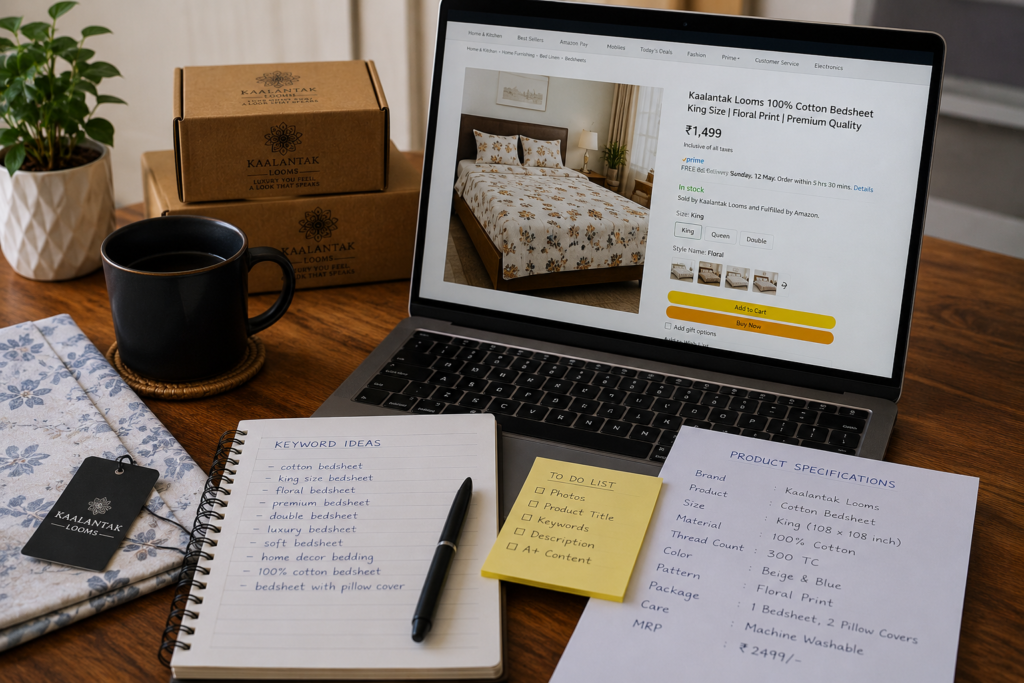
A listing should evolve with customer feedback and marketplace performance.