
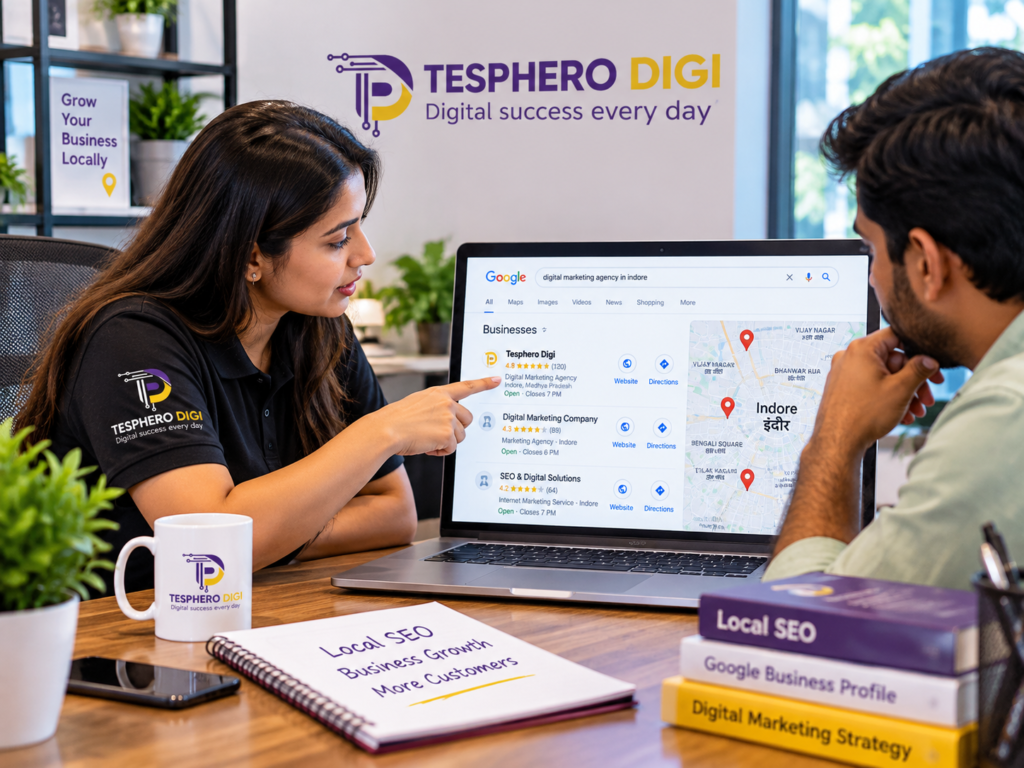
Improving local search visibility through Google Business Profile, relevant keywords and accurate business information can help small businesses reach nearby customers.
Local SEO for Small Businesses helps local companies improve their visibility on Google Search and Google Maps. When nearby customers search for relevant products or services, a strong local presence can make a business easier to discover. For example, an Indore-based business may want to reach people searching for services in their area. Therefore, accurate business information, useful website content, and a well-maintained Google Business Profile are important starting points.
For example, someone searching for “digital marketing agency in Indore” or “RO service near me” is often looking for a business that serves a specific area. Therefore, being visible for these searches can create opportunities to receive relevant enquiries.
However, local SEO is not simply about adding a city name to your website or creating a Google Business Profile. It involves accurate business information, useful website content, customer reviews, relevant local pages, and a consistent online presence.
The goal is not to appear in every search. Instead, businesses should focus on being found by people who genuinely need their services in the locations they serve.
Table of Contents
- What Is Local SEO for Small Businesses?
- Why Local SEO for Small Businesses Matters
- How Google Evaluates Local Search Results
- Optimize Your Google Business Profile
- Choose Keywords for Local SEO for Small Businesses
- Improve Your Website for Local SEO
- Create Useful Location-Based Content
- Keep Business Information Consistent
- How Reviews Support Local SEO for Small Businesses
- Improve Mobile Experience and Navigation
- Measure Local SEO Performance
- Common Local SEO Mistakes
- How Tesphero Digi Can Help
- Frequently Asked Questions
1. What Is Local SEO for Small Businesses?
Local SEO for Small Businesses is the process of improving a business’s online presence so it can appear in relevant searches connected to a specific location or service area.
Unlike broad SEO, local SEO focuses on geographical relevance.
For example, a business may want to appear when someone searches for:
- Digital marketing services in Indore
- Commercial RO maintenance near me
- Property consultants in Vijay Nagar
- Business loan consultants in Indore
- Website development company near me
These searches often show that the person wants a service available in a particular area.
Local SEO can involve several parts of a business’s digital presence, including its Google Business Profile, website, local content, business details, reviews, and other relevant online mentions.
However, creating these assets does not guarantee a particular ranking.
Google evaluates several signals when deciding which local results to display.
Local SEO vs Traditional SEO
Both approaches aim to improve organic visibility. However, their priorities can differ.
| Factor | Local SEO | Traditional SEO |
|---|---|---|
| Main focus | Location-related searches | Broader search topics |
| Target audience | Customers in a service area | Wider or topic-based audience |
| Common searches | “Service near me” | “How does this service work?” |
| Important assets | Google Business Profile, local pages, reviews | Website content, technical SEO, authority |
| Typical business goal | Local enquiries, calls, visits | Relevant traffic, leads, awareness |
Many small businesses benefit from both approaches.
For example, a digital marketing agency can publish educational SEO articles while also improving visibility for people searching for an agency in its city.
If you are new to search optimization, understanding why SEO matters for business growth can help you see how local SEO fits into a wider digital marketing strategy.
2. Why Local Search Visibility Matters for Small Businesses
Small businesses often compete with companies that have larger marketing budgets.
However, a local business may have an advantage when it provides a relevant service in the area where someone is searching.
A customer looking for an electrician in Indore does not necessarily want information about electricians across India.
Instead, they usually want someone who can serve their location.
This makes local visibility valuable.
Reach People With Relevant Intent
Local searches can connect businesses with people who already have a specific need.
For example, someone searching for “office water purifier service in Indore” may be comparing nearby providers.
If your business offers that service, clear local information can help the person decide whether to contact you.
Make Your Business Easier to Find
Accurate business information can help customers discover your location, contact details, services, and operating hours.
This reduces unnecessary confusion.
Support Customer Trust
A complete business profile, useful website, authentic reviews, and consistent contact details can help customers evaluate your business.
However, visibility alone does not create trust. The information customers find must also be accurate and useful.
Create More Relevant Inquiry Opportunities
A small business does not always need the highest possible website traffic.
Instead, it needs visitors who are interested in its products or services.
Therefore, local SEO should focus on relevant enquiries rather than traffic numbers alone.
3. How Google Evaluates Local Search Results
Understanding Google’s local ranking approach can help businesses set realistic expectations.
According to Google’s official guidance, local results are mainly influenced by three factors:
Relevance, Distance, and Prominence.
Relevance
Relevance refers to how well a business matches what someone is searching for.
For example, a business that clearly describes its commercial RO maintenance services may be more relevant to a related search than a business with very limited service information.
Therefore, accurate categories, services, and website content matter.
Distance
Distance considers how far a business is from the location used in the search.
This means local rankings can differ depending on where the customer searches.
A business may appear prominently for one nearby area but not another.
Prominence
Prominence relates to how well-known a business is, based on signals Google can evaluate.
Google’s guidance notes that factors such as links and reviews can contribute to this assessment.
However, no single action guarantees better placement.
For more information, refer to Google’s official guide:Google Business Profile Help — Tips to Improve Local Ranking
Businesses should focus on accurate information and a useful customer experience rather than trying to manipulate rankings.
4. Improve Local SEO for Small Businesses With Google Business Profile
A Google Business Profile is an important starting point for eligible local businesses.
It allows businesses to manage information that can appear on Google Search and Maps.
However, creating a profile is only the first step.
Complete Your Business Information
Make sure the profile accurately represents your business.
Important details may include:
- Business name
- Appropriate primary category
- Relevant additional categories
- Address or service area, as applicable
- Contact number
- Website
- Business hours
- Relevant services
- Suitable business photographs
Use your real business name rather than adding unnecessary keywords to it.
For example, a company called “ABC Solutions” should not automatically rename itself “ABC Solutions Best Digital Marketing Agency Indore” simply to target search terms.
Business names and other details should follow Google’s current profile guidelines.
Choose the Right Categories
Categories help describe what your business does.
Select the most accurate primary category.
Then, add other relevant categories where appropriate.
Avoid selecting unrelated categories just because they appear popular.
Keep Your Hours Updated
Customers should know when your business is available.
Therefore, update operating hours when they change, including relevant special hours.
Add Genuine Business Photographs
Photos can help customers understand your office, store, products, services, or working environment.
Use genuine, relevant images.
Avoid relying entirely on generic stock photographs.
For official setup and management guidance, visit Google Business Profile.
5. Choose the Right Local Keywords
Keywords help connect your website content with what potential customers are searching for.
However, local keyword research should begin with customer needs.
Start by identifying your main services.
Then, consider how customers describe those services and the areas your business genuinely serves.
Examples of Local Keyword Patterns
| Keyword type | Example |
|---|---|
| Service + City | Digital marketing agency in Indore |
| Product + Location | Water purifier in Indore |
| Service + Nearby Area | Website designer in Vijay Nagar |
| Service + Near Me | RO maintenance near me |
| Problem + Location | Hard water solutions in Indore |
These are illustrative search phrases, not verified search-volume recommendations.
The most useful keywords depend on the business, competition, customer language, and search intent.
Avoid Unnecessary Keyword Repetition
A page does not become more helpful by repeating “best digital marketing agency in Indore” in every paragraph.
Instead, use natural language.
Describe your services, customers, location, and important details clearly.
For example, a digital marketing service page might explain:
“We help businesses in Indore improve their online presence through SEO, website optimization, and digital marketing support.”
This communicates relevance without sounding forced.
6. Improve Your Website for Local SEO
Your Google Business Profile and website should support each other.
A business profile can help people discover your company, while the website can explain your services in greater detail.
Therefore, a website should make it easy for local visitors to understand what the business offers.
Create Clear Service Pages
Each important service should have enough useful information for visitors to evaluate it.
For example, a digital marketing company may need pages explaining:
- SEO services
- Social media marketing
- Website development
- Paid advertising
- Content marketing
However, avoid creating separate pages for minor keyword variations when the content would be nearly identical.
Even with better local search visibility, your website needs to turn relevant visits into enquiries. Understanding why your business website is not generating enough leads can help you identify common conversion problems.
Make Contact Information Easy to Find
Visitors should not have to search through multiple pages to find a contact number or inquiry form.
Provide relevant contact details in appropriate locations.
Also, clearly communicate your business location or service area.
Use Descriptive Page Titles
A page title should describe the service naturally.
For example:
SEO Services in Indore | Tesphero Digi
This is clearer than a title containing several repeated location keywords.
Add Relevant Internal Links
Internal links help visitors discover related information.
For example, a local SEO article can naturally link to:
What Is SEO and Why Is It Important for Business Growth?
Suggested anchor: why SEO matters for business growth
This gives readers useful background before they explore more specific local SEO techniques.
7. Create Useful Location-Based Content
Location-based content can help explain how your services relate to a particular area.
However, simply adding a city name to an existing article does not automatically make the content valuable.
Good local content should answer real questions.
For example, an Indore-based service provider might publish articles about local customer needs, service considerations, or common problems relevant to its work.
A water-treatment business could discuss water-quality concerns that customers commonly ask about, while avoiding unsupported claims about every neighborhood’s water supply.
Similarly, a real estate business could explain how buyers should evaluate connectivity, property documents, and local facilities.
Create Content for Real Service Areas
If your company serves several locations, explain those service areas accurately.
Avoid creating dozens of nearly identical pages where only the city name changes.
Instead, provide meaningful information about the service available in each location.
Focus on Questions Customers Actually Ask
Useful local content might answer:
What does the service include?
Which areas do you serve?
How can customers request an assessment?
What should customers prepare before contacting you?
What factors affect service requirements?
This type of content can help customers make informed decisions.
For more guidance, internally link:
How to Create Content That Attracts the Right Customers, Not Just More Views
For better results, focus on creating content that attracts the right customers rather than publishing location-based articles only to increase website traffic.
8. Keep Your Business Information Consistent
Business information should be accurate across the platforms where your company appears.
This often includes your business name, address where applicable, phone number, website, and operating details.
These details are sometimes described as NAP: Name, Address, and Phone Number.
For example, suppose your website displays one phone number while an old business directory shows another.
A potential customer may become confused.
Similarly, outdated business hours can create a poor experience.
Therefore, review important business information regularly.
Where Should Businesses Check Their Details?
Start with the platforms that matter most to your customers.
These may include your website, Google Business Profile, relevant industry directories, and active social media profiles.
However, listing your business on every available directory is not necessary.
Focus on relevant, legitimate platforms.
Also, avoid creating duplicate or misleading business profiles.
Consistency supports clarity and makes it easier for customers to contact the correct business.
9. Build Trust Through Genuine Customer Reviews
Reviews can help potential customers understand other people’s experiences.
They may also contribute to local search visibility.
However, businesses should approach review management carefully.
Ask for Honest Feedback
After completing a genuine customer interaction, you can invite the customer to share an honest review where permitted.
Do not ask only satisfied customers while deliberately excluding others in a way that violates platform policies.
Similarly, avoid offering rewards in exchange for positive reviews.
Respond Professionally
A thoughtful response shows that the business pays attention to customer feedback.
For positive reviews, a brief acknowledgment may be enough.
For negative reviews, respond respectfully and avoid discussing private customer details publicly.
Where appropriate, invite the customer to continue the conversation through a suitable support channel.
Learn From Repeated Feedback
Reviews are not useful only for reputation.
They can reveal recurring customer concerns.
For example, several reviews mentioning delayed responses may indicate that inquiry handling needs attention.
Therefore, review feedback should also inform service improvements.
10. Local SEO for Small Businesses Needs a Mobile-Friendly Website
Many local customers use mobile devices while searching for nearby services.
Therefore, your website should work well on smaller screens.
A visitor should be able to understand your services, navigate the page, and contact your business without unnecessary difficulty.
Improve Mobile Navigation
Keep menus clear.
Use readable text.
Make important buttons easy to tap.
Also, avoid placing several competing calls to action on the same screen.
A mobile-friendly design is only one part of a useful website. You should also through clear navigation, readable content and simple contact options.
Improve Page Speed
Large images, unnecessary scripts, and poorly optimized pages can affect loading performance.
Review your website’s actual performance rather than assuming it is fast because it works well on your own device.
Google’s PageSpeed Insights can help you assess page performance and identify possible improvements.
Make Contact Actions Simple
Depending on the business, useful actions may include:
- Calling the office
- Sending an inquiry
- Requesting a consultation
- Viewing business hours
- Finding the business location
However, avoid forcing every visitor into the same action.
Some customers may want to read more before contacting you.
For a related internal link, use:
Website UX: How User Experience Can Influence Business Conversions
Suggested anchor: improve website UX for better conversions
11. Improve Local SEO With Better Website Structure
Website structure helps visitors and search engines understand your content.
A small business website does not need to be complicated.
However, it should have a clear organization.
For example, an appropriate structure may include:
Home → Services → Individual Service Pages → About → Contact
A blog or resources section can provide additional educational content.
Use Helpful Headings
Headings should describe the section below them.
Avoid using headings only to repeat a keyword.
For example, “What Our SEO Services Include” is more helpful than a heading that repeats the city name without adding meaning.
Use Descriptive URLs
Keep URLs readable and relevant.
For example:
/seo-services-indore/
This is easier to understand than a long URL filled with repeated keywords.
Consider Relevant Structured Data
Where appropriate, structured data can help search engines understand business information.
However, markup should accurately reflect visible, factual content.
Adding structured data does not guarantee rich results or higher rankings.
Businesses should follow Google’s current documentation and avoid unsupported claims in markup.
12. Measure Local SEO for Small Businesses With the Right Metrics
Local SEO should be measured through meaningful outcomes rather than rankings alone.
A business may improve visibility without immediately receiving more enquiries.
Similarly, a website may attract more visitors who are not relevant to its services.
Therefore, measure several indicators together.
Useful Local SEO Metrics
| Metric | What it can help you understand |
|---|---|
| Relevant search impressions | How often your website appears for searches |
| Organic website clicks | Visits from organic search |
| Google Business Profile interactions | Actions reported through the profile |
| Calls and enquiries | Potential customer interest |
| Contact-form submissions | Website-generated enquiries |
| Location-page engagement | How visitors interact with relevant pages |
| Qualified leads | Enquiries that match your services |
| Conversions | Useful actions completed by visitors |
Google Search Console can help website owners understand search performance.
Google Analytics can provide additional information about website visits and configured events.
Official resources:Google Search ConsoleGoogle Analytics Help
However, remember that analytics tools may not capture every customer interaction.
For example, someone might discover your business online and contact you later through another channel.
Therefore, combine digital reporting with practical inquiry tracking where possible.
13. Common Local SEO Mistakes Small Businesses Should Avoid
Even businesses with good services can struggle when their online information is unclear.
Here are several common mistakes worth checking.
Incomplete Business Profiles
Missing hours, incorrect categories, or outdated contact details can make a profile less useful.
Targeting Too Many Locations
A business may try to rank in every nearby city even when it does not genuinely serve those locations.
Instead, focus on relevant service areas.
Repeating Location Keywords
Adding the same city name to every sentence creates poor content.
Write naturally and provide useful information.
Ignoring Customer Reviews
Reviews deserve professional attention, including constructive responses to genuine criticism.
Weak Website Experience
A slow or confusing website can discourage visitors even when the business appears in relevant searches.
Creating Duplicate Location Pages
Pages with nearly identical content and only changed place names offer limited value to visitors.
Expecting Immediate Results
Local SEO improvements may take time, and results can vary by competition, location, business category, and existing online presence.
Therefore, businesses should review progress over a meaningful period rather than judging every change after a few days.
Avoiding these mistakes can make Local SEO for Small Businesses more effective and help companies build a stronger presence in the areas they serve.
14. A Practical Local SEO for Small Businesses Action Plan
A small business does not need to improve everything at once.
Instead, priorities the areas that are most likely to affect customer experience and search relevance.
Local SEO action checklist
- Review Google Business Profile information and categories
- Check website contact details and service areas
- Identify relevant service and location keywords
- Improve important service pages
- Review mobile usability and page performance
- Respond to genuine customer reviews
- Set up relevant performance tracking
- Review progress and update weak areas
For example, start with incorrect business information before spending time publishing several new blog posts.
Then, improve the pages that explain your most important services.
Next, make it easier for customers to contact you.
Finally, monitor whether these improvements are contributing to more relevant enquiries.
This approach keeps the work manageable.
15. How Tesphero Digi Can Help Small Businesses
Improving local visibility requires coordination between search optimization, website content, business information, and customer experience.
Tesphero Digi – Digital Success Every Day helps businesses strengthen their digital presence through practical marketing strategies.
For small businesses, the first step should be understanding their audience, services, and target locations.
A useful local SEO review may consider website structure, service-page content, local search relevance, Google Business Profile information, mobile usability, and inquiry opportunities.
However, the right priorities depend on the business.
A service-based company may need stronger local service pages. Meanwhile, a retail business may benefit from clearer business information, product details, and customer-facing content.
Tesphero Digi focuses on helping businesses make digital marketing decisions based on their actual goals rather than following the same approach for every company.
For more background, internally link:
How to Identify the Right Digital Marketing Channels for Your Business
Local SEO works best when it supports your wider business goals. Learning how to choose the right digital marketing channels can help you decide where to focus your marketing efforts.
Final Thoughts
Local SEO for Small Businesses is about helping the right customers find relevant businesses in the locations they serve.
A complete Google Business Profile, clear service pages, accurate contact information, useful local content, genuine reviews, and a mobile-friendly website can all contribute to a stronger online presence.
However, local SEO is not a one-time activity.
Business details change, customer expectations develop, and competitors continue improving their online presence.
Therefore, businesses should regularly review their information, update useful content, and measure meaningful results.
The most practical goal is not simply to achieve more impressions or website visits. It is to become easier to discover, easier to understand, and easier to contact for customers who genuinely need your services.
Frequently Asked Questions
About the Author
Tesphero Digi – Digital Success Every Day helps businesses improve their digital presence through SEO, website optimization, social media marketing, paid advertising, and practical digital marketing strategies.
Our content focuses on making digital marketing easier to understand for business owners. We aim to explain how companies can improve online visibility, reach relevant audiences, and make better marketing decisions without unnecessary complexity.
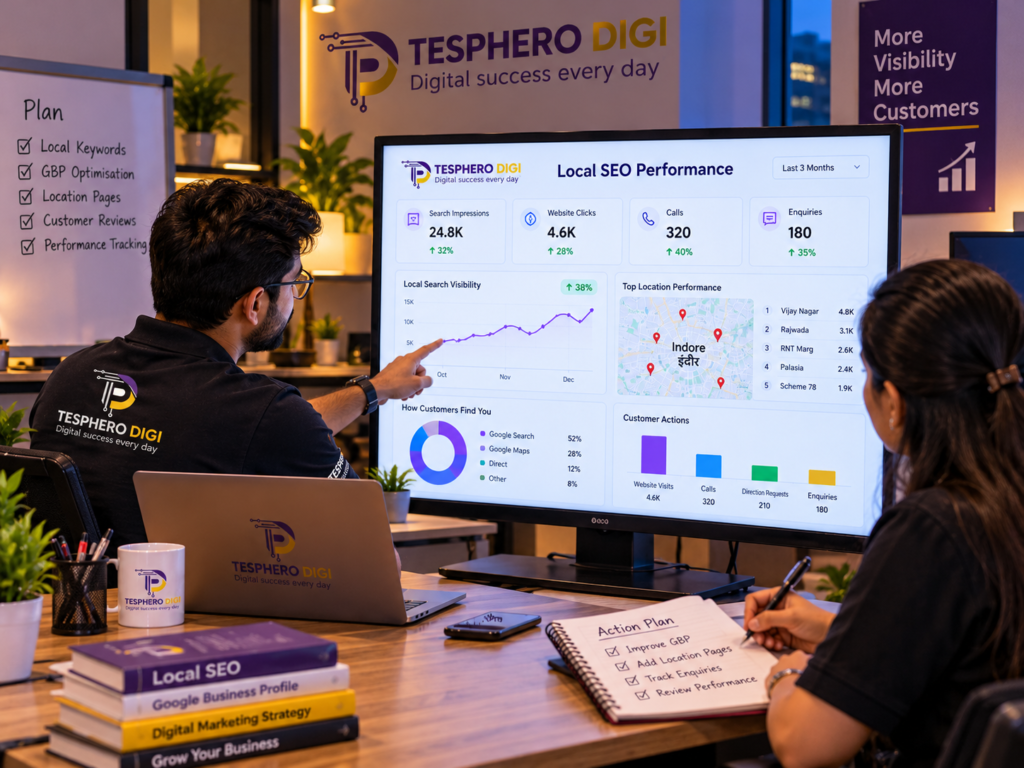
Tracking local search visibility, website clicks, customer calls and enquiries helps small businesses understand their SEO performance and identify opportunities for improvement.