
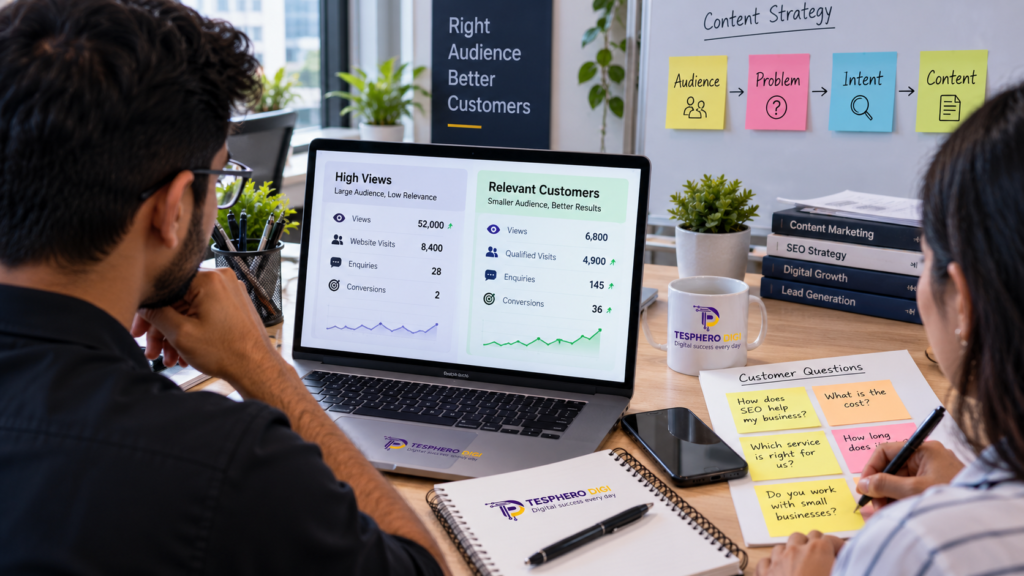
Effective content marketing focuses on reaching the right audience and generating relevant visits, enquiries, and conversions—not simply increasing views.
Content That Attracts Customers starts with understanding the right audience rather than simply chasing more views. For a business, valuable content should reach people who genuinely need its products or services and help them move closer to a meaningful action.
A post can receive thousands of views and still generate very few inquiries. Meanwhile, another piece of content may attract a much smaller audience but bring relevant website visits, qualified leads, calls, or sales conversations.
Therefore, businesses should not create content only around the question, “How can we get more views?”
A better question is:
“What does our ideal customer need to see before they feel ready to consider our business?”
That change in thinking can improve everything from topic selection and SEO to social media, calls to action, and performance measurement.
This guide explains how businesses can create useful content that attracts the right audience rather than chasing numbers that may not contribute to business growth.
Table of Contents
- Why More Views Do Not Always Mean Better Results
- How to Create Content That Attracts Customers Around Real Problems
- Create Content Around Customer Problems
- Match Content With Search Intent
- Cover Different Stages of the Customer Journey
- Choose the Right Content Channels
- Build Trust Instead of Chasing Virality
- Use Clear Calls to Action
- Measure the Metrics That Matter
- Build a Practical Content Strategy
Why Content That Attracts Customers Matters
Digital platforms make numbers highly visible.
You can quickly see views, impressions, likes, followers, clicks, and shares. Naturally, businesses start using these numbers to judge whether their content is working.
However, a large number does not always represent business value.
Imagine two posts.
Post A receives 50,000 views but attracts people who have little interest in buying the service.
Post B receives 3,000 views but reaches business owners who are actively researching the exact problem the company solves.
Which one is more valuable?
The answer depends on the business objective.
If the goal is brand awareness, reach can certainly matter. However, if the goal is qualified inquiries, website conversions, or sales opportunities, audience relevance becomes much more important.
Google’s Search Central guidance similarly recommends creating content primarily to benefit people rather than producing content mainly to attract search-engine visits.
That principle is useful beyond SEO as well.
Useful business content should serve a real audience.
1. Start With the Customer, Not the Content Format
One common mistake happens before content creation even begins.
A business says:
“We need to make more Reels.”
Or:
“We should publish four blogs every month.”
However, neither statement explains who the content is for.
Before deciding whether to create a blog, video, carousel, email, or social post, understand the customer you want to reach.
Build a Practical Customer Profile
You do not need a complicated 20-page persona document.
Instead, answer useful questions:
- Who typically needs your product or service?
- What problem are they trying to solve?
- What questions do they ask before buying?
- What concerns delay their decision?
- What alternatives are they considering?
- What information helps them compare options?
- Where do they normally discover businesses like yours?
- What would make them contact you?
For a B2B company, you may also need to understand the person’s role in the purchase.
The employee researching your solution may not be the person who finally approves the budget.
Therefore, your content may need to answer questions for several decision-makers.
2. How to Create Content That Attracts Customers Around Real Problems
Businesses often create content around themselves.
They repeatedly post:
“Our company provides…”
“We are proud to announce…”
“We offer the best…”
“Our team has…”
Some company-focused content is useful. However, customers usually pay more attention to their own problems.
So, shift the starting point.
Instead of asking:
“What should we post today?”
Ask:
“What does our customer need help understanding today?”
That question usually produces stronger topics.
Turn Customer Questions Into Content
Your sales and customer-support conversations can provide valuable ideas.
Suppose prospects repeatedly ask:
“How much does this service cost?”
That could become a pricing guide.
If customers ask:
“Which option is right for my business?”
Create a comparison.
When people ask:
“Why am I not getting leads from my website?”
Create a diagnostic article.
In fact, our guide “Why Your Business Website Is Not Generating Enough Leads” follows exactly this approach: it begins with a business problem rather than a generic marketing topic.
Useful questions can become:
- educational blogs
- FAQs
- short videos
- comparison posts
- checklists
- case studies
- email content
- social carousels
As a result, Content That Attracts Customers usually begins with real questions rather than random content ideas.
3. Understand Search Intent Before Choosing Keywords
A keyword can bring traffic.
However, the reason behind the search matters just as much as the search volume.
This is where search intent becomes important.
Suppose someone searches:
“What is SEO?”
They may simply want to learn.
Another person searches:
“SEO agency for small business.”
Their intent is different.
Similarly:
“What is CRM software?”
and
“Best CRM for a 10-person sales team”
represent different stages of research.
Do Not Select Topics Only Because They Have High Search Volume
A high-volume keyword can look attractive in an SEO tool.
Yet it may be too broad for your actual customers.
A smaller, more specific search can sometimes align much better with the service you provide.
Therefore, evaluate:
Keyword + Intent + Business Relevance
rather than keyword volume alone.
Google recommends creating people-first content for an intended audience and cautions against producing large amounts of content on many topics simply in the hope that some of it performs in search.
That makes audience relevance an important part of SEO content planning.
4. Content That Attracts Customers Should Match the Buying Journey
Content That Attracts Customers should also support people at different stages of their buying journey.
Some people have just discovered a problem.
Others understand the problem but are comparing solutions.
A smaller group may already be choosing between providers.
Therefore, creating only one type of content can leave gaps in your strategy.
Awareness Stage
At this stage, people are trying to understand a problem.
Useful content may include:
- educational articles
- beginner guides
- problem-focused videos
- explanatory social posts
- checklists
For example:
“Why Is My Website Getting Traffic but No Leads?”
The reader may not yet know what needs fixing.
Consideration Stage
Now the customer understands the problem and begins comparing possible solutions.
Useful topics include:
- X vs Y comparisons
- solution guides
- advantages and limitations
- cost considerations
- implementation guides
For example, “SEO vs Paid Marketing: Which Strategy Is Better for Your Business?” can help a business understand two different approaches before deciding how to proceed.
Decision Stage
At this stage, the prospect is closer to choosing a provider or product.
Useful content can include:
- service pages
- case studies
- testimonials
- process explanations
- FAQs
- pricing information where appropriate
- consultation pages
A balanced content strategy should support more than one stage.
5. Be Specific Enough to Attract the Right Audience
Broad content often attracts broad audiences.
Specific content can make it easier for the right reader to recognize that the information is relevant to them.
Compare these two topics:
“5 Social Media Tips”
versus:
“5 Social Media Content Ideas for Local Service Businesses”
The second topic clearly defines the audience.
Likewise:
“How to Improve Your Website”
is broad.
“How Local Businesses Can Improve Service Pages to Generate Better Inquiries”
is much more specific.
Specificity Can Filter the Audience
That filtering is not necessarily a disadvantage.
You do not need every internet user to click.
You need the people who are relevant to the business.
Therefore, consider including useful qualifiers such as:
- industry
- customer type
- business size
- location
- problem
- use case
- stage of growth
Use them only when they genuinely match the audience.
6. Answer Questions Properly Instead of Creating Thin Content
Businesses sometimes publish content simply to maintain frequency.
For example, they may post every day because they believe consistency requires daily content.
However, consistency without usefulness can create a large volume of weak material.
A better approach is to answer the customer’s question properly.
If the topic requires an in-depth guide, provide enough detail.
If a 30-second video can answer the question clearly, do not stretch it into ten minutes.
The format and length should serve the topic.
Add Practical Value
Useful content can include:
Examples: Show what the idea looks like in practice.
Steps: Explain what the reader should do next.
Comparisons: Help people understand meaningful differences.
Mistakes: Explain common problems and how to avoid them.
Checklists: Make complicated decisions easier to review.
Limitations: Explain when your recommendation may not apply.
This makes content more useful than simply repeating definitions available on dozens of other websites.
7. Build Trust Instead of Trying to Sound Perfect
Customers do not necessarily need a business to claim that it is the “best.”
They need enough useful information to evaluate whether the business understands their problem.
Therefore, content should demonstrate expertise through clarity.
Explain what works.
Also explain what does not.
Mention limitations when they matter.
For example, instead of saying:
SEO guarantees long-term leads.
A more accurate explanation would be:
SEO can help improve organic visibility over time, but results depend on competition, website quality, content, technical factors, search demand, and other conditions.
The second statement may sound less dramatic.
However, it gives the reader a more realistic understanding.
Helpful Content Can Support Trust
Google’s people-first content guidance asks whether content demonstrates first-hand expertise and provides a satisfying experience for its intended audience.
For businesses, that means content should show genuine understanding rather than simply repeating keywords.
In this way, Content That Attracts Customers can build confidence without depending on exaggerated marketing claims.
8. Your Brand Voice Should Remain Consistent
Useful content still needs to feel connected to your brand.
Imagine a company’s website sounds professional and practical.
Then its social media suddenly uses an aggressive, completely different personality.
Its advertisements use another style again.
The customer may experience several disconnected versions of the same business.
Therefore, maintain reasonable consistency in:
- tone
- terminology
- visual identity
- messaging
- positioning
- key promises
Our guide “Why Consistent Branding Matters Across Your Digital Presence” explains this in greater detail.
Consistency does not mean every post needs to look identical.
Instead, customers should be able to recognize the same brand across different touchpoints.
9. Choose Distribution Channels Based on the Audience
Creating good content is only part of the process.
The right people also need to discover it.
Different channels serve different behaviors.
For example, search can work well when people actively look for answers.
Social media can support discovery, education, engagement, and brand familiarity.
Email can help businesses continue communicating with an existing audience.
Paid campaigns can place targeted messages in front of selected audiences.
However, not every business needs to use every channel equally.
Avoid the “We Need to Be Everywhere” Approach
Managing five channels poorly may produce less value than managing two relevant channels well.
Start with customer behavior.
Where do your customers search?
Which platforms do they actually use?
Are they actively looking for a solution, or do you first need to create awareness?
What type of content fits their decision process?
For a deeper explanation, internally link to “How to Identify the Right Digital Marketing Channels for Your Business.”
The right channel depends on the customer and the objective.
To measure Content That Attracts Customers, businesses need to look beyond views and consider what relevant visitors do next.
10. Measure Content That Attracts Customers Beyond Views
Views tell you that content received attention.
That can be useful.
However, they do not tell the entire story.
Suppose a blog receives 1,500 relevant visits and generates 20 qualified inquiries.
Another receives 25,000 visits and produces almost no meaningful action.
The second blog has greater traffic.
The first may have greater business relevance.
Match Metrics With the Objective
Consider metrics such as:
| Content Goal | Useful Metrics to Review |
|---|---|
| Awareness | Reach, impressions, relevant video views |
| Engagement | Saves, shares, comments, engaged sessions |
| Website interest | Relevant traffic, landing-page engagement |
| Lead generation | Form submissions, calls, qualified enquiries |
| Clicks, replies, conversions | |
| Sales support | Lead quality, assisted conversions, sales conversations |
Do not interpret one metric in isolation.
Context matters.
11. Track What Visitors Do After They Arrive
A click is only the beginning.
What happens after someone lands on your website?
Some visitors may leave immediately, while others continue to another relevant page.
A potential customer might explore your service page or complete an enquiry form.
Others may decide to call your business directly.
Meanwhile, some visitors leave and return later when they are closer to making a decision.
These behaviors can provide more useful context than traffic alone.
Google Analytics Help provides guidance on events, conversions, reports, and other measurement features businesses can use to understand website and campaign activity.
However, analytics data should always be interpreted alongside your business objectives.
A long session is not automatically a conversion, just as a short session is not automatically a failure.
12. Give the Reader a Relevant Next Step
Useful content should not end abruptly.
Once someone finishes reading, what should they do?
The answer depends on their stage in the journey.
A beginner may benefit from another educational guide.
A person comparing solutions may need a service page.
Someone closer to making a decision may be ready for a consultation.
Therefore, the call to action should match the content.
Weak CTA
Contact us today!
This is not always wrong, but it provides little context.
Better Contextual CTA
Not sure which digital channels fit your business goals? Review your current marketing mix and identify where your ideal customers are most likely to search, compare, and take action.
Then you can naturally invite them to speak with your team.
The transition feels connected rather than forced.
Therefore, Content That Attracts Customers should always provide a useful and relevant next step.
13. Connect Content With the Website Experience
Great content cannot completely compensate for a confusing website.
Imagine a potential customer reads a helpful article and decides to explore your service.
They click through.
The service page loads slowly, the navigation is confusing, the mobile layout is difficult to use, and the contact button is hard to find.
The content succeeded.
The next experience did not.
Therefore, content strategy and website experience should work together.
Internally link here to “Website UX: How User Experience Can Influence Business Conversions.”
Content attracts interest, while the website needs to help visitors continue their journey.
14. Re-purpose Strong Ideas Instead of Constantly Starting From Zero
One useful topic can become several pieces of content.
Suppose you publish an article:
“7 Reasons Your Business Website Is Not Generating Leads.”
You could turn it into:
- seven short social posts
- one carousel
- two short videos
- an email
- a checklist
- a sales-team resource
- a FAQ section
The core idea remains consistent.
However, each format serves a different context.
Re-purposing Is Not Blind Copying
Do not simply paste the same text everywhere.
Adapt it.
A blog allows detail.
A Reel needs a fast opening and concise explanation.
A carousel needs clear visual progression.
An email needs a reason to continue reading or click.
Therefore, keep the insight while adjusting the presentation.
15. Create a Content Filter Before Publishing
A simple filter can prevent businesses from chasing irrelevant topics.
Before approving an idea, ask:
Audience
Is this relevant to the type of customer we want?
Problem
Does it answer a real question, concern, or need?
Business Relevance
Is there a logical connection between this topic and what we provide?
Intent
What is the reader likely trying to achieve?
Value
Will they learn something genuinely useful?
Next Step
What should an interested reader do after consuming the content?
If a topic cannot answer most of these questions, reconsider why you are creating it.
16. Avoid These Common Content Marketing Mistakes
Several habits can bring attention without necessarily attracting useful business opportunities.
Chasing Every Trend
A trending audio or topic may produce reach.
However, ask whether the people attracted by it are relevant to the business.
Targeting Only High-Volume Keywords
Search volume is useful data, but relevance and intent matter too.
Talking Only About the Company
Customers usually begin with their own needs.
Lead with those needs.
Creating Content Without a Next Step
Attention can disappear quickly if the reader has nowhere useful to go.
Measuring Only Likes and Views
These metrics can support awareness analysis, but they should not automatically become the main measure of business success.
Publishing Without Reviewing Results
Content strategy should evolve based on what you learn.
A practical system makes it easier to create Content That Attracts Customers consistently without chasing every new trend.
17. Build a System for Content That Attracts Customers
A practical content strategy does not need to become complicated.
Start with four content groups.
Problem Content
Answer problems customers are actively experiencing.
Example:
“Why Is Your Website Getting Traffic but Not Inquiries?”
Educational Content
Help customers understand important concepts.
Example:
“What Is Local SEO and How Does It Work?”
Comparison Content
Help people evaluate choices.
Example:
“SEO vs Paid Marketing: Which Approach Fits Your Goal?”
Decision Content
Help prospects understand your solution, process, service, or results.
Example:
“What to Expect When Working With a Digital Marketing Agency.”
Together, these categories can support different stages of the customer journey.
18. Review Content Performance Regularly
After enough data has accumulated, review what happened.
Then, look for patterns in the results.
Start by identifying the topics that attract relevant search traffic.
Next, review which posts generate saves, meaningful shares, or stronger engagement.
Also, check whether readers continue from your articles to relevant service pages.
Pay attention to the pages that contribute to enquiries or other useful actions.
Meanwhile, note the questions that continue appearing in sales conversations.
Finally, identify content that attracts traffic but produces very little relevant action.
Together, these observations can guide future content planning.
Do Not Delete Useful Content Just Because It Did Not Go Viral
Some valuable business content serves a small but highly relevant audience.
For example, a detailed B2B guide may never generate millions of views.
It does not need to.
If the right decision-makers discover it when researching a problem, it may still support the business effectively.
19. How Tesphero Digi Can Help
Creating more content is relatively easy.
Creating a connected content strategy is harder.
Tesphero Digi helps businesses approach digital marketing with a clearer connection between audience, content, channels, website experience, branding, and business goals.
Instead of publishing only to remain active, businesses can build content around the questions and problems their customers actually have.
That may involve SEO content, social media, website messaging, paid campaigns, or a combination of relevant channels.
The objective is not simply to make every number bigger.
It is to make your digital presence more useful to the people your business genuinely wants to reach.
Final Thoughts
Content That Attracts Customers starts with relevance rather than reach.
Before creating your next blog, Reel, carousel, or campaign, ask who it is meant for and why that person should care.
Then identify the problem they are trying to solve.
Match the topic with their intent and stage in the buying journey. In addition, choose a distribution channel that fits their behavior.
After publishing, look beyond views.
Review relevant traffic, engagement quality, service-page visits, inquiries, conversions, and other metrics connected to the actual objective.
Some content will reach large audiences. Other pieces may attract fewer people.
That difference is not automatically a problem.
For a business, the right 1,000 people can sometimes matter more than the wrong 100,000 views.
Create for relevance first.
Reach becomes more useful when the people you reach are the people your business can actually help.
Frequently Asked Questions
About the Author
Tesphero Digi helps businesses build stronger digital marketing systems through practical strategies across websites, SEO, social media, branding, content, and paid marketing. Our focus is on connecting digital activity with real customer needs and meaningful business objectives.
Getting Views but Not the Right Customers?
Tesphero Digi can help you review your audience, content topics, digital channels, website journey, and marketing strategy to identify where attention is getting disconnected from business goals.
Create content that does not simply get seen.
Create content that reaches people with a reason to care.

Tracking relevant visits, qualified leads, and conversions helps businesses understand whether their content is attracting potential customers—not simply generating more views.