
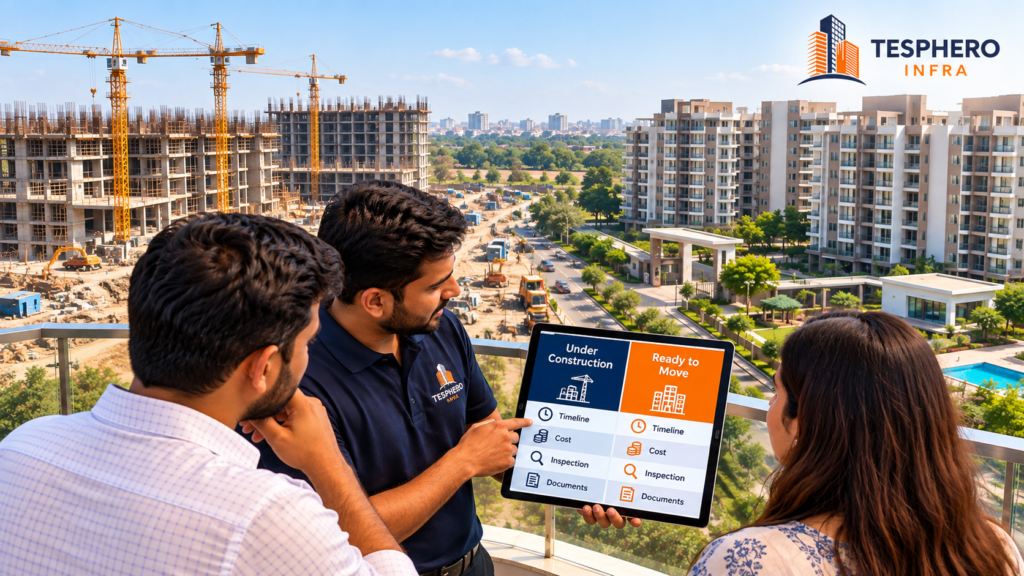
Comparing possession timeline, total cost, inspection possibilities, and documentation can help buyers choose between an under-construction and ready-to-move property.
Under-Construction vs. Ready-to-Move Property is an important comparison for buyers deciding what fits their budget, timeline, and priorities.
Additionally, both options can work for different buyers.
However, the right choice depends on much more than the advertised property price.
An under-construction property may offer a longer purchase and payment journey. However, a ready-to-move home allows buyers to inspect an existing property before making the final decision. Factors such as possession timeline, construction status, financing, expenses, documentation, location, and housing needs can influence the decision.
Therefore, instead of asking which option is universally better, buyers should compare both choices based on their own requirements.
Table of Contents
- Understanding the Two Property Options
- Under-Construction vs Ready-to-Move Property: Quick Comparison
- Compare Your Possession Timeline
- Compare What You Can Inspect Before Buying
- Understand the Payment and Financial Commitment
- Compare the Total Property Cost
- Check Construction and Project Progress
- Verify Documents and Regulatory Details
- Compare Location and Surrounding Development
- Consider Customization and Interiors
- Think About Immediate Use and Rental Plans
- Under-Construction vs Ready-to-Move Property: Which Fits You?
- Common Mistakes Buyers Should Avoid
- How Tesphero Infra Can Help
- FAQs
Understanding Under-Construction vs Ready-to-Move Property
Before comparing the two, buyers should understand what they are actually evaluating.
An under-construction property is generally a property within a project where construction is still in progress and possession is expected at a future stage.
A ready-to-move property, on the other hand, is already constructed and is expected to be available for possession, subject to the property’s documentation, approvals, transaction process, and other applicable requirements.
The difference may appear simple. Still, it can change the entire buying experience.
With an under-construction property, buyers are making a decision partly on the basis of plans, specifications, project information, construction progress, and promised timelines.
With a ready property, they can usually inspect the actual unit and surroundings more directly.
As a result, each option requires a slightly different evaluation process.
Under-Construction vs Ready-to-Move Property: Quick Comparison
| Factor | Under-Construction Property | Ready-to-Move Property |
|---|---|---|
| Possession | Expected in the future | Generally available sooner, subject to transaction requirements |
| Physical inspection | Final unit may not yet be complete | Actual property can usually be inspected |
| Payment | May follow a project/payment schedule | Purchase amount may become payable over a shorter transaction period |
| Construction risk | Progress and completion timeline matter | Construction is substantially/fully visible |
| Location assessment | Surroundings may still be developing | Existing neighbourhood is easier to observe |
| Customisation | Some changes may be possible depending on project stage | Changes usually happen through renovation/interiors |
| Immediate use | Usually not possible until possession | May be suitable for earlier occupancy after completion of required formalities |
| Documentation | Project status and RERA-related information may be relevant | Completion/occupancy and title-related documents need careful review |
This table provides a starting point. However, buyers should evaluate the actual project rather than assuming every property in either category has the same characteristics.
1. Compare Your Possession Timeline
Your timeline is one of the first things to consider in the Under-Construction vs Ready-to-Move Property decision.
Ask yourself a simple question:
When do I actually need the property?
Someone currently living in a rented home may want to move sooner. Similarly, a family relocating for work or personal reasons may not want to wait for construction to finish.
In such cases, a ready property may fit the timeline better.
An under-construction property may suit someone who does not need immediate possession and is comfortable with a future completion schedule.
However, buyers should not rely only on verbal statements about possession.
Check the project’s official information, applicable registration details, construction progress, agreement terms, and stated completion or possession timeline.
Most importantly, keep some flexibility in your personal financial and housing plans because construction timelines can be affected by various circumstances.
2. Compare What You Can Inspect Before Buying
A major difference between the two options is what you can physically inspect.
With a ready-to-move property, buyers may be able to examine the actual unit.
You can look at:
- Room dimensions
- Natural light
- Ventilation
- View from the property
- Construction finish
- Doors and windows
- Common areas
- Lifts
- Parking arrangements
- Access roads
- Existing surroundings
In addition, visiting at different times of the day can provide useful context about traffic, noise, sunlight, and neighbourhood activity.
An under-construction property requires a different approach because the final unit may not yet exist in completed form.
Therefore, buyers may need to rely more on sanctioned/project information, specifications, agreement terms, construction progress, sample units where available, and other verified project details.
A sample flat can help you understand the intended design. Still, buyers should confirm what is actually included in the purchased unit rather than assuming every feature shown in a sample or marketing material forms part of the final delivery.
3. Payment Planning in Under-Construction vs Ready-to-Move Property
Price matters, but payment timing matters too.
Under-construction projects may have payment structures linked to time, milestones, or other agreed schedules depending on the project and transaction.
Consequently, the buyer’s payments may be spread across the construction period.
A ready property can create a different financial situation because the transaction may move towards completion over a shorter period.
Therefore, compare your actual cash-flow requirements rather than looking only at the headline price.
Consider:
- Booking amount
- Down payment
- Home loan requirement
- Applicable charges
- Registration-related expenses
- Interior budget
- Existing rent
- Current loan obligations
- Emergency savings
For example, someone paying rent while also servicing a housing-related loan may experience a different financial burden from a buyer who can remain in an existing family home during construction.
So, create a realistic monthly budget before deciding.
4. Compare the Total Property Cost
One of the most common buyer mistakes is comparing only the advertised base price.
The final financial commitment can include several other components.
Depending on the property and transaction, buyers may need to consider applicable expenses such as registration and stamp-related costs, maintenance-related charges, parking or amenity-related charges where applicable, loan costs, interiors, moving expenses, taxes, and other contractual charges.
Therefore, ask for a detailed cost sheet.
Then, separate the costs into three categories:
Purchase costs – amounts directly related to acquiring the property.
Financing costs – interest and applicable loan-related charges.
Post-purchase costs – interiors, furnishing, maintenance, moving, and other expenses.
This approach creates a much clearer comparison.
Also, never assume that under-construction property is automatically cheaper or that ready property is always more expensive. Pricing depends on the individual project, location, size, demand, construction stage, property condition, and many other factors.
5. Construction Progress in Under-Construction vs Ready-to-Move Property
Construction progress becomes especially important when considering an under-construction project.
Do not evaluate progress only through advertisements.
Instead, check the project’s current status through available official information and visit the site where practical.
Observe whether the visible construction appears consistent with the stage communicated to buyers. Also, understand which parts of the overall project remain incomplete.
For a ready property, the focus changes.
Rather than tracking future construction, inspect the existing condition.
Look for signs such as water seepage, unfinished common areas, damaged fittings, cracks that need professional assessment, lift functionality, parking condition, drainage, and general maintenance.
If necessary, consider taking an independent professional for a property inspection.
A visually attractive property can still have issues that are difficult for an ordinary buyer to identify.
6. Verify Documents and Regulatory Details
Documentation should be checked regardless of which property type you choose.
For applicable projects, buyers can review RERA registration and project disclosures through the relevant state’s RERA authority.
The Ministry of Housing and Urban Affairs explains that an Occupancy Certificate relates to occupation of a building with civic infrastructure such as water, sanitation, and electricity, while a Completion Certificate relates to completion according to approved plans and specifications. RERA
This distinction matters when evaluating a completed property.
Buyers should verify applicable approvals and documents for the specific property rather than assuming that a finished-looking building automatically has every required approval.
Depending on the property and transaction, professional legal verification may also cover title-related documents, sanctioned plans, encumbrances, agreement terms, approvals, and other relevant records.
For a broader property-document checklist, internally link your existing article:
Property Buyers: 10 Essential Documents You Should Never Ignore
Suggested anchor: essential property documents buyers should verify
For official regulatory background, use the Government of India’s RERA portal:
RERA – Ministry of Housing and Urban Affairs
7. Compare Location and Surrounding Development
The property itself is only one part of the decision.
The surrounding location affects everyday life.
A ready property often gives buyers a clearer view of the existing neighbourhood. Roads, shops, schools, hospitals, public transport, traffic patterns, and nearby development can be observed directly.
In a developing area, the picture may be different.
Some under-construction projects are located in neighborhoods where infrastructure and commercial activity are still evolving.
That is not automatically negative. However, buyers should separate existing infrastructure from future proposals or expectations.
For example, ask:
What facilities are operational today?
Which roads are already usable?
How long does the actual commute take?
Are schools, healthcare, and daily shopping practically accessible?
Which future infrastructure claims can be verified through official sources?
These questions are more useful than simply hearing that an area is “upcoming.”
Internally link:
What Makes a Property Location Valuable? 7 Factors Buyers Should Consider
Suggested anchor: factors that can make a property location valuable
8. Customization in Under-Construction vs Ready-to-Move Property
Some buyers want a home that matches their preferred layout, electrical requirements, interiors, and finishes.
Depending on the project stage and developer policy, an under-construction property may offer certain customization possibilities.
However, never assume modifications will be allowed.
Ask what can actually be changed, whether additional charges apply, and whether the agreed modification will be documented.
With a ready property, structural or developer-level customization may be limited. Still, buyers can usually plan interiors and permissible renovations after purchase.
This may include furniture, storage, lighting, paint, decor, and other non-structural changes, subject to applicable rules.
Therefore, consider how important customization is to you before deciding.
9. Consider Immediate Use and Rental Plans
Your intended use should influence the decision.
A buyer purchasing a home for immediate self-occupation may place a high value on quick possession.
Meanwhile, someone buying for future use may be comfortable waiting.
Investment-oriented buyers should also think about when the property can realistically become usable or rent-able.
A ready property may potentially allow rental activity sooner after the purchase and required formalities. However, rental demand and achievable rent depend on location, property type, condition, amenities, tenant demand, and prevailing market conditions.
An under-construction property generally cannot generate rental income until it becomes available for lawful occupation and possession.
Therefore, investors should account for the waiting period instead of evaluating only the purchase price.
You can internally link:
How to Evaluate a Real Estate Investment Before You Buy in Indore
Suggested anchor: evaluate a real estate investment before buying
10. Understand the Risks of Both Options
Neither property type is completely free from risk.
With under-construction property, buyers may need to consider:
- Construction delays
- Changes permitted under applicable terms/law
- Future neighbourhood development
- Completion and possession timeline
- Financial planning during construction
- Differences between expectations and final delivery
Ready properties have their own considerations:
- Existing property condition
- Building age
- Maintenance quality
- Repair requirements
- Documentation
- Previous ownership, where applicable
- Society or maintenance arrangements
- Existing neighbourhood issues
Therefore, “ready” should not be interpreted as “nothing needs checking.”
Similarly, “under construction” should not automatically be interpreted as “too risky.”
The actual property, project, promoter, documentation, approvals, agreement, and buyer circumstances matter.
11. Under-Construction vs Ready-to-Move Property for Home buyers
So, which option fits you?
Consider a ready-to-move property if your priorities include inspecting the actual home, understanding the existing neighbourhood, and moving relatively soon after completing the required transaction and possession formalities.
An under-construction property may be worth considering when immediate possession is not essential and you are comfortable evaluating construction progress, project information, future timelines, and payment commitments.
Still, this is not a rule.
Two ready properties can be very different from each other. Likewise, two under-construction projects can have completely different timelines, pricing, locations, and project characteristics.
Therefore, compare actual properties—not just categories.
12. Questions to Ask Before Choosing
Before making a final decision, write down your priorities.
Start with these questions:
- When do I need possession?
- What is my complete budget?
- Can I manage rent and property-related payments together if needed?
- Have I inspected the property or project site?
- Have I verified applicable RERA/project information?
- What documents and approvals apply to this property?
- What exactly is included in the quoted price?
- How developed is the surrounding location today?
- What additional expenses should I plan for?
- Does this property suit my self-use or investment objective?
Your answers can make the Under-Construction vs Ready-to-Move Property comparison much more practical.
13. Common Mistakes Buyers Should Avoid
One common mistake is choosing solely on price.
A cheaper property may not automatically provide better value if it does not fit your location, possession, quality, or financial requirements.
Another mistake is relying heavily on marketing material without independent verification.
Also, avoid ignoring the agreement and other transaction documents because the sales discussion seemed clear.
Some buyers stretch their budget to the maximum loan amount without keeping enough room for registration, interiors, maintenance, moving, or unexpected expenses.
Finally, do not rush because of statements such as “last unit” or “price increasing tomorrow” without doing the checks you consider necessary.
A property purchase is a significant financial decision. Therefore, adequate verification deserves time.
Internally link your existing article:
Why Buying Property Based Only on Price Can Turn Into an Expensive Mistake in Indore
Suggested anchor: why property price should not be the only buying factor
14. How Tesphero Infra Can Help
Choosing between an under-construction and ready property becomes easier when buyers first clarify their budget, preferred location, possession timeline, and intended use.
Tesphero Infra helps property buyers explore options based on practical requirements rather than focusing only on advertised prices.
The process can include understanding location preferences, comparing suitable properties, discussing project characteristics, and helping buyers identify important points that require further verification.
However, buyers should independently review legal, financial, regulatory, and technical matters with appropriate professionals wherever necessary before completing a transaction.
Final Thoughts
The Under-Construction vs Ready-to-Move Property decision does not have one correct answer for every buyer.
Under-construction properties can suit buyers who have a longer timeline and are comfortable evaluating a project while it develops. Ready properties, meanwhile, can make it easier to inspect the actual home and surrounding environment before completing the purchase.
However, property type alone should never determine your decision.
Compare the possession timeline, total cost, financing requirements, construction status, documents, location, property condition, and your own plans.
Ultimately, the better option is the one that fits your real requirements after proper verification—not simply the one that looks more attractive in an advertisement.
Frequently Asked Questions
About the Author
Tesphero Infra helps property buyers explore residential and commercial real estate options based on location, budget, usage requirements, and long-term priorities. Our content aims to make property decisions easier to understand through practical buyer-focused information.
This article is for general informational purposes. Property documentation, approvals, taxes, charges, financing, RERA requirements, possession conditions, and legal considerations can vary by project and transaction. Buyers should verify current information with the relevant authorities and qualified legal or financial professionals where appropriate.
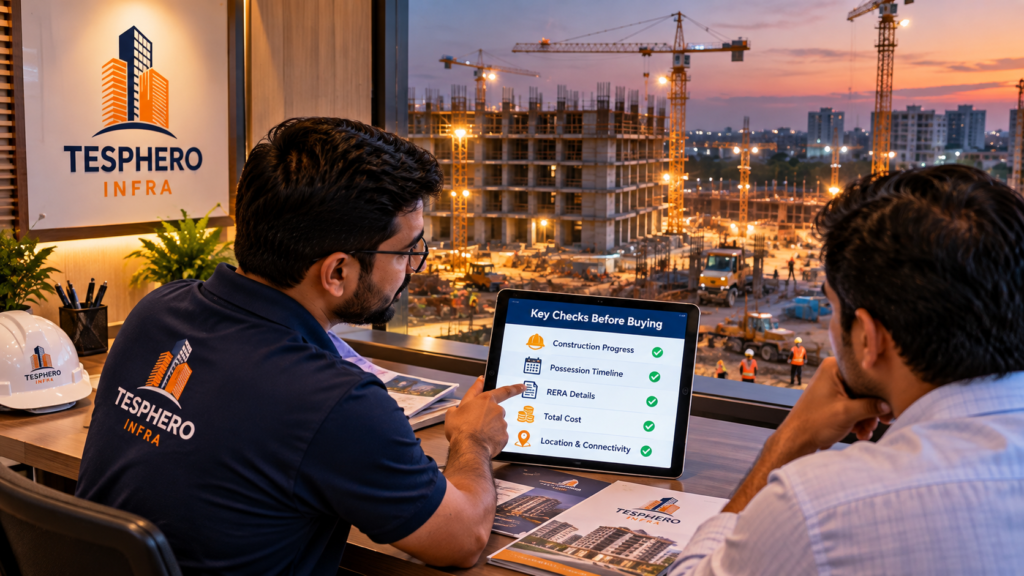
Checking construction progress, possession timelines, RERA details, total cost, and location can help buyers make a more informed property decision.