
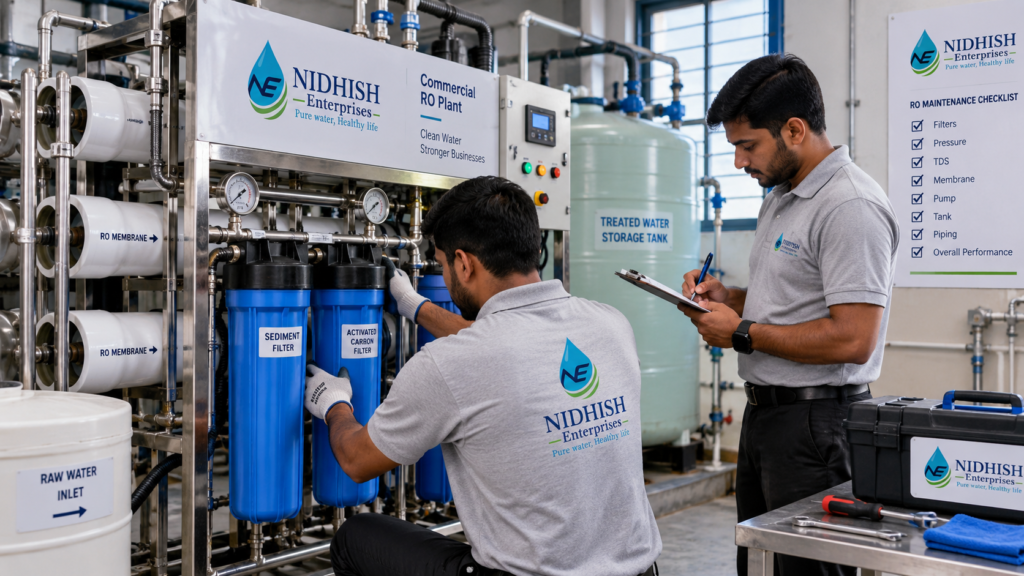
Regular RO maintenance helps businesses monitor filters, pressure, membranes, and system performance to support consistent water quality and reliable operation.
Regular RO Maintenance helps an RO system deliver consistent water quality while supporting reliable day-to-day performance. Whether you use an RO system at home, in an office, restaurant, school, factory, hospital, or another commercial space, the system needs proper care after installation.
Many users pay close attention while selecting an RO system. However, maintenance often receives less attention once the unit starts working normally.
That can become a problem.
Filters collect impurities over time. Membranes face continuous load. Storage tanks need hygiene checks. Pumps, valves, pipes, and other components may also develop issues with regular use.
As a result, an RO system that worked well when new may gradually lose efficiency if nobody maintains it properly.
Regular servicing does not mean replacing every component frequently. Instead, it means inspecting the system, monitoring its performance, cleaning where required, and replacing consumable parts according to actual condition, water quality, usage, and manufacturer guidance.
Let us understand why this matters.
Table of Contents
- Why Regular RO Maintenance Matters
- How an RO System Changes With Daily Use
- Filters Need Timely Attention
- The RO Membrane Plays a Critical Role
- Maintenance Helps Protect Water Quality
- System Performance Can Decline Gradually
- Maintenance Can Reduce Unexpected Downtime
- Different Businesses Have Different RO Needs
- Warning Signs Your RO System Needs Attention
- Building a Practical RO Maintenance Routine
Why Regular RO Maintenance Matters
An RO system performs several tasks before treated water reaches the user.
Depending on the system design, water may pass through sediment filtration, activated carbon filtration, the RO membrane, post-treatment stages, and other components. Commercial systems may also include pumps, pressure gauges, dosing arrangements, storage tanks, and additional pretreatment.
Each component performs a specific function.
Therefore, one neglected stage can affect other parts of the system.
For example, a sediment filter helps reduce suspended particles before water reaches later treatment stages. When that filter becomes heavily loaded, water flow or pressure conditions may change.
Similarly, pretreatment problems can place additional stress on the RO membrane.
Regular inspection helps identify such issues before they grow into larger operational problems.
More importantly, maintenance should match the actual system rather than follow a one-size-fits-all approach.
1. Understand What Happens Inside an RO System Over Time
Water treatment equipment works continuously against substances present in the incoming water.
These may include dissolved salts, suspended particles, hardness-related minerals, chlorine, organic matter, and other contaminants depending on the source.
Consequently, components do not remain in the same condition forever.
Sediment can accumulate inside filters. Scale may develop under certain operating conditions. Membranes can foul. Connections may loosen or leak. Meanwhile, storage areas can require cleaning and hygiene attention.
The speed of these changes depends on several factors:
- incoming water quality
- daily water consumption
- operating hours
- system capacity
- pretreatment quality
- pressure conditions
- local water characteristics
- maintenance history
A household RO purifier and a commercial RO plant may therefore need very different maintenance routines.
Source Water Makes a Difference
Bore well water, municipal water, tanker water, and other sources can have different characteristics.
Even the same source may change over time.
For that reason, businesses should not assume that a maintenance schedule suitable for one location will automatically work at another.
Understanding the incoming water is an important starting point.
2. Filters Need Timely Attention
Pre-filters protect later stages of an RO system.
A sediment filter, for example, helps remove suspended particles before they move further through the treatment process. Activated carbon stages can perform other important treatment functions depending on system design.
However, filters have a limited working life.
As they collect impurities, their condition gradually changes.
What Happens When Filters Become Loaded?
A heavily loaded filter may restrict water flow.
In addition, the system may have to operate under less favorable conditions. Commercial installations can also experience reduced output or pressure-related problems.
Ignoring filters for too long may create unnecessary stress elsewhere in the system.
Therefore, technicians should inspect them at suitable intervals and replace them when their condition or the system requirements indicate that replacement is necessary.
Avoid Fixed Assumptions
You may hear advice such as:
“Change every filter after exactly six months.”
That may work as a general reminder for a particular product. Still, it should not replace the manufacturer’s instructions or an assessment of actual operating conditions.
A system treating challenging source water may need attention sooner. In contrast, another installation may operate under different conditions.
Regular RO Maintenance should respond to the system’s real workload.
3. The RO Membrane Plays a Critical Role
The membrane sits at the heart of the reverse osmosis process.
Pressure pushes feed water through the membrane, while the system separates a portion of dissolved substances from the treated-water stream.
Because this component performs such an important job, membrane condition directly affects system performance.
Membrane Performance Can Change
Several factors can influence a membrane over time.
These may include scaling, fouling, unsuitable feed-water conditions, poor pretreatment, incorrect pressure, or simply prolonged operation.
A commercial operator might notice changes in:
- treated-water output
- operating pressure
- recovery
- reject-water behavior
- treated-water TDS
- overall system efficiency
One unusual reading does not always identify the exact problem. Therefore, a trained technician should examine the system rather than replace the membrane based on guesswork.
Membrane Replacement Should Follow Condition
RO membranes do not all fail after an identical number of months.
Water quality and operating conditions matter.
Good pretreatment can help protect the membrane. Conversely, unsuitable feed water can increase stress on it.
That is another reason routine monitoring matters.
4. Regular RO Maintenance Helps Protect Water Quality
RO maintenance is not only about keeping a machine running.
Water quality remains the main purpose of the system.
India’s Bureau of Indian Standards identifies IS 10500 as the specification for drinking water. The standard covers requirements and methods of sampling and testing for drinking water. BIS
BIS documentation covers parameters such as color, odour, pH, taste, turbidity, total dissolved solids, hardness, iron and several other chemical and microbiological requirements. BIS
For businesses that provide drinking water to employees, customers, students, guests, or other users, relying only on appearance is not enough.
Clear-looking water does not tell you everything about its quality.
Testing Provides Better Information
Where appropriate, water testing can help businesses understand both source water and treated water.
The required tests will depend on the application and local conditions.
For official reference, businesses can review the Bureau of Indian Standards drinking-water information. BIS states that IS 10500 covers drinking water intended for human consumption from different sources. BIS
Testing also helps technicians make better maintenance decisions instead of relying entirely on assumptions.
5. System Performance Can Decline Gradually
Not every RO problem causes the system to stop immediately.
Performance can decline slowly.
For instance, users may notice that the tank takes longer to fill. A commercial plant may produce less treated water during the same operating period. Pressure readings might change, or treated-water quality may shift.
Because these changes can happen gradually, people sometimes adjust to them without realizing that the system needs attention.
Track Basic Performance
Commercial users can benefit from maintaining simple operating records.
Depending on the installation, useful observations may include:
- feed-water TDS
- treated-water TDS
- operating pressure
- daily output
- filter changes
- membrane cleaning or replacement
- unusual sounds
- leaks
- service dates
Larger plants may require additional operating data.
Records make changes easier to identify.
For example, a gradual fall in output across several weeks tells you more than one isolated reading.
6. Maintenance Can Reduce Unexpected RO Downtime
A sudden RO failure can create more than an equipment problem.
It can interrupt normal business activity.
Restaurants need water for several daily operations. Offices need drinking water for staff and visitors. Schools may depend on central drinking-water systems. Factories can require treated water for employees or specific processes.
Therefore, an unexpected breakdown can create operational inconvenience and additional costs.
Our earlier guide, “What Happens When Your Business Water System Fails? The Real Cost of RO Downtime,” explains why businesses should consider the wider impact of water-system interruptions.
Preventive Checks Can Find Small Problems Earlier
During routine maintenance, a technician may identify:
- worn filters
- unusual pressure
- minor leakage
- loose connections
- pump problems
- declining membrane performance
- abnormal noise
- dirty storage areas
- damaged fittings
Fixing a small issue early can sometimes prevent a more disruptive failure later.
However, preventive maintenance cannot guarantee that a system will never break down.
Its purpose is to reduce avoidable problems and support more reliable operation.
7. Regular Maintenance Can Support Component Life
Maintenance does not make RO components last forever.
Nevertheless, proper operating conditions can help prevent avoidable stress.
Consider the membrane again.
If pretreatment works properly, fewer unwanted materials may reach later treatment stages. If technicians address scaling risks appropriately, the membrane can operate under better conditions.
Likewise, timely attention to pumps, pressure settings, valves, and connections can help the overall system operate more smoothly.
Do Not Wait for Complete Failure
Some users call a technician only when water stops completely.
That approach can turn maintenance into emergency repair.
Instead, routine inspection gives you opportunities to identify deterioration before complete failure occurs.
This distinction becomes especially important for commercial systems where even a few hours of downtime may affect operations.
8. Different Businesses Need Different Maintenance Plans
There is no single maintenance schedule that suits every RO installation.
A small office serving 15 employees does not use water at the same rate as a busy restaurant.
Similarly, a school with hundreds of students may experience heavy demand during specific hours. A factory can operate for long shifts and require much larger quantities.
Maintenance should reflect those differences.
Offices
Office systems may experience predictable weekday demand.
Teams should monitor drinking-water usage, filter condition, tank hygiene, and overall output. In addition, someone should keep basic service records so maintenance does not depend on memory.
Restaurants and Cafés
Food businesses can have high and variable water demand.
A sudden reduction in RO output may interfere with daily operations. Therefore, these businesses should pay particular attention to capacity, storage, and preventive servicing.
Schools and Institutions
Schools may need large volumes within short periods.
Regular checks before periods of heavy use can help identify issues early. Tank cleanliness and water-quality monitoring also deserve attention.
Factories and Commercial Facilities
Larger installations may include more complex pretreatment, pumps, membranes, storage tanks, instruments, and control systems.
Consequently, these systems often need a structured maintenance program rather than occasional servicing.
If you are still deciding what type or capacity of system your organization requires, read “How to Choose the Right RO System for Your Office, Restaurant or Business.”
9. Hard Water Can Add Another Challenge
Water hardness deserves separate attention because it can affect equipment and treatment decisions.
Hardness mainly relates to minerals such as calcium and magnesium.
Under certain conditions, mineral deposits can contribute to scaling in water systems and equipment.
If your property receives hard water, an RO unit may form only one part of the overall treatment solution.
The correct approach depends on the source water, intended use, flow requirements, and system design.
Our guide “Hard Water Problems in Indore: How Water Softeners Can Protect Your Home and Business” explains the role of water softening in greater detail.
Test Before Choosing Treatment
Do not select treatment equipment only because another nearby business uses it.
Two properties can experience different water conditions.
Instead, evaluate the source water and actual requirement first.
That approach helps avoid unnecessary equipment as well as inadequate treatment.
10. Warning Signs Your RO System May Need Attention
RO systems can show warning signs before a major problem develops.
Watch for noticeable changes such as:
- lower water output
- unusually slow tank filling
- changes in taste or odour
- unexpected TDS changes
- unusual pump noise
- visible leakage
- repeated starting and stopping
- abnormal pressure readings
- frequent filter blockage
- changes in reject-water flow
These signs do not all point to the same fault.
For example, low output could relate to filter restriction, pressure, membrane condition, pump performance, or another system issue.
Therefore, avoid replacing random parts without diagnosis.
A proper inspection should identify the likely cause first.
What Should an RO Maintenance Visit Include?
The exact service work depends on the type and size of the system.
Still, a practical maintenance visit may include several checks.
| Maintenance Area | What to Check | Why It Matters |
|---|---|---|
| Pre-filters | Condition and flow | Helps protect later treatment stages |
| RO membrane | Performance and condition | Supports effective RO operation |
| Pressure | Normal operating range | Helps identify performance problems |
| TDS | Feed and treated-water readings | Shows changes in system performance |
| Pump | Noise, pressure, and operation | Supports reliable water production |
| Pipes and fittings | Leaks or damage | Helps prevent water loss and failures |
| Storage tank | Cleanliness and condition | Supports hygienic water storage |
| Electrical parts | Connections and controls | Helps maintain safe operation |
| Service records | Previous work and readings | Makes trends easier to identify |
A technician may need additional checks for commercial or industrial systems.
11. Do Not Confuse TDS With Complete Water Quality
TDS meters are useful tools, but they do not provide a complete water-quality report.
A TDS reading measures dissolved ionic content indirectly through electrical conductivity. It does not tell you everything about microbiological contamination or every specific chemical contaminant.
Therefore, avoid judging drinking water only by one TDS number.
BIS drinking-water specifications address a much broader range of physical, chemical, bacteriological, virological, and other parameters. BIS
Use Testing According to the Requirement
For routine system monitoring, operators may track TDS and other operating readings.
However, businesses with specific water-quality responsibilities may need appropriate laboratory testing.
The type and frequency should reflect the application, source water, applicable requirements, and professional advice.
This approach gives a more complete picture than simply checking whether water looks clear.
12. Keep a Simple RO Maintenance Record
You do not need a complicated system to start tracking maintenance.
A basic record can include:
Service date: When did the technician inspect the system?
Filter changes: Which filters did the technician replace?
Membrane work: Was the membrane inspected, cleaned, or replaced?
TDS readings: What were the feed and treated-water readings?
Pressure readings: Were operating pressures within the expected range?
Repairs: Did the technician repair any pump, valve, pipe, or electrical component?
Next check: When should the system receive another inspection?
For commercial plants, you may need a more detailed log.
Even a simple record provides useful history when performance changes.
13. Avoid These Common RO Maintenance Mistakes
Several habits can reduce the effectiveness of an RO maintenance program.
Waiting Until Water Stops
A complete breakdown should not become the normal signal for servicing.
Regular checks can identify many developing issues sooner.
Changing Parts Without Diagnosis
Replacing the membrane every time TDS changes may waste money and fail to solve the actual problem.
First, check the complete system.
Ignoring Source-Water Changes
Seasonal conditions or a change in water supply can alter treatment requirements.
Therefore, reassess the feed water when you notice meaningful changes.
Focusing Only on Filters
Filters matter, but they are not the entire RO system.
Pumps, membranes, tanks, pressure, valves, electrical components, fittings, and pretreatment also need attention.
Keeping No Maintenance Records
Without records, businesses may forget when technicians last replaced or inspected important components.
A simple log solves much of this problem.
14. Build a Practical Regular RO Maintenance Routine
A good maintenance routine starts with the system manufacturer’s guidance and the conditions at your site.
First, understand your water source.
Next, note the system capacity and daily demand.
Then, monitor key performance indicators that apply to your installation.
In addition, keep service records and respond to unusual changes instead of waiting for complete failure.
For commercial systems, assign responsibility to a specific person or team. Otherwise, everyone may assume that someone else is handling maintenance.
A practical routine might cover:
- scheduled visual inspections
- filter-condition checks
- TDS monitoring
- pressure monitoring
- leak checks
- storage-tank hygiene
- membrane-performance review
- pump inspection
- periodic water testing where appropriate
- documented servicing
Most importantly, adapt the routine when water conditions or business demand changes.
How Nidhish Enterprises Can Help
RO systems work best when businesses treat installation and maintenance as connected responsibilities.
Nidhish Enterprises supports homes, offices, restaurants, schools, factories, and commercial facilities with water-treatment solutions based on their practical requirements.
The process can include understanding source-water conditions, assessing water demand, selecting suitable treatment equipment, and supporting the system after installation.
For businesses, this ongoing support becomes particularly useful as usage increases or water conditions change.
Rather than replacing components without understanding the cause, a proper service approach looks at the complete system and its operating conditions.
Final Thoughts
Regular RO Maintenance supports both water quality and dependable system performance.
Filters, membranes, pumps, tanks, pipes, and other components all work together. Consequently, ignoring one part can eventually affect the rest of the system.
Do not wait for a complete breakdown before checking your RO unit.
Instead, monitor performance, follow suitable service intervals, keep basic records, and investigate unusual changes early.
For commercial users, a planned approach becomes even more important because RO downtime can affect employees, customers, and everyday operations.
Ultimately, the goal is simple: keep the treatment system operating according to its design while maintaining appropriate water quality for its intended use.
Frequently Asked Questions
About the Author
Nidhish Enterprises provides water-treatment solutions for residential, commercial, and institutional requirements. The team works with RO systems, water softeners, water coolers, and related water-treatment solutions, with a focus on practical system selection, installation, maintenance, and ongoing support.
Need Help With Your RO System?
If your RO system has reduced output, unusual TDS readings, frequent filter problems, leakage, or recurring downtime, Nidhish Enterprises can help assess the system and identify suitable maintenance requirements.
A planned service approach can help you address small issues before they become larger operational problems.