
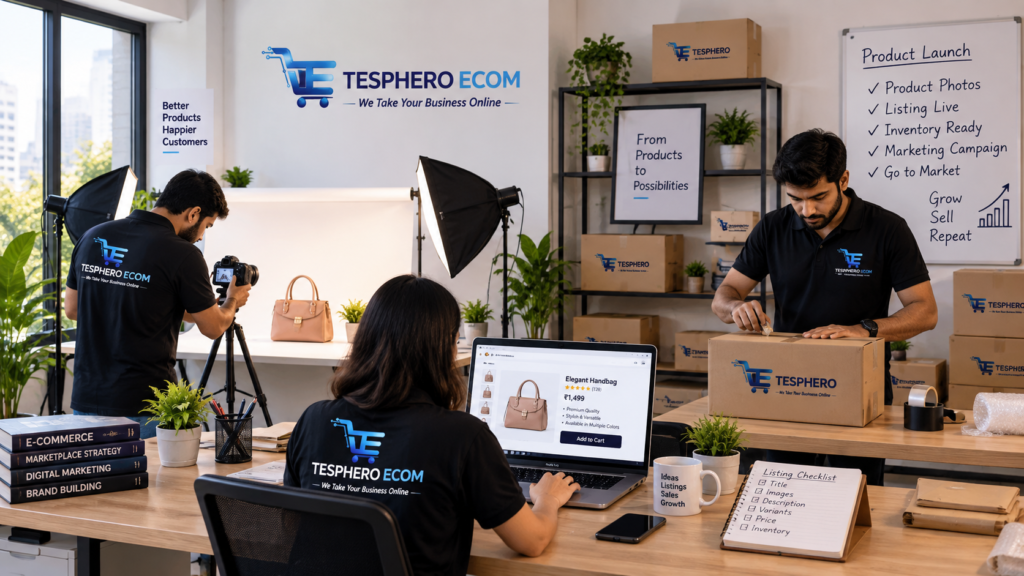
A well-planned product launch connects strong product presentation, accurate listings and smooth fulfilment to create a better e-commerce customer journey.
A strong E-commerce Customer Journey does not end when someone places an order. It starts when a potential customer first discovers your product and continues through product research, purchase, delivery, support, and the decision to buy again.
Initially, many online sellers put most of their effort into getting the first sale. They launch products, run ads, create marketplace listings, and offer discounts. As a result, these activities can attract buyers. However, growth becomes harder when every new order depends on finding a completely new customer.
A better approach looks at the entire journey.
Can customers understand your product quickly? Do they trust the listing? Is checkout simple? Does the delivery experience match their expectations? Most importantly, do they have a reason to return?
When each stage works together, an online business can create a smoother buying experience and build stronger customer relationships.
This guide explains how e-commerce businesses can improve that journey from product launch to repeat purchase.
Table of Contents
- What Is an E-commerce Customer Journey?
- Stage 1: Build the Right Product Launch
- Stage 2: Make Product Discovery Easier
- Stage 3: Turn Product Interest Into Confidence
- Stage 4: Reduce Friction Before Purchase
- Stage 5: Create a Better Delivery Experience
- Stage 6: Support Customers After the Sale
- Stage 7: Give Customers a Reason to Return
- Measure and Improve the Customer Journey
- Building a Journey That Can Grow With Your Brand
What Is an E-commerce Customer Journey?
The E-commerce Customer Journey covers the different interactions a customer has with your business before, during, and after a purchase.
A simple journey may look like this:
Discovery → Product Research → Purchase → Delivery → Experience → Support → Repeat Purchase
However, customers do not always follow a perfect straight line.
Someone may first discover your product through Instagram. Later, they may search for it on a marketplace. They might compare reviews, visit your website, leave without buying, and return a few days later.
Another customer may find your product directly through a marketplace search and place an order within minutes.
Therefore, sellers need to think beyond a single sales channel.
Google also recommends mapping the customer journey from the search query through checkout. Its Merchant Center guidance highlights product data, landing pages, rich product information, and a simple checkout process as areas that can improve the shopping experience. Google Help
The goal is simple: remove unnecessary confusion at every important stage.
1. Start With the Right Product Launch
A successful customer journey starts before the first customer places an order.
The launch stage sets expectations about the product, price, brand, and overall experience.
Before launching, sellers should clearly understand:
- who the product is for
- what problem it solves
- its main benefits
- how it differs from alternatives
- expected pricing
- available variants
- inventory requirements
- likely sales channels
Do Not Launch Only Because a Product Looks Popular
A trending product may generate attention, but attention does not always create a sustainable business.
Consider customer demand, competition, margins, sourcing, shipping requirements, and the possibility of repeat purchases.
For a deeper product-selection framework, read “What Should You Sell Online? A Practical Guide to Choosing the Right E-commerce Product.”
Once you select the product, prepare the complete buying experience before increasing promotion.
A strong launch should not send customers to incomplete listings, unclear descriptions, or unavailable variants.
2. Make Product Discovery Easier
Customers cannot buy a product they cannot find.
Product discovery may happen through:
- marketplaces
- Google Search
- Shopping results
- social media
- paid advertising
- influence content
- referrals
- direct website visits
Each channel may introduce the product differently. Still, customers should receive a consistent message.
Keep Important Product Information Accurate
Product titles, images, prices, variants, and availability should remain accurate across relevant channels.
This matters because inconsistency creates doubt.
Imagine seeing one price in a product listing and another after clicking through. A customer may question the offer or simply leave.
Google Merchant Center similarly recommends maintaining accurate price and availability information and matching product information with the landing page. Google Help
Think Like a Customer
Instead of asking only, “Where can we list this product?” ask:
How would our ideal customer search for this product?
That question can improve product titles, categories, descriptions, and advertising.
Discovery should help the right customer reach the right product rather than simply generate more traffic.
3. Turn Product Interest Into Confidence
Getting a customer to open your product page is only one step.
Now the page needs to answer their questions.
Customers cannot physically inspect most online products before buying them. Therefore, product content plays an important role in reducing uncertainty.
Use Clear Product Images
Show the product properly.
Depending on the category, useful images may include:
- clean product views
- different angles
- close-up details
- size or scale references
- lifestyle images
- packaging
- important features
High-quality images also matter for product visibility. Google recommends using high-resolution product images and avoiding placeholder images. Google Help
However, images should inform customers, not just make the listing look attractive.
Write Descriptions for Buyers
A good product description should answer practical questions.
What does the product do?
Who can use it?
What comes inside the package?
What are its dimensions, materials, specifications, or care requirements?
Clear information can help customers make a more informed decision.
This is why we discussed listing quality in “Your Product Is Good, But Is Your Listing Selling It? 8 Ways to Improve Product Listings.”
Build Trust Before Asking for the Sale
Customers may also look for:
- ratings and reviews
- return information
- shipping details
- business information
- secure payment options
- customer support details
Google’s Merchant Center guidance also recommends clear shipping, return, privacy, and support information as part of building customer trust. Google Help
Make important information easy to find.
4. Reduce Friction Before Purchase
A customer can like your product and still leave without buying.
Sometimes the problem is not the product. The buying process itself creates friction.
For example, a customer may encounter unexpected shipping charges, confusing variant selection, a slow website, unclear delivery dates, or too many checkout steps.
Every extra difficulty gives the customer another reason to leave.
Keep the Buying Process Clear
Before purchase, customers should easily understand:
Product price: What will they pay?
Availability: Is the selected product or variant actually in stock?
Delivery: When can they expect the order?
Returns: What happens if the product does not work for them?
Payment: Which payment methods can they use?
Avoid making customers search across multiple pages for basic information.
Keep Marketplace and Website Information Consistent
If you sell through several channels, maintain consistency wherever practical.
The product should not appear completely different from one platform to another.
Google specifically recommends matching product data with landing-page information because differences can confuse customers and create a poor shopping experience. Google Help
Consistency helps customers know what to expect.
5. Create a Better Delivery Experience
The customer journey does not stop after payment.
In many cases, the customer has not even physically experienced the product yet.
This makes fulfillment an important stage.
Communicate After the Order
Customers should know that you received their order.
Useful communication may include:
- order confirmation
- expected dispatch information
- tracking details
- delivery updates
- delay communication when necessary
Silence can create unnecessary uncertainty.
Protect the Product During Shipping
Packaging needs to perform a practical job.
It should protect the product and help it reach the customer in suitable condition.
At the same time, packaging can contribute to brand recognition.
A simple thank-you card, clear instructions, or neat branded packaging may help create a more complete experience. However, packaging should remain practical for the product and shipping process.
Avoid Selling Products You Cannot Fulfill
Marketing can create demand quickly.
Inventory problems can damage the experience just as quickly.
If customers repeatedly see canceled orders or unavailable products, promotion alone will not solve the underlying problem.
Our guide “E-commerce Inventory Management: How to Prevent Stock Issues as Your Business Grows” explains how better inventory processes can help businesses manage growing order volumes.
6. Support Customers After the Sale
Many sellers give customers plenty of attention before the purchase and very little attention afterwards.
That creates a gap in the E-commerce Customer Journey.
A customer may need help with installation, product usage, size, returns, replacement, or another issue.
Make support easy to access.
Provide Clear Support Options
Depending on the business, customers may contact you through email, phone, WhatsApp, marketplace messaging, or website support.
The exact channel matters less than clarity and consistency.
Tell customers:
- how to contact you
- when support operates
- what information they should provide
- how returns or replacements work
Treat Complaints as Useful Information
Complaints can reveal problems that sales data may not show clearly.
For example, repeated questions may indicate that the product description lacks important information.
Frequent return reasons may reveal a sizing, quality, packaging, or expectation problem.
Similarly, delivery complaints may show weaknesses in fulfillment.
Instead of viewing every complaint as an isolated event, look for patterns.
Then fix the source of repeated problems.
7. Give Customers a Reason to Return
A completed order should not automatically end the relationship.
If the customer had a good experience, the next goal is to stay relevant without becoming annoying.
Start With the Product Experience
Repeat purchases do not begin with a promotional email.
They begin with the first product.
If the product fails to meet reasonable expectations, aggressive re-marketing will not create genuine loyalty.
Therefore, focus first on product quality, accurate information, delivery, and support.
Stay Connected After Purchase
Depending on the product category and customer permissions, post-purchase communication may include:
- useful product tips
- care instructions
- replenishment reminders
- relevant new products
- complementary products
- loyalty benefits
- special offers
- review requests
The message should have a purpose.
Sending constant discounts can train customers to wait for the next offer.
Instead, create communication that adds value.
Make the Second Purchase Easier
A returning customer already knows something about your brand.
Use that familiarity carefully.
Help customers find related products. Make account access simple. Keep support information visible. Where appropriate, remind them about products they may need again.
The goal is not to pressure customers.
It is to reduce unnecessary effort when they genuinely want to return.
From First Order to Repeat Customer
Here is a simple way to view the journey:
| Journey Stage | Customer Question | Business Priority |
|---|---|---|
| Product Launch | Is this relevant to me? | Product-market fit and positioning |
| Discovery | Can I find the right product? | Visibility and accurate listings |
| Consideration | Can I trust this product? | Images, details, and reviews |
| Purchase | Is buying easy and clear? | Pricing, checkout and policies |
| Delivery | Will my order arrive properly? | Fulfilment and communication |
| Post-Purchase | Will the brand help if needed? | Support and problem resolution |
| Repeat Purchase | Should I buy here again? | Product experience and retention |
The strongest customer journeys connect these stages instead of treating them as separate activities.
Measure and Improve the E-commerce Customer Journey
You cannot improve the journey only through assumptions.
Use available data to understand where customers face problems.
Useful metrics may include:
Product page views: Are people reaching the products?
Add-to-cart rate: Do visitors show buying intent?
Checkout completion: Are customers leaving before payment?
Cancellation rate: Are fulfillment or inventory problems affecting orders?
Return rate: Are customers receiving what they expected?
Support inquiries: Which questions appear repeatedly?
Repeat purchase rate: Are customers returning?
Reviews: What do buyers consistently praise or criticize?
The right metrics depend on your business model and sales channels.
Look for Patterns, Not Just Numbers
Suppose a product gets plenty of traffic but few orders.
The issue may involve pricing, content, trust, reviews, or product-market fit.
Now imagine that sales are strong but returns remain unusually high.
In that case, the listing may create expectations that the product does not meet.
Data becomes more useful when you connect it to customer behavior.
Build a Journey That Can Grow With Your Brand
An online seller may start with a few products on one marketplace.
Over time, the business may add products, sales channels, a website, social media, advertising, and a larger fulfillment operation.
At that point, consistency becomes harder.
Product information needs regular updates. Inventory needs coordination. Customer questions increase. Returns become more complex. Different channels may present the brand in different ways.
Therefore, growing businesses need processes rather than constant manual fixes.
Create clear systems for:
- product information
- product images
- inventory updates
- order processing
- customer communication
- returns
- customer feedback
- performance reviews
This shift also helps a business move beyond simply being a marketplace seller.
Our guide “From Seller to Brand: The Shift Every Growing Business Eventually Needs” explores how businesses can build stronger brand recognition as they grow.
Common Customer Journey Mistakes to Avoid
A few mistakes can create problems across several stages of the journey.
Focusing only on customer acquisition: More traffic will not fix a weak buying experience.
Using unclear product information: Customers should not have to guess basic details.
Ignoring mobile shoppers: Product pages and checkout should work smoothly on commonly used devices.
Hiding important policies: Make delivery, return, and support information easy to understand.
Promoting unavailable stock: Marketing and inventory need to work together.
Stopping communication after payment: Order and delivery updates can reduce uncertainty.
Ignoring customer feedback: Repeated complaints often point to a process that needs attention.
Depending only on discounts for repeat sales: Retention should come from the overall experience, not just lower prices.
How Tesphero Ecom Can Help
Building an e-commerce business requires more than uploading products to a marketplace.
Tesphero Ecom helps businesses strengthen different parts of their online selling journey, from product listings and marketplace presence to brand development and e-commerce operations.
A growing seller may need better product content. Another business may struggle with marketplace management or inventory coordination. Meanwhile, an established seller may want to build a stronger brand beyond individual marketplace listings.
The right approach depends on the business, product category, target customers, and current stage of growth.
Tesphero Ecom focuses on practical improvements that can help create a clearer and more consistent online selling experience.
Final Thoughts
A better E-commerce Customer Journey connects product launch, discovery, product information, purchase, delivery, support, and repeat business.
The first sale matters. However, it should not become the only goal.
Customers remember the complete experience.
They notice whether product information matches reality. They notice whether ordering feels simple. They notice how the product arrives and how the business responds when something goes wrong.
Therefore, look at your store from the customer’s perspective.
Find unnecessary friction. Improve unclear information. Strengthen fulfillment. Listen to feedback. Then make it easier for satisfied customers to return.
A growing e-commerce brand does not simply chase the next order.
It builds an experience that gives customers a reason to come back.
Frequently Asked Questions
About the Author
Tesphero Ecom helps businesses build and strengthen their online selling presence. The team works across areas such as product listings, marketplace management, e-commerce operations, and brand development. Its approach focuses on practical improvements that help sellers create clearer product experiences, manage growth more effectively, and build a stronger online brand.
Want to Build a Better E-commerce Experience?
Getting products online is only the beginning.
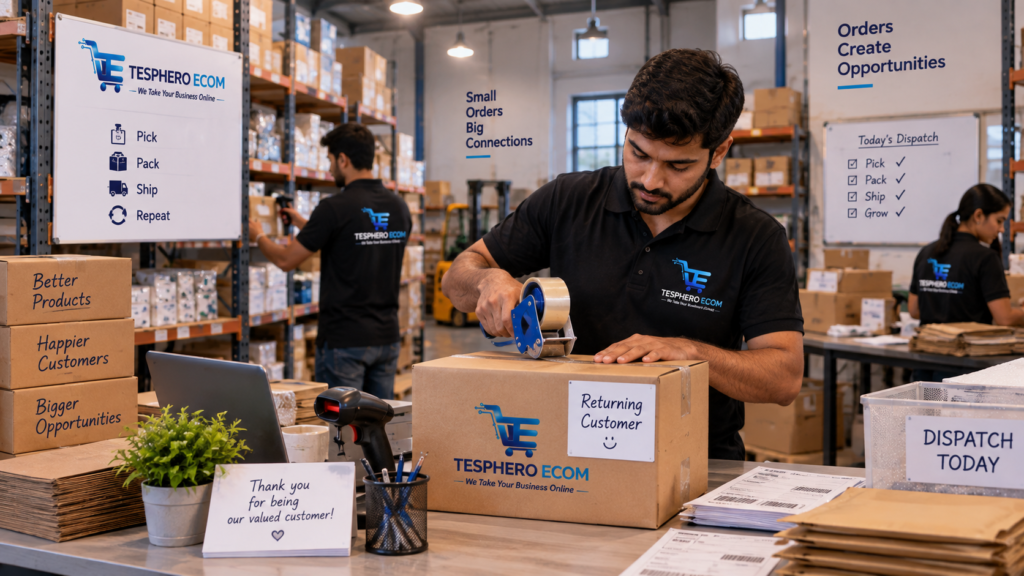
A smooth fulfilment and post-purchase experience can help turn first-time buyers into repeat customers and strengthen the overall e-commerce customer journey.