
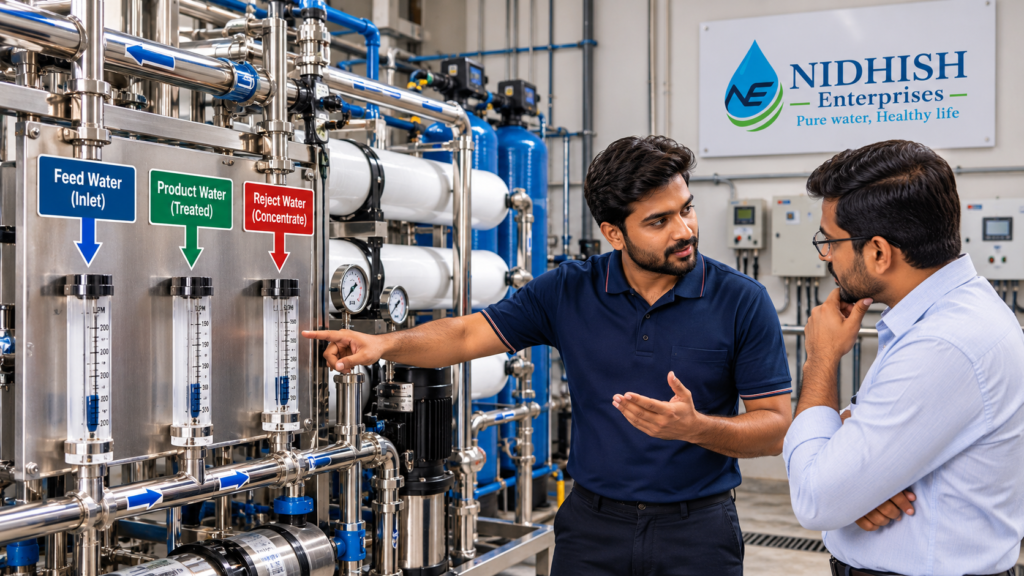
A Nidhish Enterprises technician explains commercial RO recovery by demonstrating feed water, treated water, and reject water flow, helping businesses understand water usage and improve system efficiency.
Commercial RO Reject Water is a major concern for businesses that rely on reverse osmosis systems for daily water needs. Offices, restaurants, hotels, hospitals, factories, and other commercial facilities may use RO systems to produce treated water. However, many operators do not know how much incoming water becomes usable product water and how much leaves the system as reject water.
A commercial RO system naturally produces two water streams. One is treated water, often called permeate or product water. The other is reject water, also known as concentrate, which carries a higher concentration of dissolved substances removed from the feed water.
Therefore, some reject water is a normal part of RO operation.
The real concern begins when the system produces more reject water than expected, requires excessive incoming water, or delivers less treated water than the business needs.
For example, a restaurant may notice that its water consumption has increased even though daily operations remain unchanged. Meanwhile, a factory may discover that its RO plant produces less treated water than its rated capacity.
These problems can stem from unsuitable operating settings, membrane fouling, poor pretreatment, or changes in raw water quality.
In this guide, we will explain how RO recovery works, how to calculate water usage, what causes excessive rejection, and how businesses in Indore can improve system performance without compromising water quality.
Table of Contents
- What Is Commercial RO Reject Water?
- Understanding RO Recovery Rate
- How to Calculate RO Water Recovery
- Why Commercial RO Systems Produce Reject Water
- Seven Reasons Your RO May Be Wasting Too Much Water
- How Raw Water Quality Affects Recovery
- The Business Cost of Excessive Reject Water
- Practical Ways to Improve RO Recovery
- Can Commercial RO Reject Water Be Reused?
- Warning Signs Your RO Needs Inspection
- Commercial RO Maintenance Checklist
- Choosing the Right RO System for Your Business
- How Nidhish Enterprises Can Help
- Frequently Asked Questions
1. What Is Commercial RO Reject Water?
Reverse osmosis is a membrane-based water treatment process.
During operation, pressure pushes water through a semipermeable membrane. A portion of the incoming water passes through the membrane as treated water, while another portion carries concentrated dissolved substances away from the system.
This second stream is called reject water or concentrate.
Commercial RO Reject Water is not necessarily a sign that the machine is faulty. It performs an important function by helping carry dissolved salts and other rejected substances away from the membrane.
Without sufficient concentrate flow, dissolved substances can accumulate near the membrane surface.
Consequently, the risk of scaling, fouling, and reduced membrane performance may increase.
Is All Reject Water Wasted?
Not always.
Reject water may be discharged, collected, treated further, or reused for an appropriate purpose.
However, its suitability depends on its chemical and microbiological characteristics.
For example, water with high dissolved salt content may not be suitable for irrigation or equipment washing without additional assessment.
Therefore, businesses should not assume that reject water is safe for every non-drinking application.
The first step is understanding how much reject water the system produces and whether that quantity is appropriate for its design.
2. Understanding RO Recovery Rate
RO recovery describes the percentage of incoming feed water that becomes treated product water.
It is one of the most useful measurements for understanding commercial RO water consumption.
For example, a system operating at 50% recovery produces approximately 50 liters of treated water from every 100 liters of feed water.
The remaining 50 liters leave as concentrate, assuming a simple steady-state water balance without other losses.
Why Recovery Rate Matters
A lower recovery rate means more feed water is required to produce the same amount of treated water.
Meanwhile, a higher recovery rate means a greater share of incoming water becomes product water.
However, higher recovery is not always better.
Pushing recovery beyond the system’s safe operating range can increase the concentration of dissolved substances inside the membrane system.
As a result, scaling and membrane damage risks may rise.
Therefore, the correct recovery target depends on feed water chemistry, membrane specifications, pretreatment, and system design.
3. How to Calculate RO Water Recovery
You do not need a complicated formula to understand basic RO recovery.
The standard calculation is:
RO Recovery (%) = (Product Water Flow ÷ Feed Water Flow) × 100
For example, suppose a commercial RO system receives 1,000 liters of feed water per hour and produces 600 liters of treated water per hour.
Its recovery rate is:
(600 ÷ 1,000) × 100 = 60%
The remaining 400 liters per hour become reject water in this simplified example.
Recovery Comparison Table
| Feed Water | Product Water | Reject Water | Recovery |
|---|---|---|---|
| 1,000 L | 400 L | 600 L | 40% |
| 1,000 L | 500 L | 500 L | 50% |
| 1,000 L | 600 L | 400 L | 60% |
| 1,000 L | 700 L | 300 L | 70% |
These are illustrative water-balance calculations, not recommended operating targets. Suitable recovery varies by system and feed water conditions.
What About the Reject-to-Product Ratio?
Another useful measurement compares reject water with product water.
For example, if a system produces 400 liters of reject water and 600 liters of product water, its reject-to-product ratio is approximately 0.67:1.
This means roughly 0.67 liters of reject water for every liter of treated water.
However, a single ratio does not prove whether the system is efficient.
You must compare actual performance with the manufacturer’s design specifications.
4. Why Commercial RO Systems Produce Reject Water
A reverse osmosis membrane separates water from many dissolved substances.
However, these substances do not disappear.
Instead, a significant portion remains in the concentrate stream.
As water passes through the membrane, the concentration of dissolved substances in the remaining feed stream increases.
Therefore, adequate concentrate flow is necessary to manage that concentration.
What Happens When Recovery Is Too High?
Operating beyond suitable recovery limits can increase scaling potential.
For example, calcium and other dissolved constituents may become concentrated enough to form deposits under certain conditions.
These deposits can reduce membrane performance and increase maintenance requirements.
In addition, insufficient concentrate flow can worsen fouling conditions.
Therefore, reducing reject water by simply restricting the concentrate outlet is not a safe general solution.
Any recovery adjustment should follow the membrane manufacturer’s requirements and a proper water-quality assessment.
5. Seven Reasons Your Commercial RO May Be Wasting Too Much Water
Excessive Commercial RO Reject Water can result from several operating or maintenance issues.
However, the cause should be confirmed through measurements rather than guesswork.
1. Incorrect Operating Settings
An RO system may have valves, flow controls, or automated settings that influence recovery.
If these are incorrectly adjusted, the system may produce more concentrate than intended.
Therefore, operating flows should be compared with the original design.
2. Membrane Fouling
Suspended particles, organic material, and other contaminants can accumulate on membrane surfaces.
As fouling develops, product water flow may decrease.
Consequently, the system may require more time or feed water to meet daily demand.
However, fouling should be diagnosed using operating pressure, flow, and water-quality trends.
3. Mineral Scaling
Calcium carbonate, silica, and other scale-forming substances may deposit on membranes under certain conditions.
Scaling can reduce water production and affect system performance.
Therefore, pretreatment and recovery settings must reflect the actual feed water chemistry.
4. Poor Pretreatment
Commercial RO systems often rely on pretreatment equipment.
Depending on the water source, this may include sediment filtration, activated carbon, softening, chemical dosing, or other processes.
If pretreatment is unsuitable or poorly maintained, membrane performance may suffer.
5. Changes in Raw Water Quality
Water characteristics may change with source conditions, seasons, or supply arrangements.
For example, groundwater chemistry can differ from municipal water chemistry.
A system designed for one feed water profile may not perform as expected when the source changes.
Therefore, updated water testing may be necessary.
6. Worn or Faulty Components
Pumps, valves, flow meters, sensors, and other components can affect system operation.
A faulty instrument may also display misleading readings.
Consequently, businesses should verify measurements before changing operating settings.
7. Poor Maintenance Practices
Delayed filter replacement, neglected cleaning, and inadequate monitoring can allow performance problems to develop.
Over time, the system may produce less treated water or operate less efficiently.
Therefore, a preventive maintenance schedule is usually more effective than waiting for a major failure.
6. How Raw Water Quality Affects Recovery
Raw water quality plays a major role in determining suitable RO recovery.
Two commercial systems with similar capacities may require different operating settings because their feed water characteristics differ.
TDS Is Only One Measurement
Total Dissolved Solids, or TDS, provides an indication of dissolved material in water.
However, TDS alone cannot determine whether a particular recovery rate is safe.
Other relevant parameters may include hardness, alkalinity, silica, iron, turbidity, pH, and specific dissolved ions.
Microbiological quality may also matter depending on the source and intended use.
Why Water Testing Matters
Consider two businesses in Indore.
One uses treated municipal water, while another uses groundwater.
Even if both systems have similar daily water requirements, their pretreatment and recovery needs may differ.
For example, groundwater with significant hardness or scaling potential may require additional treatment.
Therefore, a water test should guide equipment selection and operating decisions.
Businesses can also consult the Bureau of Indian Standards (BIS) for relevant Indian standards and water-quality information.
7. The Business Cost of Excessive Reject Water
Higher reject water volumes can affect more than the water bill.
They may also increase the overall cost of operating a commercial RO system.
Increased Feed Water Consumption
If a business needs 2,000 liters of treated water daily, the required feed water depends on recovery.
| Recovery Rate | Feed Water Needed | Reject Water Produced |
|---|---|---|
| 40% | 5,000 L | 3,000 L |
| 50% | 4,000 L | 2,000 L |
| 60% | Approximately 3,333 L | Approximately 1,333 L |
Figures assume steady-state operation and exclude flushing, cleaning, pretreatment losses, and other system-specific water use.
This example shows why recovery matters.
However, the highest recovery shown is not automatically suitable for every system.
Other Operating Expenses
Poor RO performance may also contribute to increased electricity consumption per liter of treated water, longer operating hours, maintenance work, and production interruptions.
For example, a restaurant may need to run its RO system longer to fill storage tanks.
Meanwhile, a factory may experience delays if treated water production falls below operational demand.
Therefore, tracking both water consumption and product water output can help identify hidden operating costs.
8. Practical Ways to Improve RO Recovery
Reducing Commercial RO Reject Water should begin with understanding the existing system.
Simply changing a valve without checking feed water quality may create larger problems.
Measure Actual Water Flow
Record feed, product, and concentrate flow rates using reliable instruments.
Then, calculate the recovery rate and compare it with the system’s design.
Test the Incoming Water
Check relevant chemical and physical parameters.
This helps determine whether scaling, fouling, or unsuitable pretreatment may be affecting performance.
Inspect Pretreatment Equipment
Review sediment filters, softeners, carbon filters, dosing systems, and other installed pretreatment components.
The correct inspection depends on the system configuration.
Monitor Membrane Performance
Track product flow, pressure, conductivity, and other relevant readings.
Where possible, compare normalized performance trends rather than relying only on a single day’s measurements.
Review Operating Settings Professionally
A qualified technician can assess whether flow controls, pressure, and recovery settings match the equipment specifications.
However, adjustments should remain within safe design limits.
Maintain Accurate Records
A simple operating log can help identify gradual changes before they become serious problems.
For example, a steady decline in product water output may indicate that further inspection is needed.
9. Can Commercial RO Reject Water Be Reused?
Reject water reuse can sometimes reduce freshwater demand.
However, it must be evaluated carefully.
Commercial RO Reject Water usually contains a higher concentration of dissolved substances than the incoming feed water.
Therefore, it should not automatically be treated as clean or harmless water.
Possible Reuse Applications
Depending on testing results and applicable requirements, some facilities may consider reject water for selected cleaning activities, suitable flushing systems, or further treatment.
However, each application requires a separate suitability assessment.
For example, using high-hardness concentrate on equipment may contribute to scaling or deposits.
Likewise, using unsuitable water for irrigation can affect soil or plants.
When Reuse May Not Be Appropriate
Reject water may contain constituents that make direct reuse unsuitable.
In addition, the presence of chemicals used during treatment can affect its characteristics.
Therefore, businesses should review water quality, local requirements, storage conditions, and the intended application before designing a reuse system.
Never use untreated reject water for drinking, food preparation, or other sensitive purposes without appropriate treatment and verification.
10. Warning Signs Your Commercial RO Needs Inspection
A commercial RO system may show early signs of performance problems.
Recognizing these changes can help businesses arrange timely maintenance.
Reduced Treated Water Production
If product water flow decreases under comparable operating conditions, membrane fouling, scaling, or equipment problems may be involved.
Unexpected Water Consumption
A sudden increase in feed water usage without a corresponding rise in treated water demand deserves investigation.
Changes in Pressure Readings
Unusual pressure or pressure-drop trends may indicate restrictions, fouling, or other operating issues.
Changes in Product Water Quality
A change in conductivity or other monitored water-quality parameters may require further assessment.
However, a single TDS reading does not establish overall water safety.
Frequent Shutdowns
Repeated alarms or shutdowns can indicate problems involving pressure, electrical components, controls, or other system conditions.
If these warning signs appear, arrange an inspection rather than attempting unverified adjustments.
For related guidance, read our previous article:
5 Signs Your Commercial Water Purifier Needs Professional Servicing
Signs your commercial water purifier needs servicing
11. Commercial RO Maintenance Checklist
Regular maintenance supports reliable water production and helps identify avoidable losses.
However, there is no universal servicing interval suitable for every commercial RO system.
Maintenance frequency depends on operating hours, feed water quality, equipment design, and manufacturer guidance.
Daily or Routine Checks
Operators can record feed water flow, product water flow, concentrate flow, operating pressure, and relevant water-quality readings.
They should also note unusual sounds, leaks, or alarms.
Periodic Inspections
Qualified personnel should inspect pretreatment equipment, pumps, valves, instruments, and membrane performance.
Cleaning or replacement decisions should follow actual conditions and manufacturer recommendations.
Water Quality Review
Repeat water testing when the source changes, performance shifts, or the operating plan requires reassessment.
Keep Maintenance Records
Document inspections, filter changes, membrane cleaning, repairs, and operating adjustments.
These records can help technicians identify recurring issues.
For more information, see:
Why Regular RO Maintenance Matters for Water Quality and System Performance
Regular RO maintenance for better system performance
12. Choosing the Right RO System for Your Business
A commercial RO system should match the business’s actual water requirements.
Capacity alone is not enough.
Understand Daily Water Demand
Estimate how much treated water the facility needs during normal and peak operating periods.
For example, an office and a food-processing facility may have very different consumption patterns.
Consider Feed Water Characteristics
Water testing helps determine suitable pretreatment and membrane system design.
Therefore, equipment should not be selected using TDS alone.
Evaluate Long-Term Operating Costs
Compare expected water use, electricity requirements, consumables, maintenance, and servicing needs.
A lower initial equipment price does not always mean lower long-term costs.
Ask About Recovery and Reject Water
Before installation, ask the supplier about the expected operating recovery, design assumptions, and concentrate handling requirements.
Also, confirm how performance will be monitored.
For additional guidance, read:
How to Choose the Right RO System for Your Office, Restaurant, or Business
Choose the right RO system for your business
13. How Nidhish Enterprises Can Help
At Nidhish Enterprises, we understand that commercial water treatment requirements differ from one facility to another.
An office, restaurant, hotel, or industrial unit may have different feed water conditions, daily demand, and maintenance requirements.
Therefore, commercial RO performance should be evaluated according to the actual application.
Commercial RO Support in Indore
Businesses experiencing excessive reject water, reduced treated water production, or recurring maintenance concerns may benefit from a professional system assessment.
A suitable evaluation may include reviewing water-quality reports, checking operating flow rates, inspecting pretreatment equipment, and identifying possible performance concerns.
However, the appropriate solution depends on the system’s condition and technical specifications.
Looking for Commercial RO Solutions?
Nidhish Enterprises provides commercial and industrial water purification solutions and related service support in Indore.
Whether you are planning a new installation or reviewing an existing system, understanding recovery and operating requirements is an important starting point.
Connect with Nidhish Enterprises to discuss your commercial RO requirements and explore suitable water treatment and maintenance options.
Conclusion
Commercial RO Reject Water is a normal part of reverse osmosis treatment, but excessive reject water may indicate operating inefficiency or unsuitable system conditions.
Understanding RO recovery helps businesses measure how much incoming water becomes treated water and how much leaves as concentrate.
However, improving recovery is not simply about reducing reject flow.
Raw water quality, pretreatment, membrane specifications, pressure, and scaling potential must all be considered.
For businesses in Indore, regular monitoring and timely maintenance can help identify avoidable water losses and support more reliable RO operation.
Most importantly, the goal should be safe, suitable, and efficient water treatment—not the highest possible recovery percentage at any cost.
Frequently Asked Questions
About the Author
Nidhish Enterprises provides information and solutions related to domestic, commercial, and industrial water purification systems in Indore. Our articles focus on practical water treatment topics, equipment selection, system maintenance, and responsible water management.
Disclaimer: This article provides general educational information. RO recovery, water quality, treatment requirements, and reject water reuse depend on site-specific conditions. System adjustments and reuse decisions should be based on appropriate testing, manufacturer specifications, professional assessment, and applicable regulations.
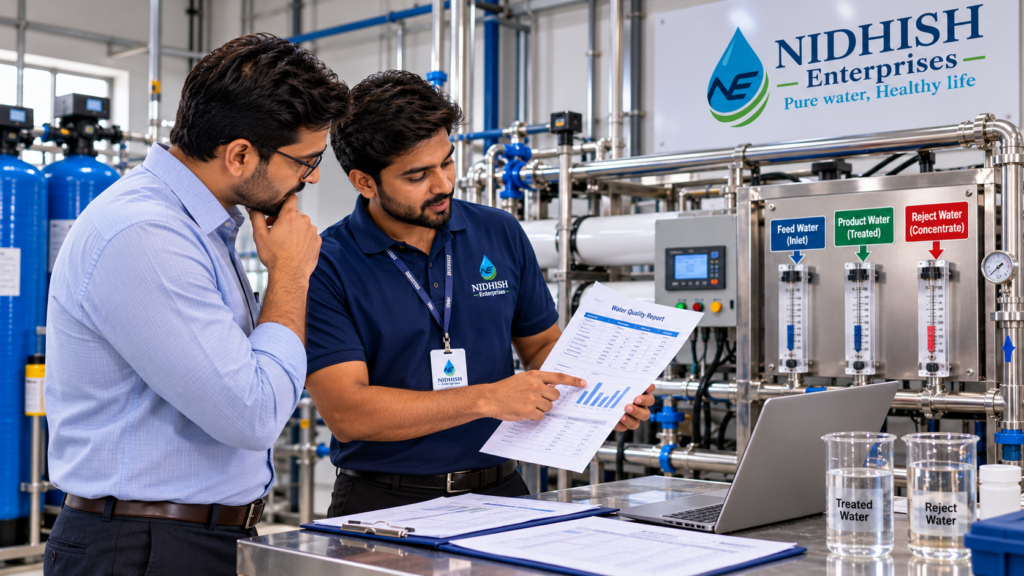
A Nidhish Enterprises technician reviews water quality reports, RO recovery readings, and maintenance records with a facility manager to assess commercial RO performance and identify opportunities for better water efficiency.