
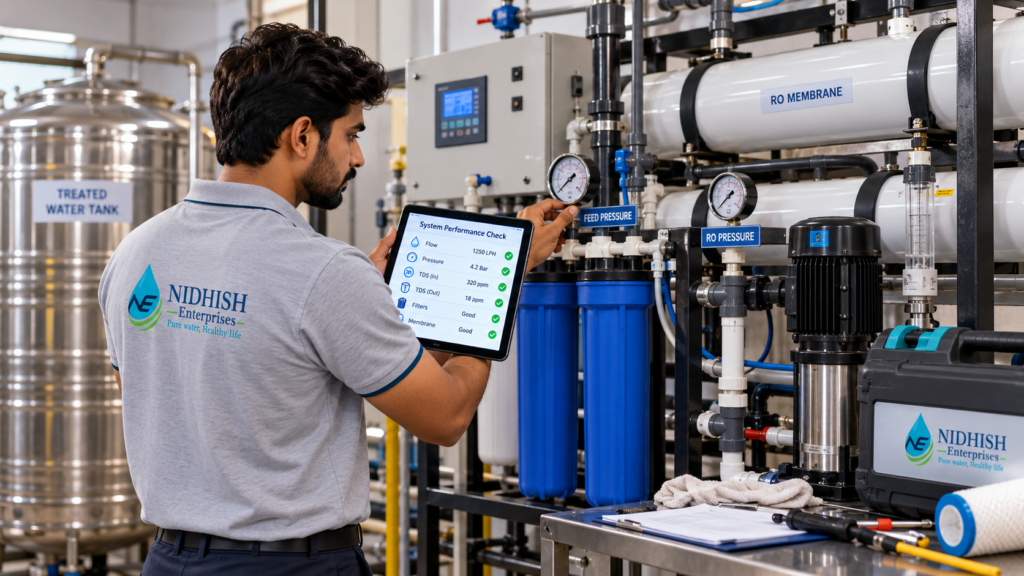
Checking flow, pressure, TDS, filters, and membrane performance can help identify early signs that a commercial water purifier needs professional servicing.
A Commercial Water Purifier Service should not begin only after the system completely stops working. In offices, restaurants, schools, factories, hospitals, hotels, and other commercial spaces, a purifier may show warning signs before a major performance problem develops.
Slower water flow, unusual taste or odour, changing TDS readings, strange noises, and visible leakage can all indicate that the system needs attention. However, these symptoms do not always point to the same fault. A clogged filter, membrane issue, pressure problem, pump fault, loose fitting, or another component may be responsible.
Therefore, guessing and replacing random parts is rarely the best approach. A trained technician can inspect the complete system, identify the likely cause, and recommend service based on the actual condition of the equipment.
This guide explains five common signs that may indicate your commercial water purifier needs professional servicing and what businesses should do when they notice them.
Table of Contents
- Why Commercial Water Purifier Servicing Matters
- Sign 1: Water Flow or Output Has Reduced
- Sign 2: Water Taste or Odour Has Changed
- Sign 3: TDS Readings Are Changing Unexpectedly
- Sign 4: The System Makes Unusual Noise
- Sign 5: You Notice Leakage or Water Around the System
- Why Professional Diagnosis Matters
- Preventive Maintenance vs Emergency Repair
- What a Professional Service Visit May Include
- Building a Practical Maintenance Routine
Why Commercial Water Purifier Service Matters
A commercial purifier can operate for many hours every day.
For example, an office may need drinking water throughout working hours. Meanwhile, a restaurant may depend on treated water for drinking, food preparation, beverages, or equipment, depending on its setup.
As usage increases, filters collect material from incoming water. RO membranes may also experience fouling or scaling, while pumps, valves, fittings, storage tanks, and other components can develop performance issues over time.
Pent air’s commercial RO guidance notes that membrane performance can be affected by contaminants, equipment size, and system pressure. It also explains that sediment Pre-filters help protect the membrane from suspended particles. Pent air
For this reason, maintenance should be based on the purifier design, source-water quality, usage, manufacturer guidance, operating conditions, and actual system performance.
If you want a broader maintenance overview, internally link here to “Why Regular RO Maintenance Matters for Water Quality and System Performance.”
Now, let us look at five warning signs businesses should not ignore.
1. Water Flow or Output Has Become Noticeably Slower
One of the easiest changes to notice is reduced water production.
Perhaps the purifier previously filled its storage tank comfortably during normal operations. Now, it takes much longer.
Alternatively, employees may notice that water flow becomes weak during busy periods.
Do not immediately assume that the RO membrane has failed.
Several factors can affect output.
These may include:
- clogged Pre-filters
- membrane fouling
- inadequate feed-water pressure
- pump problems
- blocked water lines
- valve issues
- unusually high water demand
- other system-specific faults
Pent air’s commercial EZ-RO troubleshooting guidance identifies clogged Pre-filters, fouled membranes, low feed-water pressure, blocked supply, and demand exceeding system capacity among possible causes of reduced water availability or production. Pent air Flow and Filtration Solutions
Why Reduced Flow Matters
A small drop in production can become a bigger operational problem when demand is high.
Suppose an office uses most of its stored treated water during lunch hours. If the purifier cannot replenish the tank quickly enough, employees may experience a shortage later.
Similarly, restaurants and other high-usage businesses can face disruption if treated-water production no longer matches normal demand.
What Should You Do?
First, compare current output with normal system performance.
Also check whether the incoming water supply or pressure has changed.
If the reduction continues, arrange a professional inspection.
A technician can examine filters, membrane performance, pressure, pumps, valves, and other relevant components instead of replacing parts without diagnosis.
Pent air also notes that commercial filtration systems have minimum pressure requirements and that low water pressure can affect system performance. Pent air
Therefore, reduced flow deserves investigation rather than guesswork.
2. Water Taste, Smell, or Appearance Has Changed
People often notice changes in water before they notice a mechanical problem.
Perhaps the treated water develops an unusual taste.
Maybe there is a new odour.
In some cases, its appearance may also seem different.
These changes should not automatically be blamed on one particular filter or component.
Instead, they should prompt a proper check of the purifier and, where appropriate, the water itself.
Why Can Taste or Odour Change?
Possible reasons depend on the system and source water.
For example, filters may need attention. The membrane may require evaluation. Storage and sanitation conditions can also matter.
Additionally, the incoming water itself may have changed.
Pent air’s RO troubleshooting guidance states that a gradual return of noticeable taste or odour can indicate that filter cartridges and/or the RO membrane need replacement. Pent air
However, businesses should avoid using taste alone as a water-quality test.
Water can look, smell, or taste normal while still requiring appropriate testing for the intended use.
Do Not Simply Ignore the Change
If employees or customers repeatedly report a difference, record when the issue started.
Then consider:
Has the source water changed?
When was the purifier last serviced?
Have filters recently been replaced?
Has the system remained unused for an extended period?
Does the issue affect every outlet connected to the purifier?
A technician can use this information during diagnosis.
Depending on the application and concern, appropriate water testing may also be advisable.
3. TDS Readings Are Changing Unexpectedly
Many commercial RO users regularly check Total Dissolved Solids, or TDS.
A TDS meter can provide useful information about dissolved ionic content and help operators observe changes between feed and treated water.
However, TDS should be interpreted correctly.
A single TDS number does not provide a complete assessment of drinking-water quality.
Watch for Changes From the Normal Pattern
Suppose your system usually produces treated water within a relatively stable operating range under similar conditions.
Then the reading begins changing significantly.
That change may justify further investigation.
Possible causes can include membrane performance issues, flow-control problems, operating conditions, measurement errors, or other system-specific factors.
Pent air’s troubleshooting guidance associates high product-water TDS with possible membrane or flow-control issues and recommends checking system components rather than relying on the reading alone. Pent air
Compare Feed and Treated Water
A technician may evaluate more than the final TDS number.
For an RO system, examining feed-water and permeate readings together can provide more useful performance information.
Still, proper interpretation depends on the system.
Therefore, avoid applying one universal “ideal TDS” value to every commercial installation.
Source water, treatment design, intended use, and applicable requirements all matter.
TDS Is Not a Complete Water Test
This point is especially important.
A TDS meter does not tell you everything about microbiological safety or every specific substance that may be present.
Consequently, businesses should not use a normal-looking TDS reading as proof that every water-quality parameter is acceptable.
When water quality itself is in question, suitable testing based on the application and applicable requirements may be necessary.
4. The Purifier Has Started Making Unusual Noises
Commercial water-treatment equipment naturally makes some sound.
Pumps run. Valves operate. Water moves through pipes and membranes.
Therefore, normal operating noise is not automatically a problem.
The warning sign is a new or noticeably different sound.
For example, you may hear:
- unusual vibration
- rattling
- repeated clicking
- louder pump operation
- irregular start-stop behavior
- unfamiliar humming
- other sounds that were not present earlier
Why Should New Noises Be Checked?
A new sound may indicate a mechanical or operating issue.
However, diagnosing the exact cause from sound alone is difficult.
Pressure conditions, pumps, valves, mounting, air in the system, or another component could be involved depending on the equipment.
Therefore, avoid opening pressurized housings or attempting electrical repairs without suitable knowledge.
Observe Before the Technician Arrives
You can still collect useful information safely.
Note:
When does the sound begin?
Does it happen continuously or only when the purifier produces water?
Has output also reduced?
Is the pump starting more frequently than before?
Did the problem begin after maintenance or a change in water supply?
This information can make professional troubleshooting easier.
5. You Notice Leakage or Water Around the System
Visible water near a commercial purifier should not become part of the normal routine.
Even a small recurring leak deserves attention.
Water may appear around:
- filter housings
- pipe connections
- fittings
- valves
- pumps
- membrane housings
- storage connections
- drain lines
- other joints
The exact cause requires inspection.
Why Small Leaks Should Not Be Ignored
A leak can waste water and affect the area around the purifier.
Moreover, water near electrical equipment can create additional safety concerns.
A small problem can also become more disruptive if a fitting or component deteriorates further.
Pent air’s RO troubleshooting instructions advise shutting off the water supply and seeking technical support when certain leaks persist after appropriate corrective steps. Pent air
Do Not Keep Tightening Everything
A common reaction is to tighten a leaking fitting as much as possible.
That is not always appropriate.
Over-tightening certain housings, threads, or fittings can cause additional damage.
Instead, follow the equipment manufacturer’s instructions or use a trained technician.
If leakage is significant, isolate the system safely according to its operating instructions and arrange service.
Quick Check: 5 Commercial Water Purifier Warning Signs
| Warning Sign | Possible Areas to Inspect | Recommended Response |
|---|---|---|
| Reduced water output | Filters, pressure, membrane, pump, supply | Check operating conditions and arrange diagnosis |
| Changed taste or odour | Filters, membrane, source water, storage | Inspect system and consider appropriate testing |
| Unexpected TDS change | Membrane, operating conditions, flow control | Compare readings and diagnose performance |
| New or unusual noise | Pump, pressure, valves, mounting | Stop guessing and have the system checked |
| Leakage | Fittings, housings, pipes, valves | Address promptly and inspect the source |
These symptoms are indicators, not final diagnoses.
The same symptom can have several possible causes.
Why Professional Commercial Water Purifier Service Matters
Businesses sometimes try to solve every purifier problem by replacing filters.
Sometimes that may help.
However, it will not fix every problem.
Suppose low output comes from insufficient feed pressure. Changing a filter may not address the underlying issue.
Likewise, a changing TDS reading may require membrane-performance checks rather than random component replacement.
Professional servicing can look at the system as a whole.
Depending on the purifier, a technician may check:
- feed-water conditions
- Pre-filters
- pressure readings
- pumps
- membrane performance
- TDS readings
- flow rates
- storage system
- fittings and valves
- electrical controls
- leaks
- sanitation condition
The exact procedure depends on the equipment and the problem.
That is why diagnosis should come before unnecessary replacement.
Preventive Maintenance vs Emergency Repair
Waiting until the purifier stops completely can create avoidable disruption.
Consider a restaurant during peak hours.
If its commercial RO system suddenly cannot meet water demand, the business may need an urgent solution.
Now compare that with identifying gradually declining output during a planned service check.
The second situation gives the business more time to respond.
Preventive Maintenance
Preventive maintenance focuses on inspecting and servicing equipment before an obvious breakdown occurs.
Depending on the system, this may involve monitoring filters, pressure, membrane performance, pumps, connections, tanks, and water-quality indicators.
Emergency Repair
Emergency repair begins after something has already failed or become seriously disruptive.
Businesses cannot prevent every unexpected fault.
However, routine monitoring may help identify some developing problems earlier.
For more context, internally link to “What Happens When Your Business Water System Fails? The Real Cost of RO Downtime.”
That article explains why water-system interruptions can affect more than repair costs.
Do Not Follow a Universal Filter or Membrane Schedule
You may see advice online such as:
“Change every filter every six months.”
Or:
“Replace every RO membrane after two years.”
Such numbers may apply to particular products, but they are not universal rules for every commercial purifier.
For example, Pent air’s EZ-RO documentation gives product-specific replacement recommendations while also stating that Pre-filters replacement can depend on capacity, pressure, and flow. Pent air
Meanwhile, another Pent air RO manual states that membrane life varies with feed-water quality and recommends periodic product-water testing to verify membrane performance. Pent air
Therefore, your service plan should consider:
Manufacturer Guidance + Source Water + Usage + Operating Hours + System Design + Actual Condition
A busy restaurant with challenging source water may place different demands on its purifier than a small office with lower daily consumption.
Source Water Can Affect Service Requirements
A commercial purifier does not operate independently of its incoming water.
Feed-water characteristics can influence filters, membranes, and overall treatment performance.
For example, sediment can load Pre-filters. Meanwhile, hardness and scaling conditions can affect certain systems.
Pent air notes that larger commercial RO installations may use incoming-water softening or scale-control measures to help protect membrane performance where appropriate. Pent air
This is particularly relevant when businesses experience hard-water problems.
Internally link here to “Hard Water Problems in Indore: How Water Softeners Can Protect Your Home and Business.”
However, do not assume that every RO installation requires a softener.
The appropriate pretreatment depends on source-water characteristics and system design.
What Can Happen When Warning Signs Are Ignored?
One warning sign does not guarantee that a purifier is about to fail.
Still, ignoring repeated or worsening symptoms can allow an underlying issue to continue.
For example, reduced output can eventually make it difficult to meet peak demand.
A leak can worsen.
Changing treated-water readings can continue without anyone investigating the reason.
Similarly, an abnormal pump sound may continue until operations become more disruptive.
Therefore, early inspection is often more practical than waiting for complete failure.
What a Professional Commercial Water Purifier Service May Include
There is no single service checklist that applies to every purifier.
Nevertheless, a professional visit may include several relevant checks depending on the system.
1. Visual Inspection
The technician can examine the installation for leakage, damaged components, loose connections, or unusual conditions.
2. Filter Evaluation
Pre-filters and other cartridges can be assessed based on service history, pressure, flow, capacity, and manufacturer recommendations.
3. Pressure and Flow Checks
These measurements can help identify restrictions or operating problems.
4. Membrane Performance Assessment
For RO systems, technicians may compare feed and permeate conditions and assess whether membrane performance has changed.
5. Pump and Electrical Inspection
Where applicable, the technician can examine pump operation and relevant controls.
6. Tank and Storage Inspection
Commercial systems with treated-water storage may require appropriate tank and associated component checks.
7. Leakage Inspection
Fittings, pipes, housings, and valves can be examined for visible leakage.
8. Service Records
Finally, recording readings and work completed creates a useful performance history.
This history can make future troubleshooting easier.
Keep a Simple Maintenance Record
You do not need complicated software to begin tracking purifier performance.
A simple service sheet can include:
| Record | Why It Helps |
|---|---|
| Service date | Shows maintenance history |
| Feed-water TDS | Provides source-water reference |
| Treated-water TDS | Helps observe performance trends |
| Pressure readings | Can reveal operating changes |
| Filter work | Records what was changed and when |
| Membrane work | Tracks inspection or replacement |
| Reported problem | Helps identify repeated faults |
| Technician notes | Provides context for future service |
Trends can be more useful than isolated readings.
For example, one unusual measurement may result from operating conditions or measurement error. However, repeated changes over several checks may justify deeper investigation.
When Should You Arrange a Commercial Water Purifier Service?
Some situations deserve faster attention.
For example, arrange prompt professional support when there is substantial leakage, an electrical concern, a sudden major drop in water production, repeated system shutdowns, or another condition that could affect safe operation.
Also, avoid opening pressurized components without proper procedures.
Water-treatment systems can involve pumps, pressure, electrical controls, and specialized components.
Therefore, servicing should follow manufacturer instructions and appropriate safety practices.
Build Maintenance Around Your Business
Commercial water demand differs from one business to another.
An office, restaurant, school, factory, hospital, and hotel may have very different usage patterns.
Therefore, the maintenance approach should consider:
- source-water quality
- daily water demand
- operating hours
- purifier capacity
- treatment technology
- equipment age
- manufacturer recommendations
- previous service history
- observed performance
If you are still selecting equipment, internally link to “How to Choose the Right RO System for Your Office, Restaurant or Business.”
Choosing appropriate capacity and treatment technology from the beginning can make future operation easier to manage.
How Nidhish Enterprises Can Help
Commercial water-treatment systems need more than occasional filter changes.
When output drops, readings change, leakage appears, or the purifier begins behaving differently, the underlying cause should be identified before unnecessary parts are replaced.
Nidhish Enterprises supports businesses with commercial water-treatment solutions, system servicing, maintenance, and practical troubleshooting.
The aim is to inspect the actual system, understand the operating problem, and recommend appropriate action based on equipment condition and business requirements.
Whether your system serves an office, restaurant, school, factory, hotel, or another commercial facility, a structured maintenance approach can help you manage performance more effectively.
Final Thoughts
A Commercial Water Purifier Service should not always wait for a complete breakdown.
Pay attention to five practical warning signs:
- Water flow or production has reduced.
- Taste, odour, or appearance has changed.
- TDS readings are changing unexpectedly.
- The purifier has developed unusual noises.
- Leakage appears around the system.
However, remember that these are symptoms rather than diagnoses.
Reduced output does not automatically mean the membrane needs replacement. Likewise, a TDS change does not tell you everything about overall water quality.
Instead, observe changes, maintain service records, follow manufacturer guidance, and use professional diagnosis when the system shows persistent or unusual behavior.
Regular attention can make it easier to identify problems before they turn into more disruptive operational issues.
A timely Commercial Water Purifier Service can help identify the cause of unusual performance before you start replacing components without proper diagnosis.
Frequently Asked Questions
About the Author
Nidhish Enterprises provides water-treatment solutions for homes, offices, restaurants, schools, factories, and other commercial requirements. Our focus is on helping customers select, maintain, and service water-treatment systems based on their actual water conditions, usage, and operational needs.
Is Your Commercial Water Purifier Showing Warning Signs?
Reduced output, unusual taste or odour, changing TDS readings, new noises, or leakage should not simply be ignored.
Nidhish Enterprises can help inspect your commercial water-treatment system, identify possible performance issues, and recommend suitable servicing based on the equipment and operating conditions.