
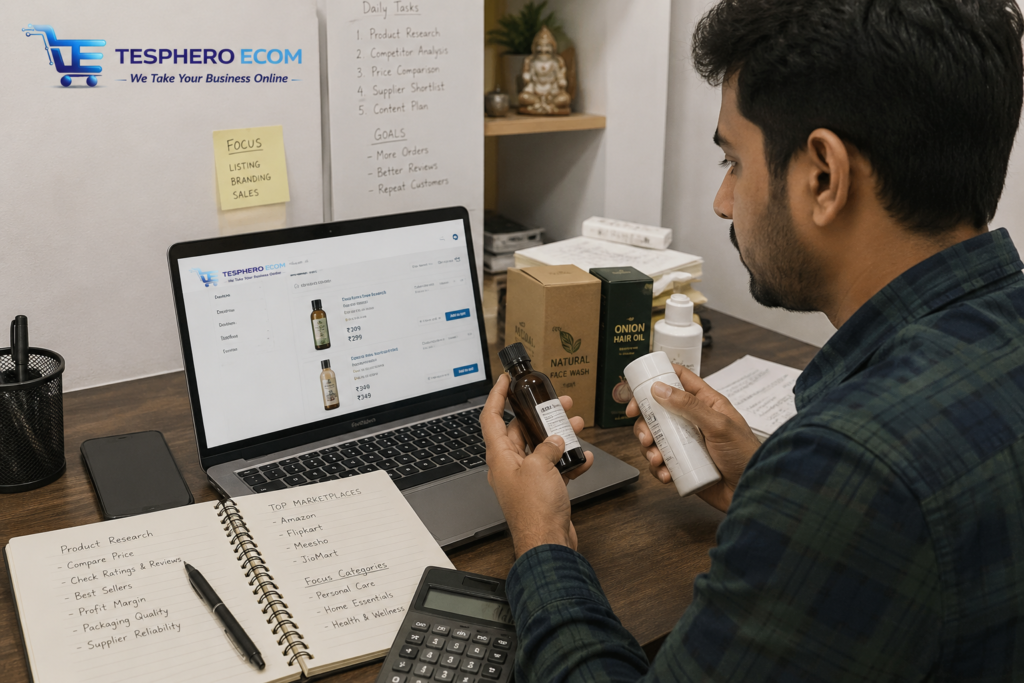
The right product begins with understanding demand, competition, and customers.
Starting an online business often begins with one question:
“What should I sell?”
It sounds simple, but this decision can influence almost everything that follows—from pricing and product listings to advertising, inventory, returns, and profitability.
Many first-time sellers make the mistake of choosing a product because it is trending, easily available, or already selling well on Amazon, Flipkart, or Meesho. But a popular product isn’t automatically the right product for your e-commerce business.
The better question is:
“Can I sell this product profitably, competitively, and consistently?”
A strong e-commerce product sits at the intersection of customer demand, manageable competition, healthy margins, reliable sourcing and practical operations.
This guide explains how to evaluate those factors before investing heavily in inventory or launching online.
Part 1: Don’t Start With a Product—Start With the Market
1. Look for Demand, Not Just Trends
A viral product can look like an easy opportunity.
You see hundreds of videos about it, marketplace listings have thousands of reviews, and suddenly it feels like something everyone wants.
But trends can disappear quickly.
By the time a new seller sources inventory, prepares packaging, creates listings, and starts advertising, customer interest may already be moving elsewhere.
Instead of asking whether a product is trending, investigate whether it has sustainable demand.
Think about why people buy it.
Does it solve a recurring problem?
Is it used regularly?
Does it belong to a stable category?
Would customers still need it six months from now?
For example, everyday kitchen organisers may not receive the attention of a viral gadget, but they can address a clear and recurring household need.
Trends can create opportunities. However, they shouldn’t be your only reason for entering a category.
2. Understand the Customer Behind the Product
Before choosing what to sell online, define who is likely to buy it.
Suppose you’re considering premium desk accessories.
Your potential customer may be a working professional who cares about design, organisation and quality.
If you’re considering affordable storage products, the target customer may be much more price-sensitive.
These audiences won’t respond to the same product positioning.
Ask yourself:
- Who is this product for?
- What problem does it solve?
- Why would someone search for it online?
- What matters most to the buyer—price, quality, convenience, design, or durability?
- Would the customer buy it once or repeatedly?
The clearer your customer is, the easier it becomes to evaluate whether the product opportunity actually makes sense.
3. Study Competition Before Entering the Category
Competition isn’t necessarily bad.
If several established sellers are successfully selling a product, that can indicate existing demand.
The problem begins when you enter a crowded category without a reason for customers to choose you.
Search for similar products on the marketplaces where you plan to sell.
Look at how competitors are presenting them.
Pay attention to their pricing, reviews, ratings, product images, specifications, packaging, and customer complaints.
Most importantly, read the negative reviews.
They can reveal opportunities.
If customers repeatedly complain about weak packaging, confusing sizing, or poor durability, there may be room for a better offer.
Your goal isn’t to copy the bestseller.
It is to understand:
“What can I offer differently or better?”
That difference doesn’t always need to be revolutionary. Better packaging, a useful bundle, improved quality, clearer sizing, or stronger product presentation can sometimes create meaningful differentiation.
4. Don’t Confuse High Sales With High Profit
This is one of the most important lessons for a new marketplace seller.
A product selling thousands of units isn’t necessarily generating excellent profits.
Imagine you source an item for ₹250 and sell it online for ₹499.
At first glance:
₹499 – ₹250 = ₹249 profit.
But that’s not your actual profit.
You may still need to account for marketplace-related charges, shipping or fulfilment costs, packaging, advertising, taxes where applicable, returns and other operating expenses.
Once these costs are considered, the margin may look very different.
Before selecting a product, create a basic unit economics calculation.
Ask:
“After all expected costs, is there still enough margin for this product to make business sense?”
This calculation should happen before you order large quantities.
5. Consider Whether the Product Is Practical to Sell Online
Some products are easier to manage online than others.
A fragile product may require stronger packaging and can carry a higher risk of damage.
A very heavy or bulky item may increase logistics costs.
Products with multiple sizes or variations can make inventory more complex.
Certain categories may also involve specific documentation, compliance requirements, or marketplace restrictions.
This doesn’t mean you should automatically avoid these products.
It means you should understand the operational challenges before entering the category.
A product can look highly profitable on a spreadsheet but become difficult to manage once packaging, shipping, and returns enter the picture.
A good e-commerce product should work operationally as well as commercially.
Test Whether the Product Can Become a Real Business
Finding a product with demand is only the beginning.
Now you need to determine whether you can source it reliably, price it competitively, and build a sustainable business around it.
6. Calculate Your Real Product Margin
Before committing to a product, understand the complete cost structure.
Your calculation may need to consider:
Product Cost + Packaging + Logistics + Marketplace Charges + Advertising + Expected Returns + Other Applicable Business Costs
Then compare this with the realistic selling price.
Notice the word realistic.
Don’t calculate profitability using the highest price in the category if most customers are purchasing products at a much lower price point.
Suppose similar products commonly sell between ₹600 and ₹750.
If your business only becomes profitable at ₹1,100, you need a strong reason why customers would pay that difference.
Maybe your quality is significantly better.
Maybe you offer more quantity.
Maybe the product has a useful feature competitors lack.
Without a clear value difference, pricing can become difficult.
Healthy margins also give you room to handle advertising, promotions, and unexpected costs without immediately making the product unprofitable.
7. Check Whether You Can Source Consistently
Imagine launching a product successfully, getting good reviews and seeing orders increase.
Then your supplier says:
“Stock will be available next month.”
Suddenly your growth stops.
Reliable sourcing matters just as much as finding a good product.
Before choosing a supplier or manufacturer, consider consistency of quality, production capacity, lead times, minimum order quantities and communication.
If you’re a manufacturer yourself, evaluate whether production can scale if online demand increases.
Consistency is especially important when building a brand.
Customers expect the product they receive next month to match the quality they received today.
Changing materials, dimensions, or finish because of sourcing problems can eventually affect reviews and customer trust.
8. Think About Returns Before You Think About Sales
Most beginners calculate expected orders.
Experienced sellers also think about why those orders might come back.
Some products naturally require more customer decision-making.
For example, products involving fit, compatibility, colour expectations, or complex usage may create more opportunities for misunderstanding.
Ask:
What could make a customer return this product?
Then determine whether the problem can be reduced before purchase.
Clear dimensions can prevent size confusion.
Accurate images can manage colour and appearance expectations.
Compatibility information can prevent incorrect purchases.
Simple instructions can reduce usage-related frustration.
Returns cannot always be eliminated, but thoughtful product selection and strong listing information can help reduce avoidable ones.
9. Ask Whether You Can Differentiate the Product
Suppose 50 sellers offer almost the same item.
Same design.
Similar photographs.
Similar quality.
Similar pricing.
Why should the customer choose yours?
If your only answer is:
“I’ll sell it cheaper,”
you may eventually enter a price war.
Instead, think about differentiation.
Could you improve the material?
Create better packaging?
Offer a useful bundle?
Solve a common customer complaint?
Target a specific use case?
Provide clearer instructions?
Build stronger branding around the category?
You don’t always need to invent a new product.
Sometimes you can take an existing product and create a better offer around it.
10. Start Small and Validate Before Scaling
Finding what appears to be a winning product can create excitement.
But don’t let excitement turn into unnecessary inventory risk.
Instead of ordering thousands of units immediately, consider testing the opportunity at a manageable scale where practical.
A small launch can help you understand real-world questions such as:
Are customers clicking the listing?
Is the price acceptable?
Which product images work?
Are customers satisfied with quality?
What questions do they ask?
Why are products being returned?
What do reviews say?
Real customer behaviour is usually more valuable than assumptions.
Once the product shows encouraging signs and the economics make sense, inventory can be increased more confidently.
Validate first. Scale second.
Choose a Product You Can Grow With
The right product isn’t necessarily the one that generates the fastest first sale.
A better product gives you room to build something sustainable.
11. Think Beyond One Product
Before entering a category, consider where it could lead.
Suppose your first product succeeds.
What would you sell next?
If you’re selling home organisation products, there may be opportunities to expand into related storage solutions.
If you’re building a personal-care brand, one successful product could potentially lead to complementary products.
This matters because long-term e-commerce growth becomes easier when customers can associate your business with a clear category or need.
Instead of building a store filled with unrelated products, consider whether your first product can become the foundation for a broader range.
12. Choose the Right Marketplace for the Product
Not every product needs to be sold everywhere from day one.
Different marketplaces can attract different customer segments, buying behaviour and competitive environments.
Your product positioning, pricing and category should influence where you begin.
Research how similar products are being sold on the platforms you’re considering.
Look at competition, pricing, customer expectations and the general presentation of successful listings.
For some businesses, focusing on one marketplace initially can make inventory and operations easier to manage.
Once the product and process are working consistently, expanding to additional channels may become more practical.
Sellers exploring different digital commerce opportunities can also learn about the broader open-commerce ecosystem through the official ONDC resources.
13. Don’t Ignore Product Presentation
Even the right product can struggle with the wrong listing.
Customers shopping online cannot physically hold the product before buying.
Your listing has to do much of the selling.
That means your product title, images, bullet points, description, and specifications should work together to answer the customer’s questions.
Strong product photography should clearly show what the customer will receive.
Your content should explain benefits without making exaggerated claims.
Important details such as dimensions, material, quantity, and compatibility should be easy to find.
If your product is good but your listing doesn’t communicate that value, customers may simply choose a competitor.
Once you’ve selected the right product, the next challenge is presenting it effectively. Read our guide “Your Product Is Good, But Is Your Listing Selling It? 8 Ways to Improve Product Listings” to understand how listing quality can influence customer decisions.
14. Look for Repeat-Purchase or Cross-Selling Potential
Not every successful product needs to be purchased repeatedly.
However, repeat purchase and cross-selling potential can strengthen the long-term economics of an e-commerce business.
Ask:
After someone buys this product, what might they need next?
It could be a refill, an accessory, a complementary product, or another item in the same category.
This shifts your thinking from:
“How do I get one order?”
to:
“How do I build a customer relationship?”
That difference becomes increasingly important as your business grows.
A Simple Product Selection Framework
Before finalising any product, evaluate five areas: Demand, Competition, Margin, Operations, and Growth Potential.
If demand exists but margins are weak, reconsider the economics.
If margins are attractive but demand is unclear, validate the market before investing heavily.
If demand and margin are strong but sourcing is unreliable, fix the supply chain first.
And if everything looks reasonable but you have no way to differentiate the product, ask why customers should choose you.
A promising product doesn’t need perfect scores in every area.
But major weaknesses should be understood before you invest.
Common Product Selection Mistakes
New sellers often run into trouble by following trends blindly, ordering too much inventory too early, copying bestselling products, ignoring marketplace costs or choosing products purely because a supplier offers them cheaply.
Another common mistake is trying to sell too many unrelated products at once.
Every new product requires inventory, listing work, pricing decisions, customer support, and performance monitoring.
A focused beginning is often easier to learn from and improve.
How Tesphero Ecom Can Help
Choosing the right product involves more than finding something that appears popular online.
At Tesphero Ecom, we help businesses approach online selling more strategically—from product selection guidance and seller account setup to product listing optimization, marketplace strategy, branding, and growth consulting.
For a new seller, this can mean evaluating a product opportunity before committing heavily to inventory.
For an existing business, it may mean identifying which products from an offline catalogue have stronger potential for online marketplaces.
The objective isn’t simply to put more products online.
It’s to build an e-commerce business around products that have a realistic opportunity to compete and grow.
Have a product idea but aren’t sure whether it is suitable for online marketplaces? Contact Tesphero Ecom to discuss your e-commerce requirements.
Final Thoughts
There is no universal “best product” to sell online.
A product that works extremely well for one seller may fail for another because their sourcing, pricing, positioning, or customer base is different.
That’s why successful product selection requires more than following bestseller lists.
Understand the customer.
Study demand.
Analyse competitors.
Calculate real margins.
Think about logistics and returns.
Check supplier reliability.
Identify how you’ll differentiate.
Then start at a manageable scale and learn from real customers.
The goal isn’t to find a product that can be listed online.
It’s to find one that makes sense as a business.
Before asking:
“What is trending right now?”
Ask a better question:
“What can I sell well, profitably, and consistently?”
That question can lead to a much stronger e-commerce journey.
Frequently Asked Questions
About the Author
Tesphero Ecom helps businesses navigate the practical challenges of starting and growing on online marketplaces. From product selection and seller account setup to listing optimization, marketplace strategy, and brand growth, the focus is on helping businesses make more informed e-commerce decisions rather than simply getting products online.
Whether you’re a first-time seller, manufacturer, retailer, or growing D2C business, Tesphero Ecom works to build a more structured path from product selection to marketplace growth. To learn more about our approach and e-commerce services, visit Tesphero Ecom.

The strongest product opportunities can create room for future growth.