
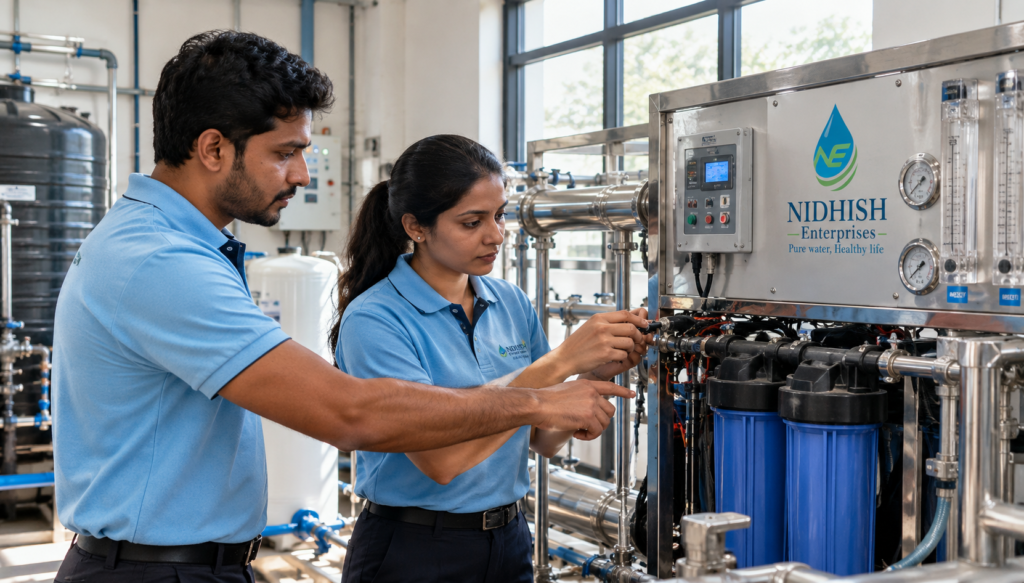
Nidhish Enterprises technicians inspect and service a commercial RO system, checking filters, connections, and operating components to support reliable water purification and consistent system performance.
Commercial RO Capacity Planning is one of the most important steps when choosing a water purification system for an office, restaurant, hotel, school, factory, or other commercial facility. The right system should provide enough purified water during busy hours without creating unnecessary operating expenses.
However, many businesses select an RO plant mainly by looking at its advertised capacity.
A supplier may offer a 250 LPH, 500 LPH, or 1000 LPH system. These numbers look straightforward, but they do not explain how much usable water the business will receive under actual operating conditions.
For example, an office may need drinking water throughout the working day, while a restaurant may require large quantities during lunch and dinner. A factory may have a completely different demand pattern.
Therefore, selecting a commercial RO system requires more than estimating the number of people using the building.
Businesses must consider daily water demand, peak usage, raw water quality, system recovery, operating hours, storage capacity, and future requirements.
This guide explains how to calculate a practical RO capacity, avoid common sizing mistakes, and make a better-informed investment.
Table of Contents
- What Is Commercial RO Capacity Planning?
- Why Choosing the Right RO Capacity Matters
- Understand LPH and Daily Water Production
- Step 1: Calculate Your Daily Purified Water Requirement
- Step 2: Identify Peak-Hour Water Demand
- Step 3: Check Raw Water Quality
- Step 4: Understand RO Recovery and Reject Water
- Step 5: Calculate Required Operating Hours
- Step 6: Plan Purified Water Storage
- Step 7: Consider Future Business Growth
- Commercial RO Capacity Comparison Table
- Common Commercial RO Sizing Mistakes
- How to Choose a Suitable RO System
- How Nidhish Enterprises Can Help
- Frequently Asked Questions
1. What Is Commercial RO Capacity Planning?
Commercial RO Capacity Planning is the process of estimating how much purified water a business needs and selecting a reverse osmosis system that can reliably meet that requirement.
The process considers both the quantity of water needed and the conditions under which the system will operate.
For example, two businesses may each require 2,000 liters of purified water daily.
However, their capacity requirements could be different.
One business may operate for ten hours with relatively steady demand. Another may need most of its water within four hours.
Although their daily consumption is similar, the second business may require a higher production rate or a larger purified water storage tank.
Capacity Planning Is Not Just About Buying a Bigger Plant
In fact, a larger RO plant is not automatically the better choice.
An oversized system may involve higher initial investment and unnecessary operating complexity.
Meanwhile, an undersized system may struggle to meet demand during busy periods.
The goal is to match production capacity with actual business requirements.
2. Why Choosing the Right RO Capacity Matters
For this reason, choosing the correct RO capacity can influence daily operations, water availability, and maintenance planning.
Avoiding Water Shortages
For example, businesses such as restaurants, offices, and schools depend on consistent water availability.
A restaurant may need purified water for food preparation and drinking. A school may require it during breaks. An office may experience higher demand during meetings and lunch hours.
If the system cannot meet these requirements, operations may be disrupted.
Controlling Operating Expenses
An unnecessarily large system may increase capital costs and may not be the most efficient option for the business.
However, operating costs depend on system design, pump efficiency, feed water quality, treatment requirements, and maintenance.
Therefore, size alone does not determine efficiency.
Supporting Equipment Performance
A properly designed system should operate within its intended pressure, flow, and treatment conditions.
Incorrect sizing or unsuitable operating conditions can affect performance and maintenance needs.
Preparing for Future Requirements
A business may expand its workforce, add new facilities, or increase production.
Capacity planning should consider realistic future demand without automatically purchasing a much larger system than necessary.
3. Understand LPH and Daily Water Production
Commercial RO systems are commonly described using LPH, which means liters per hour.
A 500 LPH system is generally described as having a nominal production capacity of 500 liters of purified water per hour under specified conditions.
However, actual production can vary depending on operating conditions.
What Does a 500 LPH RO Plant Mean?
If a system genuinely produces 500 liters per hour under its operating conditions and runs for six productive hours, the theoretical daily output is:
In other words, a 500 LPH system has a nominal production capacity of 500 liters of purified water per hour under specified conditions.
However, this is a simplified calculation.
Actual usable production may be affected by feed water quality, temperature, membrane condition, operating pressure, cleaning cycles, and downtime.
Why Rated Capacity Is Not Always Actual Capacity
Manufacturers may state capacity under particular test conditions.
Therefore, buyers should ask what assumptions were used to determine the advertised LPH rating.
A system producing its rated output under one set of conditions may deliver a different amount when installed at another location.
Practical tip: Request an expected production estimate based on your tested raw water and proposed operating conditions.
4. Step 1: Calculate Your Daily Purified Water Requirement
The first step in Commercial RO Capacity Planning is to estimate how much purified water the business actually uses.
Instead, calculate actual water demand rather than selecting a system based only on building size or employee count.
Instead, identify every activity that requires treated water.
Offices
For an office, demand may come from drinking water, pantry use, meetings, and other approved applications.
The estimate should consider daily attendance, visitors, and usage patterns.
Restaurants and Cafés
Restaurants may require purified water for drinking, beverages, cooking, and certain food preparation activities.
Demand may increase during peak service periods.
Schools and Educational Institutions
Schools may experience concentrated drinking-water demand during breaks and lunch periods.
The number of students, staff, visitors, and operating hours should be considered.
Hotels and Hospitality Businesses
Water requirements vary depending on the hotel’s facilities and the specific applications served by the RO system.
Not every hotel water requirement needs RO treatment.
Factories and Industrial Facilities
Industrial water demand depends heavily on the process.
For example, water used in a production process may require different quality specifications from water intended for drinking.
Therefore, industrial capacity calculations should begin with the actual process requirement.
A Simple Daily Demand Worksheet
Consider an illustrative office with the following estimated purified water demand:
| Usage | Estimated Daily Requirement |
|---|---|
| Employee drinking water | 300 liters |
| Visitors and meetings | 100 liters |
| Pantry and beverage preparation | 150 liters |
| Other approved uses | 50 liters |
| Total daily requirement | 600 liters |
These figures are examples, not standard consumption rates.
Therefore, each business should use its own consumption records, measured flow, or a realistic site-specific estimate.
Add an Appropriate Planning Allowance
Actual demand may vary between days.
A reasonable allowance can account for normal fluctuations, but it should be based on the business’s usage pattern rather than an arbitrary universal percentage.
Practical tip: Where possible, measure water use over several representative working days before choosing a system.
5. Step 2: Identify Peak-Hour Water Demand
However, daily consumption alone does not determine the right RO capacity.
Businesses also need to understand when water is used.
Why Peak Demand Matters
Consider two offices that each consume 1,000 liters daily.
Office A uses water steadily throughout the day.
Office B experiences a large portion of its demand during short breaks and meetings.
Office B may require greater storage capacity or a different production arrangement.
Measure the Busiest Periods
Identify when demand is highest.
For a restaurant, this could be meal preparation and service hours.
For a school, it could be scheduled breaks.
For a factory, it could be a particular production shift.
Production and Storage Work Together
A system does not necessarily need to produce water at the same rate as the highest momentary demand.
A properly sized purified water storage tank can help meet short-term peaks.
However, the RO system must still be able to replenish the tank over the available operating period.
Practical tip: Record both total daily demand and the largest expected short-period demand.
6. Step 3: Check Raw Water Quality Before Choosing Capacity
In addition, raw water quality is a major factor in RO system selection.
Two sites requiring the same amount of purified water may need different treatment designs.
Why Source Water Matters
The feed water may come from municipal supply, bore well water, tanker water, or another source.
Its quality can vary by location and season.
Parameters such as dissolved solids, hardness, turbidity, iron, and other contaminants may affect treatment requirements.
However, TDS alone does not provide a complete picture of water safety or treatment suitability.
How Raw Water Affects RO Performance
Feed water conditions can influence membrane selection, pretreatment needs, achievable recovery, operating pressure, and expected output.
For example, water with significant scaling potential may require suitable pretreatment and operating controls.
Test Before Finalizing the Plant
A professional water analysis should be used to assess relevant physical, chemical, and microbiological parameters according to the intended use.
For drinking-water applications in India, applicable BIS requirements and other relevant standards should be considered.
Practical tip: Do not finalist the RO capacity or treatment configuration based only on a salesperson’s estimate.
RO, UV and UF water purification technologies\
For information on Indian Standards, refer to the Bureau of Indian Standards (BIS).
7. Step 4: Understand RO Recovery and Reject Water
Commercial RO Capacity Planning should also consider the relationship between feed water, purified water, and reject water.
RO systems separate incoming water into two streams:
- Permeate: Water that passes through the membrane and becomes the treated output.
- Concentrate or reject water: Water carrying a higher concentration of substances retained by the membrane.
What Is RO Recovery?
RO recovery describes the percentage of incoming feed water converted into permeate.
The simplified formula is:
Recovery (%) = (Permeate Flow ÷ Feed Water Flow) × 100
For example, suppose an RO system receives 1,000 liters of feed water and produces 600 liters of permeate.
Its recovery is:
(600 ÷ 1,000) × 100 = 60%
The remaining 400 liters leave as concentrate, assuming a simple mass balance with no other losses.
Why Recovery Matters for Capacity Planning
If a business needs 3,000 liters of purified water daily, it must also consider how much feed water the RO system requires.
At an illustrative 60% recovery:
Feed water required = 3,000 ÷ 0.60 = 5,000 liters
The approximate concentrate volume would be 2,000 liters.
However, 60% is only an example.
Suitable recovery depends on feed water chemistry, system design, scaling risk, pretreatment, and operating conditions.
Higher Recovery Is Not Always Better
Increasing recovery beyond a suitable operating range can increase scaling and fouling risks.
Therefore, businesses should not select a plant based only on a high recovery claim.
Practical tip: Ask the supplier for expected permeate output, feed water requirement, recovery range, and reject water handling recommendations.
Understanding RO recovery and reject water.
8. Step 5: Calculate Required Operating Hours
After that, determine how many hours the RO system can realistically operate.
A Basic Capacity Formula
Required RO Capacity (LPH) = Daily Purified Water Demand (Liters) ÷ Productive Operating Hours
Suppose a business needs 3,000 liters of purified water daily.
If the RO plant can operate for six productive hours:
3,000 ÷ 6 = 500 LPH
A nominal 500 LPH system might appear suitable.
However, this calculation assumes that the system can consistently produce 500 liters per hour during those six hours.
Account for Real Operating Conditions
A practical design should also consider periods when the system is unavailable for maintenance, cleaning, interruptions, or other operational reasons.
Actual production may differ from the nameplate rating.
Therefore, confirm expected output under site-specific conditions before making a final decision.
Do Not Confuse Operating Hours With Business Hours
A business may remain open for twelve hours, but its RO plant may not operate continuously for that entire period.
For example, operation could be limited by water availability, storage capacity, staffing, or other constraints.
Practical tip: Use realistic productive hours, not simply the total hours the business remains open.
9. Step 6: Plan Purified Water Storage
Therefore, an RO plant and a purified water storage tank should be planned together.
As a result, storage helps businesses manage differences between water production and consumption.
Why Storage Is Important
A business may use water faster than the RO plant produces it during short peak periods.
A storage tank can provide water during those periods while the system replenishes the supply.
How Much Storage Is Needed?
There is no universal storage tank size suitable for every business.
The required capacity depends on peak demand, production rate, operating schedule, continuity requirements, and water quality management.
For example, a restaurant with concentrated service hours may need a different storage arrangement from an office with relatively steady usage.
Storage Must Also Be Hygienic
Stored purified water can be affected by poor tank hygiene, contamination, unsuitable materials, or inadequate maintenance.
Therefore, storage design should include appropriate sanitary protection, cleaning access, and monitoring.
For drinking-water systems, applicable hygiene and water quality requirements must be followed.
Practical tip: Do not select the storage tank only by matching its volume to one day’s total demand.
10. Step 7: Consider Future Business Growth
Over time, businesses may expand and require more purified water.
An office may hire more employees.
A restaurant may increase seating capacity.
A factory may add a production shift.
These changes can affect purified water requirements.
Estimate Realistic Growth
Consider planned expansions that are reasonably likely to happen.
However, avoid choosing a dramatically oversized plant based only on uncertain future possibilities.
Explore Scalable Options
Depending on the application, businesses may consider modular systems, additional storage, or future expansion provisions.
The best option depends on technical feasibility and cost.
Balance Present and Future Needs
A system should meet current demand reliably while allowing a sensible response to future growth.
Practical tip: Discuss expected business changes with the RO supplier before finalizing the design.
11. Commercial RO Capacity Comparison Table
The following table shows how different daily water requirements translate into simplified production rates.
These calculations assume the stated number of productive operating hours and do not include a separate allowance for downtime or performance variation.
| Daily Purified Water Demand | Productive Hours | Calculated Production Rate |
|---|---|---|
| 500 liters | 5 hours | 100 LPH |
| 1,000 liters | 5 hours | 200 LPH |
| 1,500 liters | 6 hours | 250 LPH |
| 3,000 liters | 6 hours | 500 LPH |
| 5,000 liters | 10 hours | 500 LPH |
| 8,000 liters | 8 hours | 1,000 LPH |
| 10,000 liters | 10 hours | 1,000 LPH |
Keep in mind that these are mathematical examples, not product recommendations.
For instance, a business requiring 5,000 liters per day could theoretically meet that demand using a system producing 500 LPH for ten productive hours.
However, a different combination of production capacity and storage may be more suitable depending on demand peaks and operational constraints.
Use the Table as a Starting Point
The table helps buyers understand the relationship between daily demand, operating time, and production rate.
It should not replace raw water testing, site assessment, or technical system design.
12. Common Commercial RO Sizing Mistakes
As a result, overlooking important sizing factors can lead to unsuitable equipment selection.
Mistake 1: Choosing Capacity Only by Employee Count
The number of employees does not fully explain how water is used.
A restaurant, office, and factory with the same number of workers may have very different requirements.
Mistake 2: Ignoring Peak Demand
A system may meet the daily volume but still struggle during busy periods if storage is inadequate.
Mistake 3: Assuming Rated LPH Is Guaranteed
Actual production depends on operating conditions.
Always request expected site-specific performance.
Mistake 4: Skipping Raw Water Testing
Without testing, the supplier may not have enough information to select suitable pretreatment and operating conditions.
Mistake 5: Ignoring Reject Water
The business must account for feed water availability and appropriate concentrate management.
Mistake 6: Choosing a Bigger Plant Without Calculation
A larger system may increase investment without providing a meaningful operational benefit.
Mistake 7: Forgetting Maintenance Access
Commercial RO plants need appropriate space for inspection, servicing, and component replacement.
Mistake 8: Planning Storage Separately
Storage and production capacity should be designed as one system.
Avoiding these mistakes can improve the quality of the purchasing decision.
13. How to Choose a Suitable Commercial RO System
A good purchasing decision should begin with clear technical and operational requirements.
Prepare a Requirement Sheet
Before requesting quotations, record:
- Intended use of purified water
- Estimated daily demand
- Peak-hour or peak-period demand
- Raw water source and test results
- Available productive operating hours
- Feed water availability
- Space and electrical arrangements
- Purified water storage requirements
- Expected business expansion
Compare More Than the Price
For example, two commercial RO plants with similar advertised capacities may differ in pretreatment, membrane configuration, automation, and operating performance.
Therefore, compare the complete system proposal.
Ask About After-Sales Support
Maintenance planning matters because filters, membranes, pumps, instruments, and other components may require inspection or servicing.
The appropriate schedule depends on system design, water quality, operating conditions, and manufacturer recommendations.
Request Performance Details
A useful quotation should clearly explain the expected purified water output, operating assumptions, feed water requirement, and relevant treatment specifications.
It should also identify any important limitations or conditions.
Practical tip: Choose a system based on documented requirements and expected performance, not only the lowest quotation.
Choosing the right RO system for your business
14. How Nidhish Enterprises Can Help
At Nidhish Enterprises, we understand that different commercial spaces have different water purification requirements.
For instance, an office may need a dependable drinking-water system.
A restaurant may require purified water for several approved uses.
Meanwhile, an industrial facility may need water that meets specific process requirements.
Therefore, one standard RO configuration is not suitable for every business.
Start With Your Actual Water Requirement
Businesses planning a commercial RO installation in Indore should first understand their daily demand, peak usage, source water quality, and available installation space.
These details provide a better foundation for discussing suitable capacity and treatment options.
Nidhish Enterprises helps businesses explore water purification solutions according to their applications and practical requirements.
However, final treatment design and performance expectations should be based on appropriate water testing and technical assessment.
Conclusion
Commercial RO Capacity Planning helps businesses select a water purification system that matches actual demand rather than relying only on advertised LPH ratings.
The process begins with calculating daily purified water use.
However, daily demand is only one part of the decision.
Peak usage, raw water quality, recovery, productive operating hours, storage capacity, and future growth also influence the final system design.
A carefully planned RO system can support more dependable water availability and better operational decisions.
Most importantly, businesses should verify their requirements and obtain site-specific technical guidance before investing.
The right RO capacity is not necessarily the biggest system. It is the system that meets your water requirements under real operating conditions.
Frequently Asked Questions
About the Author
Nidhish Enterprises shares practical information about domestic, commercial, and industrial RO systems, water purification technologies, water coolers, water softeners, and maintenance requirements in Indore. Our articles aim to help homes and businesses understand water treatment decisions and system care.
Disclaimer: This article provides general educational information. Capacity examples are illustrative and do not constitute equipment specifications or engineering recommendations. Actual RO system performance depends on feed water quality, design, operating conditions, maintenance, and intended use. Drinking-water safety and industrial process suitability must be assessed using relevant testing and applicable standards.
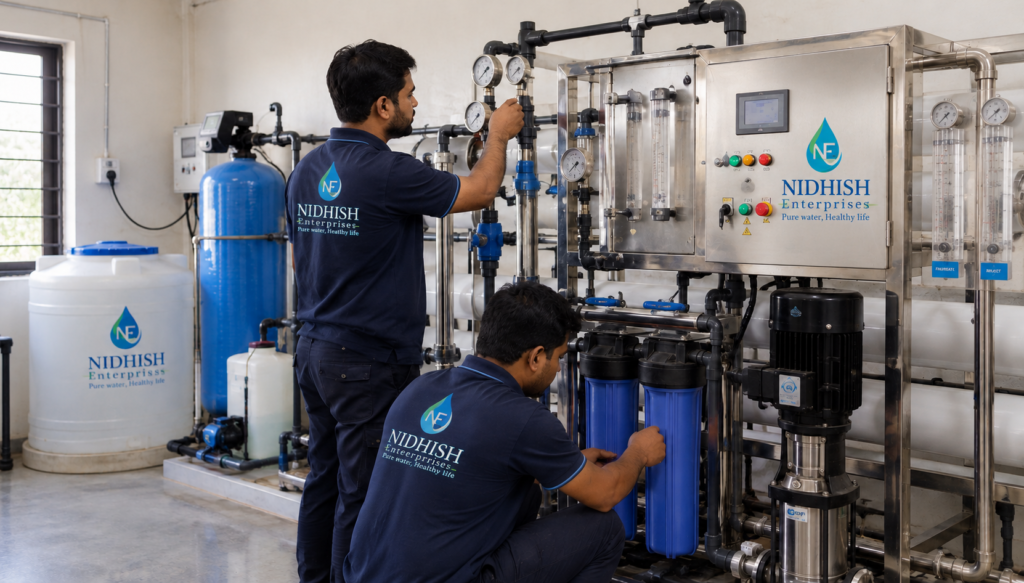
Nidhish Enterprises technicians inspect pressure gauges, filters, and operating components of a commercial RO plant to maintain reliable water purification and consistent system performance.