
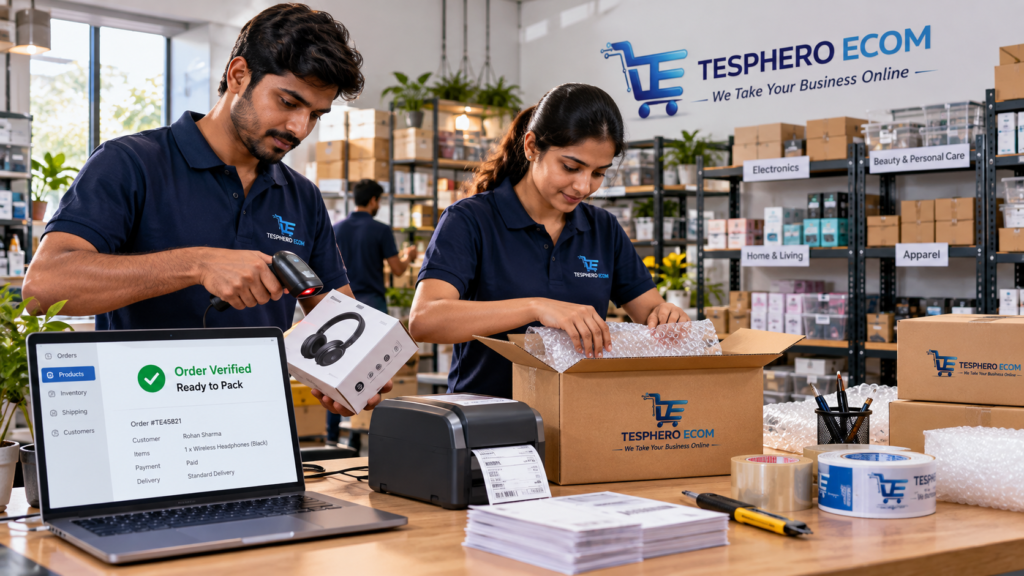
Accurate order verification, secure packaging, and an organized fulfilment process can help create a smoother e-commerce customer experience.
E-commerce Customer Experience does not end when a shopper clicks the “Buy Now” button. What happens after the purchase can be just as important. Accurate picking, secure packaging, timely dispatch, clear tracking, and a smooth delivery all shape how customers remember an online brand.
A strong product listing may convince someone to place their first order. However, the package that arrives at their door becomes a physical representation of the brand.
If the correct product arrives safely and on time, the buying experience feels complete. On the other hand, damaged packaging, incorrect products, missing items, or unclear delivery updates can create frustration even when the product itself is good.
That is why packaging and order fulfilment should not be treated as simple back-end activities.
Shopify defines order fulfilment as the process covering the journey from receiving an order through picking, packing, shipping, and delivery; returns can also form part of the process. Shopify
For growing e-commerce businesses, the goal is straightforward: make the post-purchase experience as reliable as the buying experience.
Table of Contents
- Why the Post-Purchase Experience Matters
- Packaging Is More Than a Shipping Box
- Protect Products During Delivery
- Use Packaging to Support Your Brand
- Accurate Picking and Packing Matter
- Delivery Speed and Customer Expectations
- Tracking and Communication Build Clarity
- Returns Are Part of the Experience
- Scaling Fulfilment Without Losing Quality
- Building a Better Fulfilment Process
Why Packaging and Fulfilment Matter to the E-commerce Customer Experience
Think about the customer’s journey.
First, they discover a product. Next, they evaluate images, descriptions, reviews, price, and other details. Then they place the order.
At that moment, control largely moves from the customer to the seller and the logistics process.
The customer begins waiting.
Questions naturally follow:
Has my order been confirmed?
When will it ship?
Will it arrive on time?
Will the package be damaged?
Is the correct product inside?
The fulfilment process provides the answers.
Therefore, a seller should think beyond simply “sending the parcel.” The real objective is to complete the promise created on the product page.
Our guide “From Product Launch to Repeat Customers: Building a Better E-commerce Customer Journey” explains this broader journey in detail.
Packaging and fulfilment sit at an especially important stage because they connect the digital shopping experience with the physical product.
1. Packaging Creates a Physical Brand Experience
Until delivery, most customer interactions with an e-commerce business happen through screens.
They see your listing, product images, advertising, website, marketplace store, emails, and notifications digitally.
Then the parcel arrives.
For many online businesses, packaging becomes one of the first physical interactions between the customer and the brand.
That makes presentation important.
However, good packaging does not necessarily mean expensive packaging.
Start With the Basics
A package should first protect the product.
After that, sellers can think about presentation and branding.
Depending on the product, useful packaging may involve:
- an appropriately sized outer box or mailer
- suitable cushioning
- secure sealing
- product protection
- organized internal presentation
- accurate labels
- clear documentation where required
- simple branded elements
Amazon India also notes that packaging plays an important role in making a good first impression while helping products reach customers in good condition. https://sell.amazon.in
Therefore, function should come before decoration.
A beautiful box cannot compensate for a broken product inside it.
2. Product Protection Should Be the First Priority
E-commerce orders can move through several handling points before reaching customers.
Boxes may be stacked, moved, transported, sorted, and handled during the journey.
As a result, packaging should match the characteristics of the product.
Fragile glassware needs different protection from clothing. Likewise, electronics, cosmetics, books, food products, jewelry, and large household items may require different packing approaches.
Avoid One Packaging Method for Every Product
A growing seller may find it convenient to use the same box and cushioning for everything.
However, that can create problems.
A small product inside an oversized box may move unnecessarily during transit. In addition, excessive packaging can increase material usage and potentially affect shipping costs.
On the other hand, packaging that is too small or weak may fail to provide adequate protection.
Shopify notes that carriers commonly consider package size and weight when determining shipping costs, making appropriate package dimensions operationally important. Shopify Help Center
Therefore, sellers should match packaging to product size, weight, fragility, and shipping requirements.
Test Packaging Before Scaling
Do not wait for customer complaints to discover weaknesses.
Instead, test common packaging combinations.
Ask practical questions:
Can the product move inside the box?
Is cushioning sufficient?
Can the outer packaging handle normal transit?
Does the seal remain secure?
Could moisture affect the item?
Is the shipping label positioned clearly?
Simple checks can identify problems before order volume increases.
3. Good Packaging Can Support Brand Recognition
Protection comes first, but packaging can also communicate brand identity.
Imagine ordering from two unfamiliar online sellers.
The first parcel arrives in a damaged, oversized box with the product loosely placed inside.
The second arrives securely packed with a clean presentation, a simple branded sticker, and a clear thank-you card.
Even if both products are identical, the overall experience may feel different.
Branding Does Not Need to Be Excessive
Smaller sellers do not necessarily need premium custom boxes.
Instead, they can use simple elements such as:
- branded tape
- a logo sticker
- a thank-you card
- product-care instructions
- a small insert
- consistent brand colours
These details can make the package feel intentional.
However, avoid adding unnecessary material purely for appearance.
Good packaging should balance protection, presentation, cost, and practicality.
For sellers moving beyond marketplace-only selling, this connects naturally with our guide “From Seller to Brand: The Shift Every Growing Business Eventually Needs.”
Your packaging can support that shift because it gives customers another opportunity to recognize the business behind the product.
4. Accurate Order Picking Is Essential
Great packaging cannot fix an incorrect order.
If a customer orders a blue medium-size shirt and receives a black large-size shirt, the fulfilment process has failed.
Similarly, missing accessories, incorrect quantities, wrong variants, or incomplete bundles can quickly damage the experience.
Therefore, picking accuracy deserves attention.
Errors Become More Likely as Order Volume Grows
When a business processes a few orders each day, employees may manage them manually.
As volume grows, complexity increases.
You may have:
- more SKUs
- additional variants
- multiple sales channels
- higher daily order volumes
- several packing employees
- different storage locations
- more returns and replacements
At that stage, memory is no longer a reliable inventory system.
Clear SKUs, organized storage, accurate inventory records, bar code-based workflows where appropriate, and order verification can help reduce avoidable mistakes.
Shopify also highlights bar code scanning as one way businesses can streamline picking and packing as fulfilment volume becomes more complex. Shopify Help Center
5. Inventory Accuracy Supports Better Fulfilment
Fulfilment problems often begin before anyone starts packing.
For example, your online store may show an item as available even though the warehouse has no usable stock.
The customer places the order expecting delivery.
Then the team discovers the problem.
Now the seller may need to delay, cancel, replace, or contact the customer.
That creates unnecessary friction.
Connect Inventory With Order Operations
Accurate stock records help fulfilment teams know what is genuinely available.
Therefore, inventory updates should happen consistently across relevant sales channels and storage locations.
Businesses should also understand which products sell quickly, which variants need safety stock, and where inventory differences occur.
For a detailed discussion, internally link to “E-commerce Inventory Management: How to Prevent Stock Issues as Your Business Grows.”
Inventory management and fulfilment are closely connected.
After all, you cannot reliably dispatch what you cannot accurately locate or track.
6. Packing Accuracy Deserves a Final Check
After picking, the packing station becomes an important quality-control point.
Before sealing the parcel, verify the order.
A simple process can check:
Product → Variant → Quantity → Condition → Accessories → Documents → Packaging
This does not need to become complicated.
The purpose is simply to catch errors before the package leaves your control.
Shopify’s current fulfilment guidance similarly recommends confirming that products being shipped match what the customer ordered. Shopify
Standardize Repetitive Tasks
A packing checklist can help teams follow the same basic process.
For example:
- Scan or verify the order.
- Pick the correct product and variant.
- Inspect the product condition.
- Add required accessories or inserts.
- Select appropriate packaging.
- Protect the product.
- Seal the package.
- Attach the correct shipping label.
- Update the order status.
A repeatable process becomes increasingly useful when several people handle fulfilment.
7. Delivery Expectations Should Be Realistic
Customers generally want their orders quickly.
However, promising unrealistic delivery times can create a worse experience than providing a realistic estimate from the beginning.
Imagine a website promising delivery in two days when the seller normally needs two days just to process the order.
The promise and operational reality do not match.
Separate Processing Time From Transit Time
These are different stages.
Processing or fulfilment time covers the period needed to prepare the order.
Transit time covers the carrier’s journey from dispatch to delivery.
Both affect the final delivery experience.
Shopify’s fulfilment tools, for example, distinguish fulfilment time when calculating and communicating estimated delivery dates. Shopify Help Center
Therefore, businesses should understand their actual operational timelines before communicating delivery expectations.
Fast Is Useful, but Reliable Matters Too
Not every small business can offer next-day delivery across India.
That does not automatically create a poor customer experience.
A realistic promise followed by reliable execution can be more useful than an aggressive promise that the business repeatedly misses.
8. Tracking and Communication Reduce Uncertainty
Once an order leaves the warehouse, customers still want visibility.
Tracking can help answer basic questions without forcing them to contact support.
Useful updates may include:
- order confirmation
- order packed
- order dispatched
- tracking details
- expected delivery information
- delivery confirmation
- delay information when available
Clear communication becomes especially important when something changes.
If an order is delayed, silence can make the situation more frustrating.
Meanwhile, an accurate update gives the customer useful information.
Do Not Over-Communicate
Customers do not need a message for every tiny warehouse action.
Focus on meaningful updates.
The goal is clarity, not notification overload.
Shopify’s order-management tools, for example, allow merchants to manage shipping information and provide tracking details as part of the fulfilment workflow. Shopify Help Center
9. Packaging Can Influence Returns and Damage Issues
Not every return happens because the customer dislikes the product.
Some problems begin during fulfilment.
A damaged item, leaking bottle, crushed box, missing component, or wrong variant can turn an otherwise successful sale into a return or replacement request.
Therefore, sellers should analyze return reasons.
Look for Patterns
Suppose one fragile product repeatedly arrives damaged.
That may indicate a packaging problem rather than a product problem.
Similarly, frequent wrong-size shipments could point to a picking or labeling issue.
Ask:
Which products receive the most damage complaints?
Are certain SKUs often picked incorrectly?
Do specific packaging types fail more often?
Are returns linked to one warehouse process?
Does a particular product require additional protection?
Patterns can reveal operational problems that individual complaints may hide.
10. Returns Are Part of the E-commerce Customer Experience
The customer journey does not always end with a successful delivery.
Sometimes customers need to return or exchange an item.
Therefore, businesses should consider reverse logistics as part of fulfilment planning.
A confusing return process can create frustration. On the other hand, clear instructions can make an unavoidable return easier to manage.
Set Clear Expectations
Explain relevant return and exchange conditions before purchase.
Then, when a valid request arises, provide clear next steps according to your policy and the applicable marketplace or platform process.
Customers should understand what they need to do, what happens next, and how the return will move through the system.
The exact process will depend on the seller’s platform, policy, product category, and fulfilment model.
11. Packaging Should Balance Experience and Cost
Premium packaging can look impressive.
However, e-commerce businesses also need sustainable unit economics.
A ₹300 packaging experience for a low-margin ₹500 product may not make commercial sense.
Therefore, calculate packaging costs realistically.
Consider:
- box or mailer cost
- protective material
- labels
- tape
- inserts
- labour
- package weight
- package dimensions
- storage requirements
- damage rate
The cheapest packaging is not always the lowest-cost option either.
If weak packaging creates frequent damage and replacements, the business may spend more overall.
Find the Practical Middle Ground
The ideal solution protects the item, presents the brand appropriately, works efficiently at the packing station, and fits the product’s economics.
That balance can differ across categories.
12. Choose the Right Fulfilment Model
Not every seller needs the same fulfilment setup.
Some businesses handle orders themselves. Others use marketplace fulfilment or third-party logistics providers. Growing brands may combine several methods.
For example, Amazon India currently describes three broad fulfilment approaches for sellers on its marketplace: Fulfilment by Amazon, Easy Ship, and Self-Ship. The responsibilities for storage, packaging, shipping, returns, and customer service differ between these options. https://sell.amazon.in
Similarly, Shopify supports self-fulfilment, fulfilment services, or combinations of different methods. Shopify Help Center
In-House Fulfilment
Handling fulfilment internally can provide greater direct control.
However, the business also manages space, staff, processes, packaging, shipping coordination, and operational errors.
Third-Party Fulfilment
A fulfilment partner can handle some or many logistics activities.
This may become useful as order volume expands.
Still, sellers should evaluate service areas, integration, pricing, handling requirements, return processes, reporting, and performance before choosing a partner.
Outsourcing operations does not remove the brand’s responsibility for the customer’s experience.
13. Scaling Can Expose Weak Fulfilment Processes
A fulfilment system that works for 20 orders a day may struggle at 200.
As volume grows, small inefficiencies become bigger.
For example, unclear storage locations can slow picking. Manual inventory updates can create discrepancies. Poor packing-station organization can increase errors.
Therefore, businesses should improve systems before operations become chaotic.
Watch Useful Operational Metrics
Depending on your business, track measures such as:
| Fulfilment Area | What to Monitor |
|---|---|
| Picking | Incorrect item or variant errors |
| Packing | Damage and packaging problems |
| Dispatch | Time from order to shipment |
| Delivery | Delays and failed deliveries |
| Inventory | Stock discrepancies |
| Returns | Return reasons and frequency |
| Customer support | Delivery-related complaints |
Metrics should help identify problems rather than simply create more reports.
When one number worsens, investigate the reason.
14. The Product Listing and Delivered Product Must Match
Customer expectations begin before fulfilment.
Product images and descriptions tell shoppers what they are buying.
Therefore, the item inside the package should match the expectation created online.
For example, colour, size, quantity, included accessories, and product presentation should be accurately represented.
This connects directly with “Your Product Is Good, But Is Your Listing Selling It? 8 Ways to Improve Product Listings.”
You can also internally link “How Product Images and Descriptions Influence Online Buying Decisions.”
Accurate listings and accurate fulfilment work together.
If the listing creates the wrong expectation, perfect delivery cannot completely fix the disappointment.
15. Small Packaging Details Can Improve the Unboxing Experience
Unboxing does not need to become an elaborate social-media event.
For many products, simple and thoughtful presentation is enough.
The customer should be able to open the parcel without unnecessary difficulty and find the product organized and protected.
For suitable categories, a small card can provide:
- a thank-you message
- product-use instructions
- care information
- support details
- warranty information where relevant
- a genuine invitation to connect with the brand
However, avoid overwhelming customers with promotional material.
The product should remain the focus.
Make Repeat Orders Feel Consistent
If a customer orders again, a familiar packaging experience can reinforce recognition.
Consistent logos, presentation, inserts, and communication can help customers connect the product with the brand they previously purchased from.
That connection becomes increasingly useful when a seller wants to build repeat business rather than depend only on one-time marketplace transactions.
16. Build a Simple Fulfilment System Before You Need a Complex One
You do not need an enterprise warehouse system on day one.
Instead, create a process appropriate for your current order volume.
Start by documenting how an order moves through the business:
Order Received → Inventory Confirmed → Picked → Checked → Packed → Labelled → Dispatched → Tracked → Delivered
Then identify where mistakes commonly occur.
If incorrect variants are a problem, improve SKU identification.
If products arrive damaged, review packaging.
If dispatch is slow, examine picking and packing time.
If customers repeatedly ask where their parcel is, improve tracking communication.
As a result, operational improvements remain connected to real customer problems.
17. How Tesphero Ecom Can Help
Managing an e-commerce business involves much more than uploading products to a marketplace.
As order volume grows, inventory, listings, packaging, fulfilment, customer communication, and brand presentation increasingly need to work together.
Tesphero Ecom helps businesses strengthen their e-commerce operations and online presence with a practical approach.
That may include improving product presentation, marketplace operations, listing quality, brand consistency, and the processes that support a better customer journey.
The objective is not to create unnecessarily complicated operations.
Instead, businesses should build systems that help them deliver the right product, in suitable packaging, with clear communication and a dependable customer experience.
Final Thoughts
A strong E-commerce Customer Experience continues long after checkout.
The customer may have discovered your business through an advertisement or marketplace listing. However, packaging and fulfilment determine whether the promise made online reaches their doorstep successfully.
Start with accuracy.
Send the correct product and variant.
Next, protect it with packaging suited to the item. Then dispatch it within a realistic time frame and provide useful tracking information.
When problems occur, learn from them.
Damage complaints may reveal packaging weaknesses. Wrong-product returns can expose picking problems. Repeated delivery questions may show that communication needs improvement.
Most importantly, do not treat fulfilment as an invisible warehouse task.
Every correctly picked item, securely packed parcel, accurate shipping label, and useful delivery update contributes to the customer’s overall impression of your brand.
A better fulfilment process cannot guarantee repeat purchases. However, it can remove avoidable problems that may otherwise prevent customers from wanting to buy again.
Frequently Asked Questions
About the Author
Tesphero Ecom helps businesses strengthen their e-commerce presence through practical marketplace support, product presentation, brand-building, and operational improvement. Our approach focuses on helping sellers create a more consistent journey from product discovery and listing to fulfilment and repeat purchase.
Want to Improve Your E-commerce Operations?
If your business is receiving more orders but packaging, inventory, listings, or fulfilment are becoming difficult to manage, Tesphero Ecom can help you identify areas that need improvement.
Build an e-commerce operation that works not only until checkout, but all the way to the customer’s doorstep.
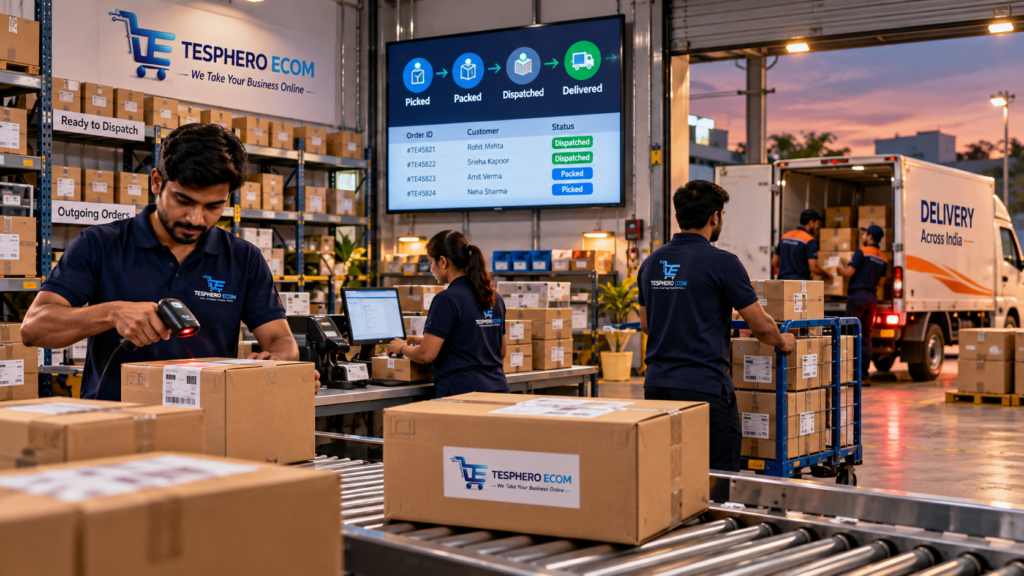
A well-organized fulfilment process connects picking, packing, dispatch, and delivery to create a smoother and more reliable e-commerce customer experience.