

Product images become the customer’s first way of inspecting an item online.
Product Images and Descriptions can strongly influence online buying decisions. Customers cannot touch, hold, or inspect a product before buying it online. Therefore, they depend on clear photos and useful written details to understand what they will receive. When both work together, customers can compare products more easily and buy with greater confidence.
A customer finds your product on a marketplace.
The price looks reasonable.
Reviews seem good.
But the main image doesn’t clearly show the product. The description feels generic, and important details are difficult to find.
The customer hesitates.
Then they open another listing.
The competing product may not necessarily be better. However, its photographs clearly show what the buyer will receive. The size is easy to understand, key features are explained simply, and the listing answers common questions.
That customer now feels more confident buying from the competitor.
This is why e-commerce sellers should not think of product images and descriptions as simple listing requirements.
They are part of the online sales experience.
In this guide, we’ll explore how product images and descriptions affect customer confidence, product understanding, conversions, and returns—and what sellers can do to make their listings more useful without turning them into exaggerated advertisements.
How Product Images and Descriptions Build Customer Confidence
1. Online Shopping Has an Information Gap
In a physical store, customers can interact with a product before purchasing.
They can pick it up.
Look at it from different angles.
Compare its size with nearby products.
Check the material.
Read the packaging.
Ask a salesperson questions.
Online shoppers don’t have the same experience.
Instead, they rely on the information available on the screen.
This creates an information gap between the product and the buyer.
Good product images and descriptions help reduce that gap.
The more clearly customers understand what they are buying, the easier it becomes for them to decide whether the product fits their needs.
2. Your Main Image Creates the First Impression
On marketplaces and e-commerce websites, customers often see several competing products at once.
Before they read a detailed description, they notice:
The image.
The price.
The title.
The rating.
This makes the main product image especially important.
A dark, blurry, or poorly framed photograph can make a perfectly good product look less trustworthy.
On the other hand, a clear image can help the customer understand the product quickly.
The goal is not to make the item look unrealistically perfect.
It is to show the actual product clearly and professionally.
Marketplace image requirements vary, so sellers should always follow the current rules of the platform where they list their products.
Product-image requirements can differ between marketplaces and categories. Sellers should therefore check the latest listing and image guidelines provided by the marketplace they use before preparing product photographs. For Amazon sellers, the official Amazon Seller website can be used as a starting point for current seller information and marketplace guidance.
3. One Product Image Is Usually Not Enough
The main image may attract attention.
Additional images help customers evaluate the product.
Think about the questions someone might have while viewing your listing.
What does the back look like?
How thick is it?
What is included in the package?
How large is it?
What does the material look like up close?
How is the product used?
Your image gallery can answer many of these questions without forcing customers to read a long block of text.
For example, a seller offering a storage container could show the front, side, and open view. Another image might communicate dimensions, while a lifestyle photograph can show how much the container realistically holds.
Each image should have a purpose.
4. Show Scale and Size Clearly
Size-related confusion is a common problem in online shopping.
A customer sees a product against a plain background and imagines it to be larger than it actually is.
When the package arrives, the first reaction is:
“I thought it would be bigger.”
That is not always a product-quality problem.
It can be a communication problem.
Where relevant, use dimension graphics or contextual photographs to make scale easier to understand.
A handbag could be shown naturally carried by a person.
A desk organiser might appear on a normal working desk.
Home décor can be photographed in a realistic room.
However, lifestyle images should not misrepresent the actual product.
5. Details Build Confidence
Customers often want to inspect the details they would normally check in a physical store.
For a fabric product, that could mean texture and stitching.
A kitchen product may require a closer look at handles, lids, or joints.
With furniture, buyers may want to see surface finish and construction details.
Electronics may require clear images of ports, controls, or included accessories.
Close-up photographs can help.
They communicate that the seller is not trying to hide the product.
Good photography does not only make a product attractive. It makes the product easier to evaluate.
6. Lifestyle Images Help Customers Imagine Ownership
Plain product photographs are useful for clarity.
Lifestyle photographs serve a different purpose.
They provide context.
Suppose you sell a desk lamp.
A plain-background image shows the product clearly.
A lifestyle image showing the same lamp on a realistic study desk helps customers imagine how it could fit into their own space.
Similarly, cookware can be shown in a kitchen.
A backpack can be photographed during everyday use.
Office accessories can appear on an actual workstation.
The important word is realistic.
If the lifestyle setting makes the product appear larger, more premium, or functionally different from reality, it can create false expectations.
How Product Images and Descriptions Help Customers Understand the Product
7. Don’t Write Descriptions Only for Search Algorithms
Keywords matter in e-commerce.
Customers still need to find your product.
However, stuffing a listing with repeated keywords can make the content difficult to read.
Consider a product description that repeatedly uses phrases such as:
“Best water bottle for office, premium office water bottle, high-quality water bottle for office…”
It may contain keywords.
It doesn’t necessarily help a customer decide.
A stronger description naturally includes relevant search terms while explaining the product in useful language.
Write for the customer first.
Then optimise the content for marketplace search without damaging readability.
8. Explain Benefits Alongside Features
Features tell customers what the product has.
Benefits help explain why those features matter.
Suppose you’re selling a backpack.
A feature might be:
Padded laptop compartment
The benefit could be:
Helps keep a compatible laptop separated from other items during everyday travel.
Another feature:
Multiple compartments
The benefit:
Makes it easier to organise chargers, notebooks and smaller accessories.
Avoid turning every feature into an exaggerated promise.
Simple, practical benefits are usually more useful.
9. Put Important Information Where Customers Can Find It
Online shoppers often scan before they read.
They may not study every paragraph.
Therefore, key information should be easy to find.
Depending on the product and marketplace, this may include dimensions, material, quantity, compatibility, care instructions, package contents, and important usage information.
Bullet points can work well for scannable details.
Longer descriptions can then provide additional context.
The objective is to prevent customers from searching through several paragraphs for one basic answer.
10. Product Titles Need Clarity Too
The product title is another important part of the listing.
A title should help customers quickly understand what the product is.
It may also need relevant attributes such as size, quantity, material, model, or compatibility where appropriate.
However, avoid turning the title into a wall of keywords.
A title such as:
“Premium Best Amazing High Quality Stylish…”
uses valuable space without providing much useful information.
Clear product identification is more helpful than empty adjectives.
Marketplace title requirements differ, so follow the current rules for each platform.
11. Answer the Questions That Cause Hesitation
Good descriptions often come from customer questions.
Look at the enquiries customers send.
Read reviews.
Study return reasons.
Notice questions on competing listings.
You may discover repeated concerns.
“Will this fit my model?”
“Is one piece included or two?”
“Can this be washed?”
“Does it require assembly?”
“Is the colour exactly the same?”
Those questions reveal missing information.
Instead of answering the same question repeatedly after purchase, improve the listing before the next customer arrives.
Customer questions can become a practical product-listing improvement checklist.
12. Be Careful With Claims
E-commerce sellers naturally want their products to sound attractive.
But there is a difference between persuasive communication and unsupported claims.
Words such as:
100% guaranteed
Unbreakable
Best in India
Works for everyone
can create problems when they cannot be supported.
The same applies to claims involving health, safety, performance, or other regulated areas.
Describe what the product actually does.
Use accurate specifications.
Where a claim requires evidence or marketplace compliance, make sure you have the appropriate support before using it.
Trust is easier to build when the listing sounds confident without sounding unbelievable.
13. Images and Descriptions Must Tell the Same Story
Imagine the image shows a pack of four products.
The description says:
Quantity: 1
What will the customer think?
Confusion reduces confidence.
The same issue occurs when a lifestyle image shows accessories that are not included, but the listing does not make that clear.
Product images, title, bullet points, variations, and description should remain consistent.
If props appear only for demonstration, make that clear where appropriate.
Similarly, dimensions shown in graphics should match the written specifications.
Small inconsistencies can create large expectations.
Product images and descriptions work best when the rest of the listing supports the same message. Titles, bullet points, specifications and customer-facing information all contribute to the buying experience. For a broader listing review, read “Your Product Is Good, But Is Your Listing Selling It? 8 Ways to Improve Product Listings” for practical ways to strengthen your product pages.
14. Mobile Shoppers Need Fast Answers
Many customers shop on phones.
This changes how listings are consumed.
Long paragraphs can feel even longer on a small screen.
Important information may sit below several scrolls.
Therefore, structure matters.
Keep sentences relatively simple.
Use clear headings where the platform supports them.
Put important information early.
Use bullet points for key specifications.
Images should also remain understandable on smaller screens.
A graphic filled with tiny text may look impressive on a desktop but become almost unreadable on a phone.
How Product Images and Descriptions Support Better Buying Decisions
A strong product listing is not only about persuading more people to buy.
It can also help the right people decide whether to buy.
That distinction matters.
15. Clear Listings Can Reduce Expectation Gaps
Returns can happen for many reasons.
Some are unavoidable.
Others begin with a mismatch between what customers expected and what they received.
Perhaps the colour looked different.
The size was misunderstood.
A customer assumed an accessory was included.
The product was incompatible with their device.
A feature worked differently from what they imagined.
Clear images and accurate descriptions can help reduce some of these expectation gaps.
They cannot eliminate every return.
However, a listing that communicates honestly gives customers a better chance to make an informed choice.
16. Don’t Optimise Only for More Clicks
A highly attractive image might increase clicks.
That sounds positive.
But what happens when the photograph makes the product look substantially different from reality?
Customers may click.
Some may even purchase.
Then disappointment appears after delivery.
Therefore, listing optimisation should not focus only on click-through rate.
Look at the complete journey.
Impressions.
Clicks.
Conversions.
Customer questions.
Reviews.
Returns.
Repeat purchases.
These signals can tell you whether the listing is attracting suitable customers or simply creating curiosity.
Listing improvements can help customers understand a product, but presentation cannot create lasting demand for the wrong product. If you’re still deciding what to sell, our guide “What Should You Sell Online? A Practical Guide to Choosing the Right E-commerce Product” explains how demand, competition, margins, and customer needs can influence product selection.
17. Use Reviews as Listing Research
Reviews are more than social proof.
They are research.
Positive reviews can reveal what customers value most.
Negative reviews may highlight areas of confusion.
Suppose several buyers say:
“Product is good, but it was smaller than expected.”
That may suggest your listing needs clearer dimensions or scale photographs.
Another product may receive repeated praise for packaging.
That strength could deserve more visibility in your images or description.
Don’t copy customer wording into unsupported claims.
Instead, use recurring feedback to understand what information matters.
18. Test Improvements Instead of Guessing
You don’t always need to redesign the entire listing at once.
Start with obvious problems.
Improve the main image.
Add missing angles.
Clarify dimensions.
Rewrite confusing bullet points.
Improve the title.
Then monitor performance.
Where marketplace tools allow appropriate testing, sellers may compare different listing approaches.
The objective is to learn what improves customer understanding and business performance.
A change that looks visually attractive isn’t automatically a better change.
Data and customer behaviour should guide future improvements.
19. Brand Consistency Matters
When customers see several products from the same seller, the listings should feel related.
This doesn’t mean every image must look identical.
However, photography quality, graphic style, tone, and product information can follow a consistent approach.
Consistency becomes especially important as a seller grows beyond one successful product.
Customers may not remember every specification.
They can still remember how the brand made the shopping experience feel.
Clear.
Reliable.
Easy to understand.
Professional.
These impressions contribute to brand recognition over time.
20. Your Listing Is Part of Your Brand
Marketplace sellers sometimes think branding begins only after creating a separate website.
It starts earlier.
Packaging is branding.
Product photography is branding.
Your description tone is branding.
The way you answer customer questions is branding.
Post-purchase experience also contributes to branding.
Suppose two sellers offer products with comparable specifications and prices.
One listing feels generic and inconsistent.
The other clearly explains the product, uses recognisable visual presentation, and delivers a consistent experience.
Over time, the second seller has a stronger opportunity to become memorable.
A marketplace gives you a place to sell. Your presentation helps customers understand who they are buying from.
Strong listings can help individual products perform, but long-term growth often requires customers to remember the business behind those products. Read “Selling on Marketplaces Is Not Enough: How to Build a Brand That Customers Remember” to understand how sellers can move beyond marketplace visibility and build stronger brand recognition.
Common Product Listing Mistakes
One common mistake is using supplier images without checking whether they accurately represent the actual product.
Another is uploading only one or two photographs.
Some sellers add large amounts of text to images, making them difficult to read on mobile devices.
Descriptions may repeat keywords instead of answering customer questions.
Important dimensions are sometimes missing.
Package contents can remain unclear.
Sellers may also use lifestyle images that accidentally imply accessories are included.
Another common mistake is copying a competitor’s listing.
Apart from originality and compliance concerns, another seller’s description may not accurately represent your product.
Your listing should be built around your actual product and your customer’s questions.
A Practical Product Listing Checklist
Before publishing or updating a listing, check the following:
- Main image: Is the actual product immediately clear?
- Angles: Can customers inspect important sides and details?
- Scale: Is size easy to understand?
- Dimensions: Are measurements accurate and visible?
- Package contents: Is it clear what the buyer receives?
- Title: Does it identify the product without unnecessary keyword stuffing?
- Features: Are important specifications easy to scan?
- Benefits: Do you explain why relevant features matter?
- Compatibility: Is it clear where applicable?
- Claims: Can important claims be supported?
- Consistency: Do the images and written details match?
- Mobile view: Is important information readable on a smaller screen?
- Customer feedback: Have common questions and return reasons been considered?
A listing doesn’t need to be complicated.
It needs to be clear.
How Tesphero Ecom Can Help
Selling online involves more than uploading products to a marketplace.
At Tesphero Ecom, we help businesses approach e-commerce with a broader view of how products are presented, discovered, and understood by online customers.
Depending on the business requirement, this may include support around marketplace listings, product presentation, e-commerce strategy, catalogue development, online marketplace management and brand-building activities.
For a new seller, the challenge may be creating listings correctly from the beginning.
An existing marketplace seller may already receive traffic but struggle with conversion.
Another business may have good products but inconsistent photographs, weak descriptions, or unclear brand presentation.
The right improvement depends on the actual problem.
The goal isn’t simply to make a listing look attractive.
The goal is to make it easier for the right customer to understand the product and make a confident buying decision.
Final Thoughts
Online customers cannot inspect your product before ordering it.
Your listing becomes their eyes.
Your photographs show what the product looks like.
The description explains what images cannot communicate.
Specifications reduce uncertainty.
Lifestyle images provide context.
Clear package information sets expectations.
Together, these elements influence how confident customers feel about clicking “Buy Now.”
So when a product receives views but not enough sales, don’t immediately assume that the price is the problem.
Look at the listing from the customer’s perspective.
Can I clearly see the product?
Do I understand its size?
Do I know exactly what I will receive?
Have my main questions been answered?
Does the listing make me confident enough to buy?
A good product may get customers interested.
A strong listing helps them understand why it is the right product for them.
Frequently Asked Questions
About the Author
Tesphero Ecom works with businesses that want to establish, improve, and grow their presence across online marketplaces and e-commerce channels. The focus goes beyond simply uploading products—it includes how products are presented, how customers understand them, and how individual listings contribute to the wider online brand.
From product listing and catalogue support to marketplace management and e-commerce strategy, the aim is to help sellers create a more structured online selling experience. To learn more about our approach and e-commerce services, visit the About Tesphero Ecom.
Contact Tesphero Ecom
Therefore, if your product is good but the listing isn’t getting enough attention, the way it is presented may need improvement. Contact Tesphero Ecom to discuss your product listings, marketplace presence, and e-commerce requirements. Sometimes the product itself isn’t the biggest problem—the way customers see, understand, and compare it online may be what needs attention.
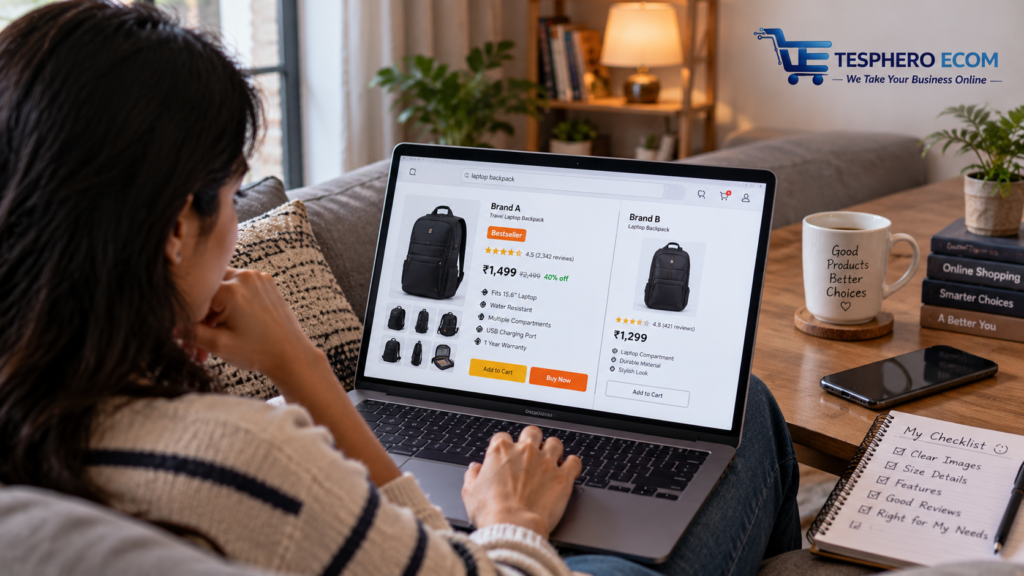
When products look similar online, customers may struggle to choose. Therefore, clear images and useful details can make the final decision much easier.