
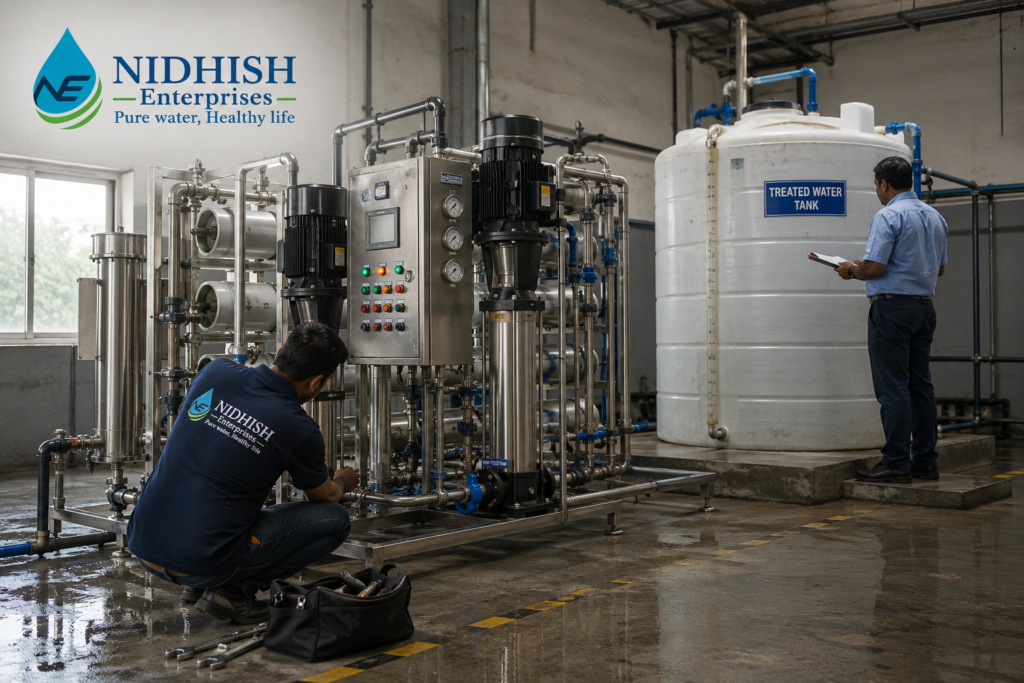
RO downtime becomes a business problem when daily operations depend on treated water.
Your commercial RO system stops working at 10:30 in the morning.
At first, it may seem like a maintenance problem that can wait.
Then employees start asking for drinking water. Production needs treated water. Storage levels begin falling. Someone has to arrange an emergency alternative, and the team starts calling technicians while normal work continues.
Suddenly, one RO breakdown is no longer just a water problem—it is a business problem.
For offices, schools, factories, hospitals, hotels, restaurants, and other commercial facilities, a reliable water-treatment system can be part of everyday operations. When that system goes down, the real cost may include much more than the repair bill.
There can be lost working time, emergency water purchases, operational disruption, delayed production, and unnecessary pressure on staff.
That’s why businesses shouldn’t only ask:
“How much will it cost to repair our RO?”
They should also ask:
“How much is every hour of RO downtime costing our business?”
RO Downtime Costs More Than the Repair Bill
1. What Does RO Downtime Actually Mean?
RO downtime is the period during which a reverse osmosis system cannot provide the quantity or quality of treated water required for normal operations.
A complete shutdown is the most obvious example.
However, downtime can also be partial.
For instance, the RO may continue operating but produce significantly less water than required. Pressure may fall, water quality may change, or storage tanks may fail to refill quickly enough.
From an operational perspective, the system is still creating a problem.
Therefore, businesses should not define RO reliability only as:
“Machine chal rahi hai ya nahi?”
A better question is:
“Is the system consistently delivering the water our facility requires?”
2. The Immediate Cost: Emergency Water
When an RO system suddenly stops working, one of the first expenses can be arranging an alternative water supply.
For an office, that might mean purchasing packaged drinking water.
A larger facility may need water cans, tankers, or another temporary arrangement depending on the intended use and water-quality requirements.
These emergency purchases may cost considerably more than normal in-house water treatment.
In addition, someone has to coordinate them.
Staff members make calls, confirm availability, arrange payment, and manage delivery.
So the real emergency cost isn’t just the water.
It also includes the time and effort required to keep operations moving.
3. Employee Productivity Can Be Affected
In an office, drinking water may not directly produce revenue.
Yet employees still depend on convenient access to suitable drinking water throughout the working day.
Imagine hundreds of employees relying on one central water-treatment system.
If it fails, the administration team has to respond. Employees may need to walk farther to temporary water points, and normal workplace routines can be disrupted.
Individually, these interruptions may appear small.
Across a large workforce, however, they can add up.
Factories can face an even greater challenge, particularly when treated water supports processes in addition to drinking-water requirements.
That is why the cost of downtime should include lost productive time, not simply technician charges.
4. Production Can Slow Down or Stop
For some businesses, treated water isn’t merely an employee facility.
It is an operational input.
Depending on the industry and process, suitable water may be required for manufacturing, cleaning, food and beverage operations, commercial kitchens, or other applications.
When the water-treatment system fails, operations may have to slow down until an alternative is arranged.
In some cases, a particular process may need to stop.
Suppose a facility loses several hours of production because its water-treatment system cannot supply the required output.
The repair itself may cost relatively little compared with the value of the production lost during those hours.
This is where RO downtime becomes an operational risk rather than simply a maintenance issue.
5. Customer Experience May Also Suffer
Water-system failures can sometimes affect customers.
Consider a hotel, restaurant, educational institution, or customer-facing commercial facility.
If the water arrangement becomes unreliable, the business may need to change normal operations while the issue is resolved.
Even when customers never learn exactly what happened behind the scenes, service quality may be affected.
For hospitality and other service businesses, maintaining reliable supporting infrastructure is part of providing a consistent customer experience.
A customer may never compliment you because the water-treatment system worked perfectly.
They may certainly notice when essential services don’t.
6. A Small Problem Can Become a Bigger Repair
Commercial equipment often gives warning signs before a complete breakdown.
Reduced flow.
Unusual pressure.
Frequent pump cycling.
Leaks.
Changes in water quality.
Unusual sounds.
Filters requiring more frequent attention.
Ignoring these signs can allow a manageable issue to develop into a more disruptive failure.
For example, waiting until a component stops working completely may result in emergency service rather than planned maintenance.
Consequently, businesses should treat unusual RO performance as something worth investigating early.
Preventive attention is usually easier to plan than an unexpected shutdown.
Why Commercial RO Systems Fail
Unexpected breakdowns can happen.
However, many RO problems don’t appear without warning.
Understanding common causes can help businesses reduce avoidable downtime.
7. Delayed Filter Replacement
Pre-filters play an important role in protecting the components that follow them.
Over time, filters collect contaminants, and their performance can decline.
When replacement is delayed beyond what the actual water conditions and system usage require, flow and pressure can be affected.
The problem with using a fixed calendar alone is that every site is different.
A commercial system operating for long hours with challenging feed water may require attention differently from a lightly used system with better incoming water.
Therefore, maintenance should consider actual operating conditions, along with manufacturer recommendations.
8. Scaling and Hard Water Can Create Problems
Hard water contains dissolved minerals that can contribute to scale formation under certain conditions.
In commercial water systems, scaling can affect components and reduce performance if the pretreatment arrangement isn’t suitable for the incoming water.
This is especially important for businesses operating in areas where hardness is a recurring concern.
The correct solution depends on water analysis and the system design.
In some applications, suitable pretreatment may be required before RO.
Installing a larger RO alone does not automatically solve every feed-water problem.
The water entering the RO matters almost as much as the RO itself.
Feed-water conditions can have an important influence on the overall treatment system. If hardness and scale are recurring concerns at your property, read “Hard Water Problems in Indore: How Water Softeners Can Protect Your Home and Business” for a broader explanation of hard-water problems and treatment planning.
9. Pump and Pressure Problems
RO systems depend on appropriate pressure to operate effectively.
Pump issues, pressure changes, or other mechanical problems can therefore affect water production.
A facility may first notice that the tank takes longer to fill.
Later, output may fall further.
Instead of waiting until the system stops completely, changes in pressure and production should be investigated.
Regular operating records can be useful here.
When staff know what “normal” pressure and output look like, unusual performance becomes easier to recognise.
10. Membrane Performance Can Decline
The RO membrane is a critical part of the treatment process.
Its performance can be influenced by feed-water conditions, pretreatment, operating parameters, fouling, scaling and maintenance practices.
Membranes do not simply need attention because a certain number of months have passed.
Actual performance matters.
Businesses should monitor relevant water-quality and operating parameters according to the system design and appropriate service recommendations.
A sudden or gradual change can indicate that the system needs professional inspection.
11. Electrical and Control Problems
Commercial RO plants include electrical and control components in addition to filters, membranes, and pumps.
A fault involving a controller, sensor, switch, wiring, or other electrical component can interrupt operation even when the filtration components themselves are fine.
This is another reason commercial RO maintenance should look at the complete system.
Replacing filters alone is not the same as maintaining a commercial water-treatment plant.
12. Poor Maintenance Records Make Problems Harder to Predict
When was the last filter replacement?
What was the normal operating pressure three months ago?
Has the system’s output gradually decreased?
When was the membrane last evaluated?
If nobody knows, maintenance becomes reactive.
A simple service log can make a significant difference.
Record maintenance dates, replacements, unusual observations, and important operating readings where appropriate.
This creates history.
Over time, the maintenance team or service provider can identify patterns and make more informed decisions.
Water-treatment performance should not be judged only by whether the system is producing water. Businesses should also understand the relevant quality requirements for the intended use of that water. For general information related to drinking-water quality standards in India, the Bureau of Indian Standards (BIS) can be used as an authoritative reference. Actual treatment and testing requirements should still be evaluated according to the water source, application and applicable standards.
13. Don’t Forget Storage Capacity
Sometimes the problem isn’t that the RO system has completely failed.
The business simply doesn’t have enough buffer capacity when something goes wrong.
Suppose the RO plant needs several hours of maintenance.
A suitably planned treated-water storage arrangement may help the facility continue essential operations during that period, depending on usage and application.
Without sufficient buffer, even a relatively short service interruption can immediately affect users.
Storage should therefore be planned together with production capacity and peak demand.
How Businesses Can Reduce the Cost of RO Downtime
You cannot guarantee that equipment will never develop a fault.
What you can do is reduce the likelihood that one unexpected issue turns into a major disruption.
14. Move From Reactive to Preventive Maintenance
Reactive maintenance follows a simple pattern:
Something breaks → call the technician → wait → repair it → restart operations.
Preventive maintenance takes a different approach.
The system is inspected before a complete failure occurs. Filters and components are reviewed according to actual condition and recommendations. Operating changes can be investigated early.
As a result, some maintenance can be planned during periods when disruption is easier to manage.
This doesn’t eliminate every unexpected breakdown.
However, it can reduce unnecessary surprises.
Unexpected downtime is often more expensive than planned maintenance because the business has to solve the water problem while normal operations are already being affected. To understand the longer-term financial impact of delayed servicing, read our guide “The Hidden Cost of Neglecting RO Maintenance: How Regular Servicing Can Save You Money.”
15. Know Your Critical RO Numbers
A business doesn’t need every employee to understand RO engineering.
However, the people responsible for the system should know its basic operating expectations.
Depending on the installation, useful information can include normal output, storage levels, relevant pressure readings, and water-quality parameters.
Once there is a baseline, changes become easier to spot.
For example, a gradual reduction in water production over several weeks may deserve investigation even though the system is technically still operating.
Maintenance becomes more effective when decisions are based on performance, not only on breakdowns.
16. Create a Downtime Plan Before You Need One
Ask this question today:
What would we do if our RO stopped working tomorrow morning?
Where would temporary water come from?
Who would call the service provider?
Which operations depend directly on treated water?
How much stored water is normally available?
Which activities would receive priority?
Businesses that answer these questions in advance can react faster during an actual failure.
For a small office, the backup plan may be simple.
For a large factory or commercial facility, it may require much more structured contingency planning.
17. Keep Essential Service Information Accessible
When a system fails, nobody should have to search through old messages to find the service provider’s number.
Keep relevant information accessible to the responsible team.
This may include system details, service contacts, previous maintenance records and information about commonly replaced components.
For larger installations, having suitable critical spares available may also reduce downtime where appropriate.
The exact requirement depends on the system and facility.
18. Review Whether the Existing System Still Fits the Business
Businesses grow.
Water systems don’t automatically grow with them.
A commercial RO plant installed when a facility had 50 employees may struggle after the workforce increases significantly.
Similarly, a factory may add production lines without reviewing whether its water-treatment capacity remains adequate.
Frequent shortages don’t always mean the system is faulty.
Sometimes the business has simply outgrown it.
Review the water requirement when operations expand, usage patterns change, or additional processes are introduced.
The Real Cost of One Hour of RO Downtime
There isn’t one universal number.
For a small office, an hour of downtime may create limited inconvenience.
For a factory where treated water supports production, the same hour could have a much larger impact.
A useful way to think about downtime cost is:
Emergency water + lost productivity + interrupted production + staff time + emergency service + potential customer impact
Not every business will experience every cost.
Still, this framework makes one thing clear:
The technician’s invoice is only one part of the total financial impact.
Common Mistakes Businesses Make
A common mistake is servicing the RO only after it stops working. Another is assuming that water output is fine simply because water is still coming from the system.
Businesses may also ignore gradual pressure or output changes, delay filter replacement, overlook feed-water conditions, or operate without maintenance records.
Another problem is installing a system according to today’s requirements with no consideration for future demand.
Finally, some facilities have no backup plan at all.
When the system fails, every decision has to be made during the emergency.
A little preparation can make the response much easier.
How Nidhish Water Solutions Can Help
Commercial water-treatment systems need to be evaluated according to the actual water source, usage, and operating requirements of the facility.
At Nidhish Water Solutions, we work with offices, schools, factories, and other commercial facilities across water-treatment requirements, including commercial RO systems, water softeners, water coolers, and RO service and maintenance.
For an existing system, the requirement may involve diagnosing performance issues or planning routine servicing.
For a growing facility, it may involve reviewing whether current production and storage capacity are still suitable.
Where hard water or other feed-water conditions affect the treatment requirement, the broader system may also need to be evaluated rather than focusing on the RO unit alone.
The objective is straightforward:
Keep the water-treatment system supporting the business instead of allowing it to become an unexpected source of downtime.
If you have any requirements or qureis Contact Us.
Final Thoughts
Businesses routinely protect important equipment.
Computers are backed up.
Vehicles are serviced.
Production machinery is inspected.
Generators are tested.
A commercial RO system deserves the same thinking when daily operations depend on it.
Don’t wait for water production to stop before paying attention.
Monitor performance.
Maintain appropriate records.
Investigate warning signs.
Plan storage and backup arrangements.
Review system capacity as the business grows.
And schedule maintenance according to actual operating requirements.
Because when a commercial RO system fails, the question isn’t only:
“What will the repair cost?”
The bigger question is:
“What is the business losing while we wait for the water to start flowing again?”
Frequently Asked Questions
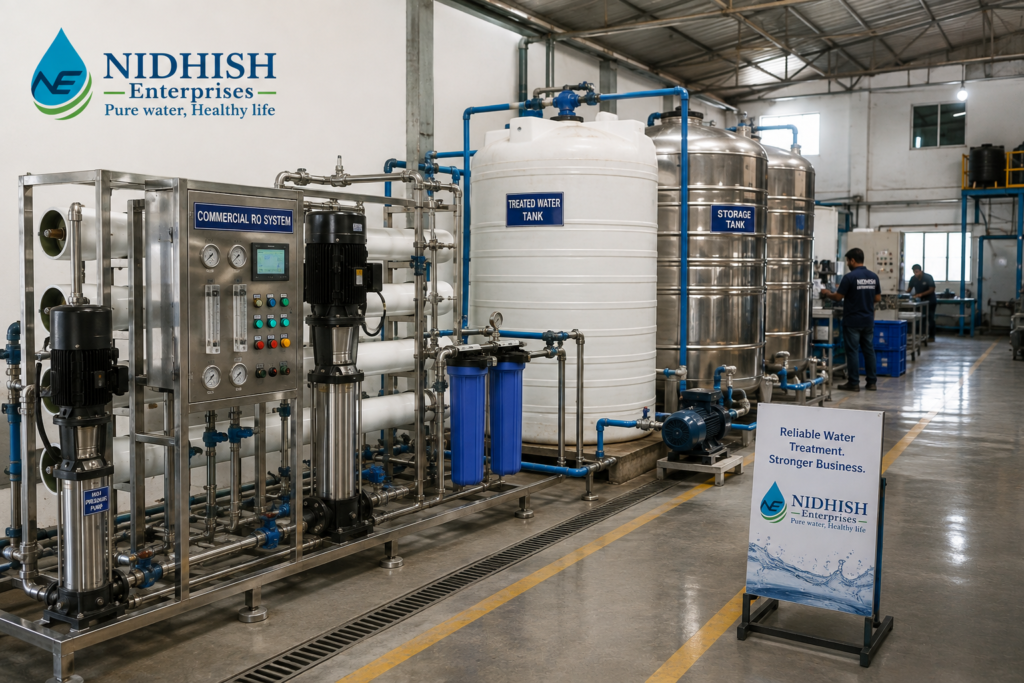
Reliable treatment, suitable storage and planned maintenance can reduce the impact of unexpected downtime.
About the Author
Nidhish Water Solutions works with homes, offices, schools, factories and commercial facilities to address practical water-treatment requirements. Its solutions include commercial and domestic RO systems, water softeners, water coolers, system servicing and preventive maintenance.
For commercial facilities, the focus goes beyond installing equipment. Water source, daily demand, treatment requirements, system capacity, and long-term maintenance all need to work together for reliable performance. To learn more about our approach to water-treatment solutions and service support, visit the About Nidhish Water Solutions.