
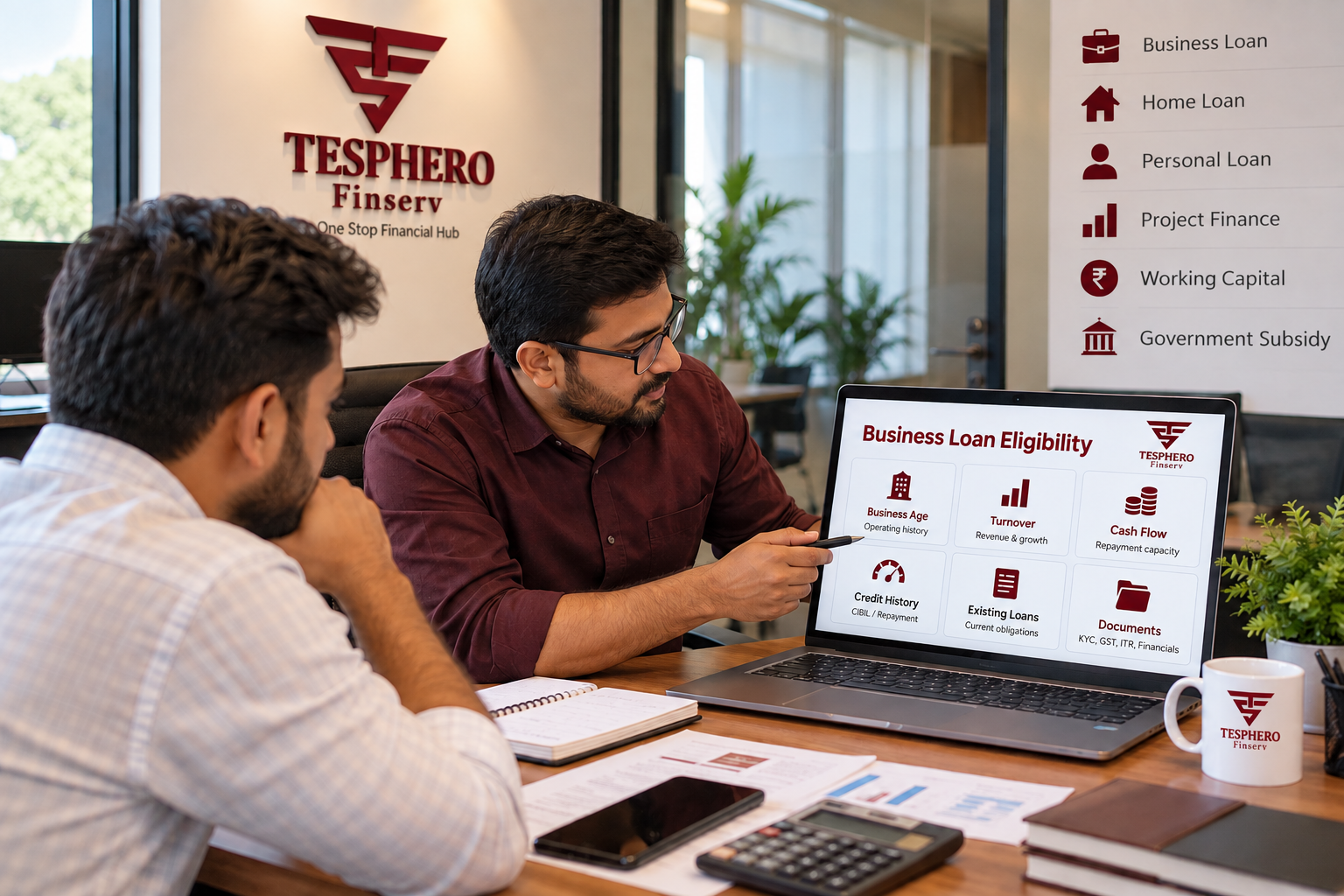
Understanding turnover, cash flow, credit history, and obligations helps businesses prepare effectively for Business Loan Eligibility.
Business Loan Eligibility depends on several factors.
These include business history, turnover, cash flow, credit behaviour, existing financial obligations, and documentation.
Therefore, before approving an application, lenders may review these areas to gauge the business’s ability to manage borrowing.
For many small businesses and MSMEs in India, borrowing can support expansion.
It can fund machinery purchases, working capital, inventory, technology, or other genuine business requirements.
However, approval is never automatic for Business Loan Eligibility.
Additionally, different banks and financial institutions have their own eligibility criteria, credit policies, documentation requirements, and risk assessment processes.
Therefore, understanding what lenders may examine can help you prepare a more complete application and set realistic expectations before applying.
Table of Contents
- What Is Business Loan Eligibility?
- Why Do Lenders Check Business Loan Eligibility?
- Business Age and Operating History
- How Turnover Affects Business Loan Eligibility
- Profitability and Cash Flow
- How Credit History Affects Business Loan Eligibility
- Existing Loans and Financial Obligations
- Banking and Financial Records
- Loan Purpose and Requested Amount
- Documents That Support Business Loan Eligibility
- How to Improve Business Loan Eligibility
- Common Mistakes Before Applying
- How Tesphero Finserv Can Help
- FAQs
What Is Business Loan Eligibility?
Business Loan Eligibility refers to the conditions and financial factors a lender considers when assessing whether a business qualifies for a particular loan.
Eligibility should not be confused with guaranteed approval.
A business may satisfy basic criteria but still receive a different loan amount, interest rate, repayment period, security requirement, or other terms than expected. In some cases, a lender may also decline an application after completing its credit assessment.
The exact process varies by lender and loan product.
For example, eligibility requirements for a working capital facility may differ from those for a machinery loan or another type of business finance.
Therefore, business owners should review the specific lender’s requirements rather than relying on one universal checklist.
Why Do Lenders Check Business Loan Eligibility?
A business loan creates a repayment obligation.
Naturally, lenders need to understand whether the borrower appears capable of meeting that obligation under the proposed terms.
Creditworthiness is a central part of this process. SBI’s MSME lending guidance, for example, discusses financial discipline, repayment behavior, income and turnover trends, updated financial statements, and banking trails when explaining creditworthiness and cost of credit. SBI
Modern MSME credit assessment can also use several sources of financial information. SIDBI explains that its FIT Rank framework uses GST, bank-statement and income-tax-return information to support risk assessment for MSME lending. SIDBI
So, what should a business prepare for?
Here are eight important factors.
1. Business Age and Operating History
The first factor is how long the business has been operating.
An established operating history gives a lender more information to evaluate. It may provide financial statements, tax filings, bank transactions, sales patterns, repayment records, and other evidence of business activity.
In contrast, a very new business naturally has less historical information.
This does not mean every new business will be rejected. Different lenders and loan products can have different requirements.
However, some products specifically prescribe a minimum operating history. For example, SIDBI’s published information on one EXPRESS loan product states eligibility conditions that include a specified period of business operations along with other requirements. SIDBI
What can help?
Keep business registration records, tax documents, financial statements, and other relevant records organized.
A clear business history can make it easier for a lender to understand how the company has developed over time.
2. How Turnover Affects Business Loan Eligibility
Another important part of Business Loan Eligibility can be your turnover and revenue pattern.
Lenders may want to understand how much business you generate and whether that level of activity appears suitable for the requested loan.
However, one large sales month does not necessarily tell the complete story.
A lender may examine trends across a longer period.
For example, revenue may be:
- Growing steadily
- Relatively stable
- Highly seasonal
- Declining
- Irregular
- Concentrated among a few customers
Each situation can provide different information about the business.
Consistent turnover records can also help support the information provided in a loan application.
Therefore, businesses should maintain proper sales records and file applicable returns accurately and on time.
Turnover alone does not guarantee approval
A high-turnover business can still face financial pressure.
Why?
Because revenue is not the same as available cash or profit.
That brings us to the next factor.
3. Profitability and Cash Flow
A business may generate strong sales but still struggle to meet regular financial obligations.
For instance, customers may take 60 or 90 days to pay invoices while suppliers require much faster payment. Similarly, large amounts of money may remain tied up in inventory.
As a result, cash flow becomes important.
A lender may review financial information to understand whether the business appears capable of servicing additional debt.
Relevant information can include:
- Profit and loss statements
- Balance sheets
- Cash-flow information
- Bank transactions
- Receivables
- Existing expenses
- Current financial obligations
SBI’s MSME borrower guidance lists financial statements—including balance sheets, profit and loss statements and cash-flow statements—among documents that may generally be required when seeking finance. SBI
Profit and cash flow are not the same
This distinction matters.
A business can show accounting profit while experiencing a temporary cash shortage. Likewise, money in the bank at one point does not automatically mean the business is consistently profitable.
Therefore, lenders may consider multiple financial indicators rather than relying on one number.
4. How Credit History Affects Business Loan Eligibility
Credit history can play an important role in Business Loan Eligibility.
Depending on the borrower structure and product, a lender may review relevant business and/or promoter credit information.
This history can help show how previous credit obligations were handled.
Lenders may consider patterns such as:
- Timely repayments
- Delayed payments
- Outstanding debt
- Credit utilization
- Recent borrowing activity
- Defaults or serious delinquencies, where applicable
SIDBI’s MSME research notes that commercial credit assessment can use historical credit attributes such as utilization, payment, and balance trends to support lending decisions. SIDBI
Therefore, business owners should not think about their credit profile only when they need a new loan.
Regularly reviewing credit obligations and making repayments on time can support better financial discipline.
Does a good credit score guarantee a loan?
No.
A strong credit profile may support an application, but it does not guarantee approval.
The lender may still assess revenue, cash flow, existing obligations, documentation, business profile, loan purpose, and its own credit policy.
5. Existing Loans and Financial Obligations
Before approving additional credit, lenders may consider how much debt the business already has.
Suppose a company already has several EMIs, a working capital facility, equipment finance, or other repayment obligations.
A new loan adds another commitment.
Therefore, lenders may examine whether the business appears capable of handling the additional repayment burden.
This is why borrowers should disclose existing liabilities accurately when required.
Trying to hide an existing obligation can create problems during verification and credit assessment.
Before applying, calculate your commitments
Review:
- Existing business loan EMIs
- Working capital borrowings
- Equipment or machinery finance
- Other business-related debt
- Relevant guarantees or obligations
- Regular fixed business expenses
Then compare these commitments with actual business cash flow.
The purpose is not to calculate your lender’s internal credit decision. Instead, it helps you understand your own borrowing position before submitting an application.
6. Bank Statements and Financial Discipline
Bank statements can tell a broader story about business loan eligibility.
They may show regular receipts, payments, balance movements, existing loan deductions, cheque returns, and other transaction patterns.
Consequently, they can form an important part of financial assessment.
SBI’s published MSME guidance lists bank statements—typically for a specified recent period—among documents generally requested for a loan application. It also highlights maintaining a clear banking trail as part of financial discipline. SBI
Meanwhile, SIDBI’s digital lending initiatives demonstrate how bank information, GST information and credit-bureau data can be used together in certain lending processes. SIDBI
Maintain a clear business banking trail
Where appropriate for your business structure, keeping business transactions properly recorded can make financial activity easier to understand.
In addition, reconcile your accounts regularly.
If your financial statements, tax records and banking activity contain major unexplained differences, a lender may seek clarification.
7. Loan Purpose and Requested Amount
The purpose of borrowing can also affect Business Loan Eligibility and loan assessment.
A business should be able to explain why it needs the funds.
Common requirements may include:
- Purchasing machinery
- Expanding operations
- Managing working capital
- Purchasing inventory
- Upgrading equipment
- Opening an additional facility
- Supporting other legitimate business requirements
The loan type should ideally fit the requirement.
For example, SBI’s MSME guidance distinguishes between term loans for longer-term assets such as machinery and working-capital facilities for day-to-day operations. SBI
This is important because borrowing structure matters as much as borrowing amount.
Avoid choosing the amount randomly
“Maximum available” is not automatically the right loan amount.
Instead, estimate the actual funding requirement.
For example:
Project requirement – available business contribution = funding gap
The actual financing offered can still differ because lenders apply their own assessment and product conditions.
A realistic request, supported by a clear purpose and relevant documents, gives the lender better context for evaluating the application.
8. Documents That Support Business Loan Eligibility
Even a financially healthy business can face delays if its documentation is incomplete or inconsistent.
Documents required vary according to the lender, product, business structure, and applicable regulations.
However, SBI’s current MSME borrower handbook lists examples such as PAN and Aadhaar, Udyam Registration, GST certificate and returns, income-tax returns, bank statements, business address/ownership proof, and financial statements among documents generally required for MSME loan applications. SBI
Not every document will apply to every borrower or product.
Still, businesses should keep applicable records updated.
Before submitting your application, check:
Are the names and business details consistent?
As per applicable tax returns filed?
Are financial statements updated?
Do bank transactions broadly support the reported business activity?
Are registration details current?
Have all documents requested by the lender been provided?
A complete application cannot guarantee approval. However, it can reduce avoidable delays caused by missing information.
Quick Comparison: 8 Business Loan Eligibility Factors
| Factor | What a Lender May Evaluate |
|---|---|
| Business history | Operating period and business track record |
| Turnover | Revenue level and trends |
| Cash flow | Ability to manage regular financial commitments |
| Credit history | Previous borrowing and repayment behaviour |
| Existing debt | Current repayment obligations |
| Banking records | Transaction patterns and financial discipline |
| Loan purpose | Why funds are required and whether the amount is reasonable |
| Documentation | Completeness and consistency of relevant records |
Importantly, lenders may consider additional factors. The weight given to each factor can also vary.
How to Improve Business Loan Eligibility Before Applying
You cannot control every part of a lender’s decision. However, you can improve how prepared your business is for a credit assessment.
Start by organizing your financial records.
Next, check whether applicable GST returns, income-tax filings, registrations, and financial statements are up to date.
Also, review existing loans and repayment obligations.
If there are errors in relevant credit information, follow the appropriate process to address them rather than waiting until the loan application is already under review.
Meanwhile, prepare a clear explanation of why you need the loan and how the funds are expected to support the business.
Most importantly, avoid manipulating financial information merely to appear eligible.
Accurate records provide a much stronger foundation for a lending relationship.
Business Loan Eligibility: Common Mistakes to Avoid
Applying without checking the lender’s criteria
Different lenders and products have different requirements.
Therefore, check basic eligibility before completing a full application.
Requesting an unrealistic amount
A loan requirement should connect to a genuine business need and repayment capacity.
Ignoring existing debt
New borrowing needs to be considered alongside current repayment commitments.
Submitting incomplete documents
Missing or inconsistent documents can slow down assessment.
Applying repeatedly without understanding previous issues
Multiple applications do not automatically improve your chances.
Instead, understand why an earlier application did not progress and address issues where possible.
Looking only at the interest rate
The interest rate matters, but borrowers should also understand applicable fees, security requirements, repayment period, prepayment conditions, penalty charges, and other loan terms.
Does Collateral Decide Business Loan Eligibility?
Not always.
Some business loans may require collateral, while certain products or eligible credit-guarantee arrangements may support credit without traditional collateral.
For example, the CGTMSE framework supports eligible credit facilities extended by member lending institutions that are not backed, or are only partly backed, by collateral and/or third-party guarantees. However, the existence of a guarantee framework does not mean every borrower automatically qualifies for a collateral-free loan. Lender assessment and scheme conditions still apply. SIDBI
Therefore, borrowers should check the specific product and lender requirements instead of assuming that every business loan needs property security—or that every MSME automatically qualifies without it.
Business Loan Eligibility vs Loan Approval
These two terms should not be treated as identical.
Eligibility generally means you satisfy certain basic conditions for consideration.
Approval comes after the lender evaluates the complete application under its credit process.
A borrower may meet initial eligibility conditions but still receive:
- A lower sanctioned amount
- Different pricing
- A different tenure
- Additional documentation requests
- Security-related conditions
- Other terms
- Or a declined application
Therefore, an online eligibility result or preliminary indication should not automatically be treated as final sanction.
Always read the lender’s actual sanction terms before making a financial commitment.
How Tesphero Finserv Can Help
Understanding business finance can become difficult when different lenders offer different products, eligibility criteria, repayment structures, and documentation requirements.
Tesphero Finserv can help businesses understand available financing options and prepare more systematically before approaching a lender.
The objective is not simply to find a loan. Instead, businesses should understand the borrowing requirement, compare suitable options, review documentation, and consider repayment obligations before making a decision.
If you are still deciding which type of finance may suit your requirement, read our guide How to Choose the Right Loan for Your Financial Needs: A Practical Guide for Borrowers.
Businesses considering short-term working capital facilities can also read CC vs OD for Business: Which Working Capital Facility Is Right for Your MSME?
Final Thoughts
Business Loan Eligibility is influenced by several factors rather than one single number.
Business history, turnover, cash flow, credit behavior, existing debt, banking records, loan purpose, and documentation can all form part of a lender’s assessment.
Therefore, prepare before applying.
Keep financial records organized, understand your funding requirements, review existing obligations, maintain accurate documentation, and compare the terms of suitable lending options.
Most importantly, remember that meeting eligibility conditions does not guarantee approval. The lender’s final decision, amount, pricing, security requirements, and terms depend on its assessment and applicable loan policy.
Frequently Asked Questions
About the Author
Tesphero Finserv helps individuals and businesses understand financial products more clearly and make informed decisions based on their requirements. Our content focuses on practical financial awareness, transparent comparisons, and responsible decision-making.
This article is for general educational purposes and should not be treated as a guarantee of loan approval or as personalized financial advice. Loan eligibility, interest rates, charges, collateral requirements, sanction amounts, and other terms vary by lender, product, borrower profile, and applicable conditions.

Reviewing key eligibility factors can help businesses prepare their financial records, understand borrowing requirements, and approach a business loan application more systematically.