
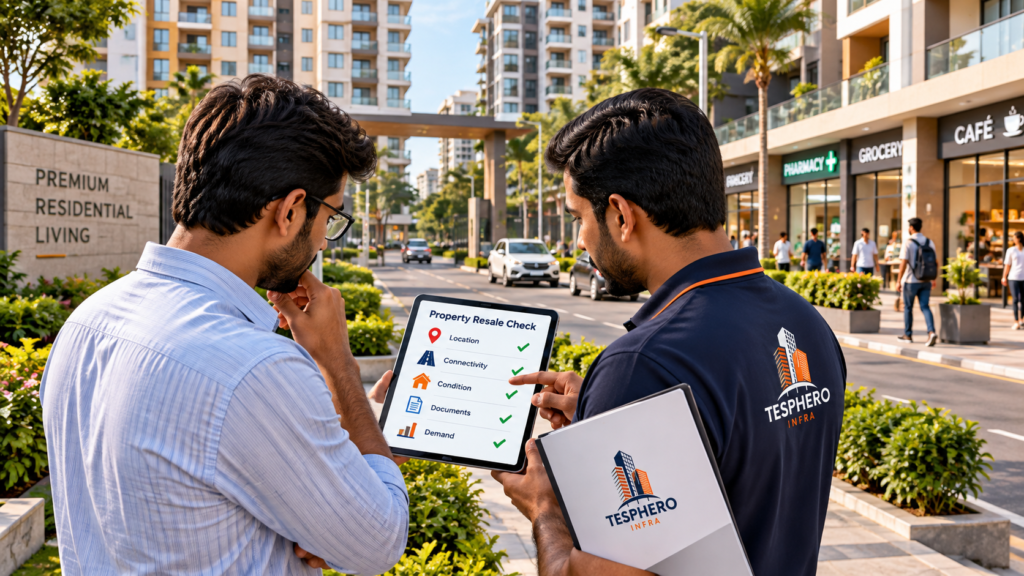
Evaluating location, connectivity, property condition, documentation, and local demand can help buyers better understand a property’s resale potential before making a purchase.
Property Resale Value is an important factor to consider before buying a home, plot, or investment property. A property may look attractive today, but buyers should also think about how easily it could attract future buyers and what factors may influence its market value over time.
No single formula guarantees a property’s future resale price. Location, connectivity, infrastructure, property condition, legal clarity, demand, supply, and the surrounding neighbourhood can all influence resale prospects.
This is especially important in a developing city like Indore. Infrastructure and connectivity can evolve, while residential and commercial activity can expand into new areas. The Indore Development Authority (IDA), for example, describes its role as planning and implementing residential, commercial, public-sector, transportation, and infrastructure development in the city. Indore Development Authority
Therefore, buyers should evaluate a property not only for today’s needs but also for factors that may matter when they eventually decide to sell.
Table of Contents
- What Does Property Resale Value Mean?
- Location and Neighbourhood Quality
- Connectivity and Accessibility
- Infrastructure and Future Development
- Property Condition and Age
- Property Size, Layout and Usability
- Legal and Documentation Factors
- Amenities and Project Maintenance
- Market Demand and Supply
- How to Evaluate Resale Potential Before Buying
What Does Property Resale Value Mean?
Property Resale Value refers to the price a property may command when its owner sells it in the secondary market.
Suppose you purchase an apartment for ₹60 lakh. After several years, you decide to sell it. The price buyers are willing to offer at that time will depend on the property’s characteristics and the market conditions then prevailing.
However, resale value should not be confused with guaranteed appreciation.
A property purchased for ₹60 lakh does not automatically become worth ₹80 lakh or ₹1 crore after a certain number of years. Real estate markets can move differently across cities, neighborhoods, property types, and time periods.
In addition, asking price and actual transaction price can differ.
For that reason, buyers should focus on resale potential rather than trying to predict an exact future price.
1. Location Can Strongly Influence Property Resale Value
Location is usually one of the first things future buyers evaluate.
Two similar apartments can attract different levels of buyer interest simply because they are located in different neighborhoods.
A useful location often provides reasonable access to everyday requirements such as:
- workplaces and business areas
- schools and colleges
- hospitals
- grocery stores and markets
- public transport
- major roads
- recreational facilities
- commercial areas
However, a good location does not always mean the center of the city.
An emerging neighbourhood can also become attractive when connectivity, infrastructure, housing demand, and everyday services develop around it.
Evaluate the Micro-Location
Do not evaluate only the broad locality name.
Visit the actual street and surrounding area.
For example, one property may sit on a well-connected road, while another property in the same locality may have narrow access or difficult traffic conditions.
Likewise, noise, drainage, parking pressure, nearby land use, street condition, and surrounding development can differ within a few kilometers.
If you want to evaluate this in greater detail, internally link to “What Makes a Property Location Valuable? 7 Factors Buyers Should Consider.”
That article complements resale analysis because location quality and future buyer demand are closely connected.
2. Connectivity and Accessibility Matter
Future buyers usually want a property that fits comfortably into daily life.
Therefore, accessibility can influence demand.
Look at road connectivity and practical travel time rather than distance alone. A location may appear close to an employment area on a map, but congestion or poor road access can make the journey inconvenient.
Meanwhile, a slightly farther property with better roads may offer easier travel.
Consider access to:
- major roads
- employment hubs
- commercial centers
- public transport
- schools
- hospitals
- railway or bus facilities where relevant
In Indore, buyers should also review planned infrastructure carefully rather than relying only on sales claims. IDA states that its planning and implementation work considers transportation facilities along with water supply, sewage lines, and electricity infrastructure. Indore Development Authority
Existing Connectivity vs Proposed Connectivity
This distinction matters.
An operational road provides a benefit today. A proposed road represents a possible future change whose timeline and final implementation may vary.
Therefore, verify major infrastructure claims through relevant government or development-authority sources.
Do not pay a large premium only because someone says a metro, flyover, road, commercial hub, or another major project “will definitely come here.”
3. Infrastructure and Future Development Can Change an Area
Real estate value does not depend only on the building.
The surrounding area matters too.
Road improvements, public facilities, commercial activity, transportation links, and organized residential development can affect how convenient an area becomes.
For example, IDA currently lists multiple infrastructure and development works in Indore, including road and related projects. Its website also provides information about town and country planning schemes. Indore Development Authority
Still, buyers should distinguish official information from speculation.
Look at Development From Both Sides
New infrastructure may improve accessibility and convenience. However, every nearby development does not automatically increase residential value.
Consider what the project actually does.
A useful road connection may improve access. On the other hand, certain high-traffic or incompatible neighboring uses may affect noise, congestion, or residential comfort.
Therefore, evaluate the effect on the specific property instead of assuming that all development is positive.
4. Property Condition Can Affect Buyer Interest
Imagine two apartments in the same building.
They have similar floor areas and layouts. However, one has severe seepage, damaged flooring, poorly maintained bathrooms, and old electrical fittings.
The other has received reasonable maintenance.
Which one will be easier to present to a future buyer?
Condition can influence both buyer interest and negotiation.
Check the Property Carefully
Before purchasing a resale home, inspect:
- seepage and dampness
- wall cracks
- plumbing
- electrical systems
- doors and windows
- flooring
- bathrooms
- kitchen condition
- ventilation
- natural light
- structural concerns that require professional inspection
Cosmetic improvements can make a home more presentable. However, they do not necessarily solve deeper structural or building-maintenance problems.
Building Condition Matters Too
An excellent apartment inside a poorly maintained building can still face resale challenges.
Therefore, inspect common areas as well.
Check lifts, staircases, corridors, parking areas, security systems, landscaping, water arrangements, waste management, and general upkeep.
Future buyers will notice them too.
5. Property Age Matters, but It Is Not the Only Factor
Older properties are not automatically poor resale options.
Some older developments may have useful locations, established neighborhoods, spacious layouts, or strong connectivity.
At the same time, age can introduce additional considerations.
Older buildings may require more maintenance. Common facilities can also need repairs or upgrades.
Therefore, buyers should consider age together with maintenance and construction condition.
A well-maintained older property may remain attractive to buyers, while a newer but poorly maintained property may create different concerns.
If you are buying an older property, consider getting appropriate technical advice when necessary.
6. Size, Layout and Usability Can Influence Demand
A larger property does not automatically have better resale potential.
Usability matters.
Suppose an apartment has a large total area but awkward room dimensions, limited natural light, or inefficient circulation.
Another apartment may be smaller but have a practical layout.
Depending on the target buyer segment, the second property may be easier to use and evaluate.
Think Like a Future Buyer
Ask practical questions:
Does the home have enough usable bedrooms?
Is the kitchen practical?
Is there adequate storage?
Does natural light enter important rooms?
Is ventilation reasonable?
Is parking suitable?
Can furniture fit comfortably?
A property’s layout should match the likely requirements of buyers in that market.
7. Legal Clarity Can Affect Property Resale Value and Sale ability
Documents may not make a property look more attractive in photographs, but they can become critical during a transaction.
Legal uncertainty can make buyers cautious.
It can also complicate due diligence, financing, or the sale process.
Under the Real Estate (Regulation and Development) Act, 2016, promoters registering applicable projects must provide information that includes sanctioned plans, project location details, apartment types and carpet areas, title-related declarations, and details of encumbrances, among other prescribed information. India Code
The Act also defines a completion certificate as a certificate from the competent authority confirming that the project has been developed according to the sanctioned plan, layout, and specifications. India Code
Verify Relevant Property Documents
Depending on the property type and transaction, buyers may need to review relevant documents such as title records, sale deeds, approvals, encumbrance-related information, sanctioned plans, completion/occupancy documentation where applicable, tax records, and society or association records.
The exact documents can vary by property.
Therefore, appropriate legal verification is advisable before completing a major transaction.
For a detailed explanation, internally link to “RERA, Title & Property Documents: What Every Property Buyer Should Verify.”
8. Project Amenities Can Help—But Only When They Add Practical Value
Swimming pools, clubhouses, gyms, landscaped areas, children’s play spaces, security, and other facilities can make a project attractive.
However, more amenities do not automatically mean stronger resale value.
Future buyers may also consider the cost of maintaining them.
A large set of poorly maintained amenities may be less attractive than a smaller set of useful, well-managed facilities.
Focus on Everyday Utility
Parking is a good example.
In many residential markets, convenient and clearly defined parking can matter significantly to buyers.
Similarly, reliable lifts, security, power arrangements, water availability, and well-maintained common spaces can influence everyday experience.
Therefore, consider quality and usefulness, not merely the number of amenities listed in a brochure.
9. Maintenance and Society Management Matter
After a project becomes occupied, ongoing management becomes important.
Poorly maintained common areas can gradually affect the overall appeal of the development.
Look at how the property or society handles:
- common-area maintenance
- security
- lifts
- water systems
- parking
- waste management
- repairs
- common facilities
- cleanliness
Also understand recurring maintenance charges.
Very high costs can affect affordability for future buyers, while unrealistically low maintenance may not support adequate upkeep.
The goal is a reasonable balance.
10. Market Demand and Supply Influence Resale Prices
Even a good property operates within a market.
If many similar properties are available for sale while buyer demand remains limited, sellers may face greater negotiation.
Conversely, limited supply combined with healthy buyer demand can affect pricing differently.
However, these conditions can change over time.
Compare Similar Properties
Do not compare your apartment with every property in the locality.
A more useful comparison looks at properties with similar:
- location
- age
- configuration
- size
- project type
- condition
- floor and view, where relevant
- amenities
- parking
- legal characteristics
Also remember that an online listing price is an asking price, not proof of the final transaction value.
That distinction is important when estimating resale potential.
11. The Developer or Project’s Track Record Can Matter
In certain markets, buyers recognize established projects or developers.
That recognition may affect initial interest. However, a brand name alone should never replace property-level due diligence.
Look at the actual development.
How has the building aged?
Are common areas maintained?
Do promised facilities exist and function?
Are there significant unresolved issues?
Does the project provide a practical living experience?
These questions can be more useful than relying on advertising alone.
12. Nearby Social Infrastructure Can Support Liveability
Residential buyers do not live inside the property 24 hours a day.
They interact with the surrounding neighbourhood.
Therefore, nearby schools, hospitals, grocery stores, pharmacies, restaurants, parks, and everyday services can contribute to convenience.
Established social infrastructure may make an area easier for a future buyer to evaluate.
Still, the right combination depends on the target buyer.
A family may priorities schools and healthcare. A working professional may place greater importance on employment access and transportation.
Understanding the likely future buyer segment can help you assess resale potential more realistically.
13. Avoid Paying Too Much at the Time of Purchase
Future resale performance does not depend only on what happens after you buy.
Your entry price matters too.
Suppose comparable properties in a micro-market are available within a certain range, but you pay a substantial premium without a clear property-specific reason.
Even if the locality develops, that initial premium may affect your eventual return.
Therefore, compare similar properties before negotiating.
Internally link here to “How to Evaluate a Real Estate Investment Before You Buy in Indore.”
That guide can help buyers assess the broader investment before committing capital.
Do Not Depend on One Price Source
Review multiple comparable listings and, where possible, relevant transaction information and professional inputs.
Also understand why one property commands a different price.
A better floor, larger usable area, parking, superior condition, stronger location, or another genuine feature may justify a difference.
14. Commercial and Residential Resale Factors Can Differ
Not every property follows the same demand drivers.
For residential properties, buyers may priorities liveability, schools, healthcare, security, neighbourhood quality, and commuting convenience.
Commercial buyers can focus more heavily on business visibility, accessibility, customer movement, parking, commercial activity, tenant demand, and permitted use.
Therefore, apply the right evaluation framework to the property type.
For commercial-property readers, internally link to “Why Location Matters for Businesses in Indore: Choosing the Right Commercial Property for Growth.”
Quick Comparison: What Can Influence Property Resale Value?
| Factor | What Buyers Should Examine |
|---|---|
| Location | Neighbourhood, convenience and surrounding development |
| Connectivity | Roads, transport and practical travel time |
| Infrastructure | Existing facilities and verified future plans |
| Property condition | Repairs, seepage, fittings and upkeep |
| Building condition | Lifts, common areas, parking and maintenance |
| Layout | Usable space, ventilation and practicality |
| Documentation | Title, approvals and relevant property records |
| Amenities | Utility, quality and maintenance |
| Demand and supply | Availability of similar properties and buyer interest |
| Purchase price | Whether the initial price is reasonable for comparable property |
No single factor determines the final resale price.
Instead, these elements work together.
15. How to Evaluate Property Resale Value Before You Buy
Start with the location.
Visit it at different times of day rather than relying only on a site visit arranged by a seller.
Next, examine current connectivity, surrounding development, social infrastructure, and everyday convenience.
Then inspect the property and building carefully.
After that, compare the asking price with similar properties.
Review relevant documents and approvals as well. Where necessary, use qualified legal and technical professionals for verification.
For Indore properties, official planning and development information can also provide useful context. IDA says its role includes planning and implementing residential, commercial, and public-sector development, and its website provides project, scheme, property, and citizen-service information. Indore Development Authority
Most importantly, separate verified facts from future expectations.
A proposed project may improve an area’s prospects, but buyers should not treat a future development as a guaranteed source of appreciation.
16. How Tesphero Infra Can Help
Buying real estate requires more than finding a property that looks attractive.
Tesphero Infra helps buyers explore property options in Indore while considering practical factors such as location, connectivity, property type, budget, surrounding development, and intended use.
For buyers concerned about resale potential, the starting point should be understanding the property itself and its market context.
That means comparing alternatives rather than relying on a single claim about future appreciation.
No property advisor can guarantee a particular future resale price. Market conditions, buyer demand, infrastructure, property condition, regulations, and many other factors can change over time.
A careful purchase decision should therefore balance today’s requirements with reasonable long-term considerations.
Final Thoughts
Property Resale Value is not determined by one feature, one development announcement, or one price trend.
Location matters. Connectivity matters. Property condition, documentation, layout, building maintenance, amenities, demand, supply, and purchase price matter too.
Moreover, buyers should distinguish between an established advantage and a promised future advantage.
A road that already provides strong connectivity is different from a proposed road. Similarly, a functioning commercial area is different from a planned commercial hub.
Before buying property in Indore, compare the property with realistic alternatives, verify relevant information, visit the location personally, and review the documents that apply to the transaction.
The aim should not be to predict an exact resale price years in advance.
Instead, look for a property with characteristics that could remain useful and attractive to future buyers.
Frequently Asked Questions
About the Author
Tesphero Infra helps property buyers explore residential and commercial real estate opportunities in Indore with a practical, requirement-based approach. Our content focuses on helping buyers understand location, property evaluation, documentation, and other factors that may support better-informed real estate decisions.
This article provides general information and should not be treated as a guarantee of property appreciation, future resale price, legal clearance, or investment return. Buyers should conduct appropriate property-specific legal, technical, and financial due diligence before making a transaction.
Planning to Buy Property in Indore?
Tesphero Infra can help you explore property options based on your location preference, budget, intended use, and practical requirements.
Evaluate the property for both today’s usability and tomorrow’s sale-ability before making your final decision.

Nearby schools, hospitals, transport, shops, and road connectivity can influence neighbourhood demand and a property’s future resale potential.