
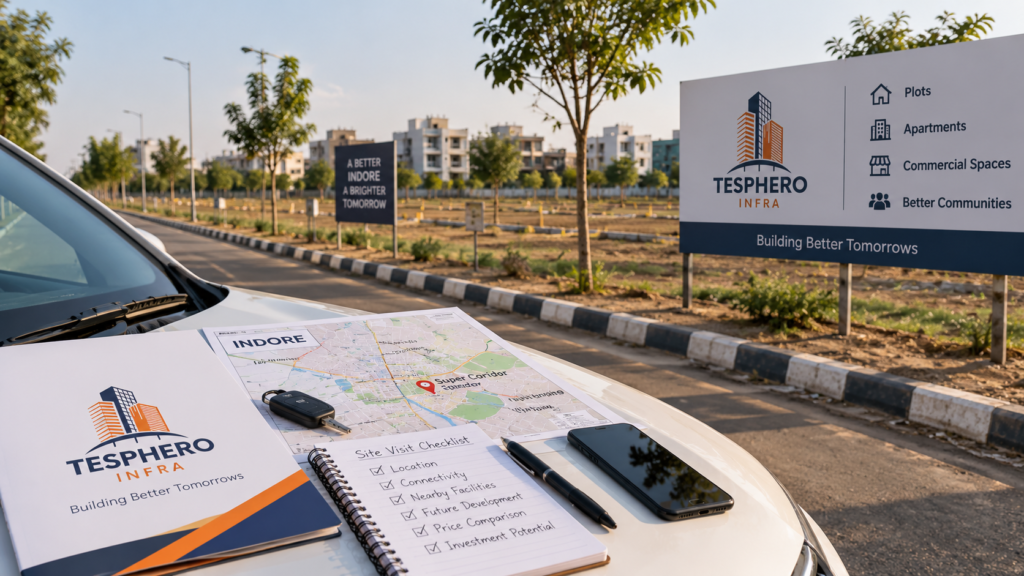
A real estate investment should begin with the location, demand and actual development around it.
A real estate investment in Indore can look attractive on paper—but the real question is whether the property still makes sense after you check the location, legal status, actual cost, rental potential and future demand.
A new highway is coming nearby.
A broker says prices are rising.
The developer says only a few units are left.
Someone you know has already invested in the same area.
All of this can create urgency.
However, urgency is not the same as a good investment opportunity.
Whether you are considering a residential plot, apartment, commercial property or land on the developing side of Indore, the decision should be based on more than the quoted price and promises of future appreciation.
Before asking:
“Will this property give me good returns?”
Ask:
“What factors could actually create—or reduce—the value of this property over time?”
This guide explains how investors can evaluate a real estate investment in Indore before buying, from location and connectivity to approvals, total cost, rental demand, infrastructure and exit potential.
Part 1: Start With the Investment, Not the Property
1. First Decide Why You Are Buying
Before comparing projects, define your investment goal.
Are you buying for long-term appreciation?
Do you want rental income?
Are you purchasing a commercial property for your own business?
Perhaps you want a plot that can be held for several years.
These are different goals.
A property suitable for rental income may not necessarily offer the same potential as land purchased for long-term development-led appreciation.
Similarly, a low-priced plot far from established development may require much more patience than an apartment in an active residential area.
Therefore, start with your purpose.
Once the goal is clear, evaluating properties becomes easier.
2. Don’t Judge an Investment Only by the Purchase Price
A property priced lower than nearby alternatives can immediately look attractive.
But cheap and undervalued are not the same thing.
There may be a reason for the lower price.
Connectivity may be weaker.
Development could still be limited.
The property may have approval or documentation concerns.
Rental demand might be low.
Infrastructure may take years to develop.
On the other hand, a higher-priced property in an established area may provide better access, stronger demand or easier resale.
So instead of asking:
“Which property is cheaper?”
ask:
“What am I receiving for this price?”
Price should always be evaluated together with location, development, documentation and demand.
3. Evaluate the Micro-Location, Not Just “Indore”
Saying that a property is “in Indore” tells you very little about its investment potential.
Real estate performance can vary significantly even within the same city.
Two properties located a few kilometres apart may have different road access, surrounding development, employment connectivity and buyer demand.
When evaluating a location, check practical factors such as access roads, public transport, schools, hospitals, commercial areas and nearby employment zones.
Also look at what already exists around the property.
A location surrounded by active residential or commercial development is different from one where almost everything depends on future promises.
City-level growth creates opportunity, but micro-location often determines how much of that opportunity reaches your property.
Location becomes even more important when the property is intended for business use. Customer access, visibility, surrounding activity and connectivity can directly influence the usefulness of a commercial space. If you’re evaluating property for a business, read our guide on “Why Location Matters for Businesses in Indore: Choosing the Right Commercial Property for Growth.”
4. Drive the Area Yourself
Google Maps and brochures are useful.
They are not enough.
Visit the property.
Ideally, visit at different times of the day.
Drive from the property to places that would matter to future users.
How long does the journey actually take?
What is the road condition?
Is the approach comfortable?
Does traffic become difficult during peak hours?
Are shops and essential services available nearby?
A project brochure may say “15 minutes from a major location,” but your actual travel experience can tell a different story.
Physical visits also reveal things photographs may not show.
You may notice drainage conditions, nearby industrial activity, noise, undeveloped roads or other practical factors.
5. Look at Existing Infrastructure Before Future Infrastructure
Infrastructure can influence real estate value.
New roads, transport links, commercial development and employment hubs can make surrounding locations more attractive.
However, investors should separate:
Infrastructure that already exists
from
Infrastructure that may exist in the future.
Future projects can be relevant.
But avoid building your entire investment decision around one proposed road, metro extension or commercial development.
Timelines can change.
Projects may be modified.
The actual impact on a specific property may also differ from expectations.
A stronger investment usually has some value based on today’s reality, with future infrastructure providing additional potential rather than being the only reason to buy.
6. Understand Who Will Actually Want the Property Later
Every investment eventually needs another person.
A tenant.
A homebuyer.
A business owner.
Another investor.
Before buying, ask:
Who is the future customer for this property?
For an apartment, it may be families working nearby.
For a commercial unit, the future user could be a retailer, office or service business.
A plotted development may attract families planning future construction or long-term investors.
If you cannot identify who may realistically want the property later, expected appreciation becomes harder to evaluate.
Real estate value is ultimately supported by demand.
Part 2: Check the Property Before You Calculate the Return
A promising location does not automatically make every property in that location a good investment.
The specific property still needs proper due diligence.
7. Verify Ownership and Property Documents
Before making a significant payment, understand who legally owns the property and whether the seller has the right to transfer it.
Relevant documents can vary depending on whether you are purchasing a plot, apartment, resale property or another type of real estate.
Title-related documents, previous transactions, approvals and other records may need to be reviewed.
For this reason, independent legal verification can be valuable.
Do not rely only on statements such as:
“Sab clear hai.”
Real estate involves significant money.
Important claims should be supported by appropriate documentation.
Investment potential should never replace basic property due diligence. Before finalising any transaction, it is worth reviewing the practical checks every buyer should make. Our guide “Buying Property in Indore? Don’t Decide on Price Alone.” covers important factors to consider before committing to a property.
8. Check RERA Details Where Applicable
For projects that fall within the applicable regulatory framework, buyers should review the information available through the relevant Real Estate Regulatory Authority.
Project details, registration information and other disclosures may help buyers understand the project more clearly.
Do not simply accept a RERA number printed on a brochure.
Verify relevant details through the official source.
Also remember that RERA registration itself should not replace broader due diligence.
Buyers still need to understand the property, documents, agreement terms and financial commitment.
Before relying on project-registration information shared in advertisements or brochures, buyers can verify applicable project and promoter details through the official Madhya Pradesh Real Estate Regulatory Authority (MP RERA) resources. RERA information is an important part of due diligence where applicable, but it should be reviewed together with property documents, agreement terms and independent professional advice.
9. Understand Land Use and Relevant Approvals
This becomes particularly important when purchasing plots or land.
A piece of land may look attractive because of its location and price.
However, investors should understand its legal use and whether relevant development permissions or approvals are in place for the intended transaction and use.
Terms such as diversion, layout approval and local authority permissions can become relevant depending on the property.
The exact documents required vary.
Therefore, obtain appropriate professional verification rather than relying on assumptions.
A beautiful site visit cannot replace clear documentation.
10. Calculate the Real Acquisition Cost
The advertised price is not always your final investment amount.
Depending on the transaction, additional costs can include stamp duty, registration expenses, applicable taxes or charges, brokerage, maintenance deposits, parking charges, fit-out costs and other expenses.
Suppose an investor mentally calculates returns based only on a ₹50 lakh property price.
If the actual total cash outflow becomes materially higher after all related expenses, the investment calculation changes.
Therefore, create a simple sheet:
Property price + transaction costs + immediate expenses = actual acquisition cost
Use this number when comparing investments.
11. Don’t Ignore Ongoing Costs
Property ownership can continue to cost money after purchase.
Apartments may involve maintenance charges.
Commercial properties can have common-area or facility-related expenses.
Vacant properties may still require security, upkeep and other payments.
There can also be applicable taxes and repair costs.
If you’re buying for rental income, these expenses matter because rent is not automatically equal to profit.
For example, a property generating ₹25,000 per month in rent doesn’t necessarily put the full ₹3 lakh annual amount into the owner’s pocket.
Vacancy and recurring expenses can reduce the effective return.
12. Calculate Rental Yield Realistically
If rental income is part of your strategy, calculate the expected yield rather than relying on statements like:
“Yahan rent bahut achha milta hai.”
A simple gross rental yield calculation is:
Annual Rent ÷ Total Property Cost × 100
Suppose the total property investment is ₹60 lakh and realistic annual rent is ₹2.4 lakh.
The gross rental yield would be approximately:
₹2.4 lakh ÷ ₹60 lakh × 100 = 4%
However, this is a gross figure.
Maintenance, vacancy and other ownership costs can reduce the effective return.
More importantly, use realistic rent based on comparable properties—not the highest rent someone says might be possible.
13. Compare Similar Properties
One of the best ways to evaluate a property is to compare it with alternatives.
Don’t compare an apartment with a distant plot and conclude that the plot is better simply because its price per square foot is lower.
Compare like with like.
However, leverage changes investment economics. Interest adds to the total cost, while EMIs create a regular monthly commitment. Even when a property remains vacant, loan payments still continue. Therefore, evaluate the loan amount, interest cost and EMI affordability before depending on expected appreciation. Rental income may support part of the EMI, but it should not be assumed to cover every expense.
14. Check the Developer’s or Seller’s Track Record
When buying in a development, look beyond the current project.
What has the developer completed before?
Visit previous developments where practical.
Are internal roads and common infrastructure maintained?
Did the completed project broadly match what buyers were shown?
For resale transactions, the focus shifts more toward ownership history, property condition and documentation.
The objective is not to find a seller or developer with a perfect online reputation.
Instead, collect enough information to make an informed decision.
Part 3: Evaluate Future Returns Without Depending on Predictions
Everyone wants to know:
“Kitna appreciation milega?”
Unfortunately, nobody can responsibly guarantee exactly what a property will be worth five or ten years from now.
Instead of trying to predict one future price, evaluate the factors that could support demand.
15. Look for Demand Drivers
Property values generally need reasons to grow.
Those reasons can include improving connectivity, employment, population growth, commercial activity and better social infrastructure.
For example, a residential location that becomes easier to reach from major employment areas may become more practical for working families.
Likewise, commercial development can create new demand around growing neighbourhoods.
But don’t simply count nearby projects.
Ask how they could influence the specific property.
A new road matters when it meaningfully improves access.
An employment hub matters when it creates genuine residential or commercial demand.
Infrastructure matters because of the demand it can create—not because it looks impressive on a brochure.
16. Check How Much Development Is Already Priced In
Imagine a location receives major attention after a new infrastructure announcement.
Land prices rise quickly.
Investors enter.
Sellers begin quoting much higher rates.
At that point, buying solely because “prices will increase when the project comes” may be risky because part of that expected growth may already be reflected in today’s price.
Compare historical asking prices where reliable information is available.
Speak with multiple market participants.
Review actual registered transaction information where accessible and relevant.
The objective is to understand whether you’re entering early, at a reasonable stage or after speculation has already pushed expectations very high.
17. Think About Liquidity Before Buying
Real estate is not as liquid as money in a bank account.
Selling can take time.
A property may appear valuable, yet finding a buyer at your expected price could take months.
Therefore, think about exit potential before entering.
Ask:
How many people could realistically buy this property later?
Is the ticket size affordable for the target market?
Is financing generally available for this type of property?
Does the location attract end users or mainly investors?
Properties supported by genuine end-user demand may have a different resale profile from locations driven mostly by speculation.
18. Consider Your Holding Period
Real estate often works better when investors have enough time.
Buying today with the expectation of selling after a few months at a large profit is speculation, not a dependable investment plan.
Transaction costs alone can make very short holding periods challenging.
Before purchasing, decide how long you can realistically hold the asset.
Would you still be comfortable owning it if prices remained relatively flat for a few years?
Can you manage loan payments or maintenance during that time?
A good investment should fit your financial capacity—not force you to sell at the wrong time.
19. Evaluate Financing Carefully
A home or property loan can make a purchase possible without paying the entire amount upfront.
However, leverage changes investment economics.
Interest increases the total cost.
EMIs affect monthly cash flow.
If the property remains vacant, loan payments still continue.
Therefore, don’t evaluate a financed property using only expected appreciation.
Consider the loan amount, interest cost, EMI affordability and your ability to handle unexpected expenses.
Rental income may support part of the EMI.
It should not automatically be assumed to cover everything.
20. Keep an Emergency Buffer
Avoid using every available rupee for the down payment and transaction costs.
Property investments can create unexpected expenses.
Repairs may arise.
Possession could require additional spending.
A rental property may remain vacant longer than expected.
Your personal finances can also change.
Maintaining liquidity outside the property can prevent an investment from creating unnecessary financial pressure.
A Simple Investment Checklist Before You Buy
Before finalising a real estate investment in Indore, check these areas:
- Purpose: appreciation, rental income, business use or future self-use.
- Location: roads, connectivity, neighbourhood and nearby facilities.
- Demand: identify likely future tenants or buyers.
- Documentation: ownership, title and relevant approvals.
- RERA: verify applicable project information through official sources.
- Total cost: include transaction and immediate ownership expenses.
- Rental potential: use realistic comparable rents.
- Developer or seller: review relevant background and track record.
- Future development: separate confirmed infrastructure from speculation.
- Exit: consider how easy the property may be to resell.
- Finance: calculate loan and holding costs.
- Risk: ask what happens if appreciation takes longer than expected.
If several important answers are unclear, don’t allow sales pressure to make the decision for you.
Common Mistakes Real Estate Investors Make
A common mistake is buying because prices have recently increased.
Another is choosing a property based entirely on a future infrastructure announcement.
Some investors focus only on price per square foot while ignoring connectivity and demand.
Others calculate rental returns using optimistic rent assumptions.
Documentation may also receive less attention when the project looks professional or someone trusted recommends it.
Another mistake is assuming that every part of a growing city will appreciate at the same rate.
It won’t.
Even within Indore, different micro-markets can behave differently.
Finally, avoid making the investment simply because:
“Property mein paisa kabhi nahi doobta.”
Every investment has risk.
Real estate is no exception.
How Tesphero Infra Can Help
Evaluating property requires more than showing available plots, apartments or commercial spaces.
At Tesphero Infra, we help property buyers and investors explore real estate options in Indore according to practical requirements such as location, budget, intended use, connectivity and long-term objectives.
An investor may be looking for a plotted development with a longer holding period.
Another buyer may prefer residential property with stronger existing demand.
A business owner could need commercial space where location and customer accessibility matter more than future appreciation alone.
The right property can therefore differ from one buyer to another.
The aim is to help you compare options more clearly before making a major financial commitment.
Independent legal, tax and financial advice should still be taken where appropriate before completing a transaction.
Final Thoughts
Real estate investment becomes risky when excitement replaces evaluation.
A growing location can still contain an overpriced property.
A low-priced plot can still be a poor investment.
A premium project can still provide weak rental returns.
And a future infrastructure announcement does not automatically guarantee appreciation.
Before buying in Indore, understand your goal.
Visit the location.
Check connectivity.
Study actual demand.
Verify documentation.
Calculate the total investment.
Evaluate rental potential where relevant.
Consider how you would eventually exit.
Most importantly, leave room for the possibility that the market may not move exactly as expected.
Because the best question before investing isn’t:
“How much will this property increase in value?”
It is:
“Does this investment still make sense even if appreciation takes longer than I expect?”
That question can protect you from many expensive decisions.
Frequently Asked Questions
About the Author
Tesphero Infra works with property buyers, investors and businesses exploring real estate opportunities in Indore. The focus is on understanding practical requirements such as location, budget, connectivity, intended use and long-term objectives before comparing suitable property options.
Whether someone is evaluating a residential property, plotted development or commercial space, the aim is to make the property-selection process more structured and informed. To learn more about our approach and real estate services, visit the AboutUs.
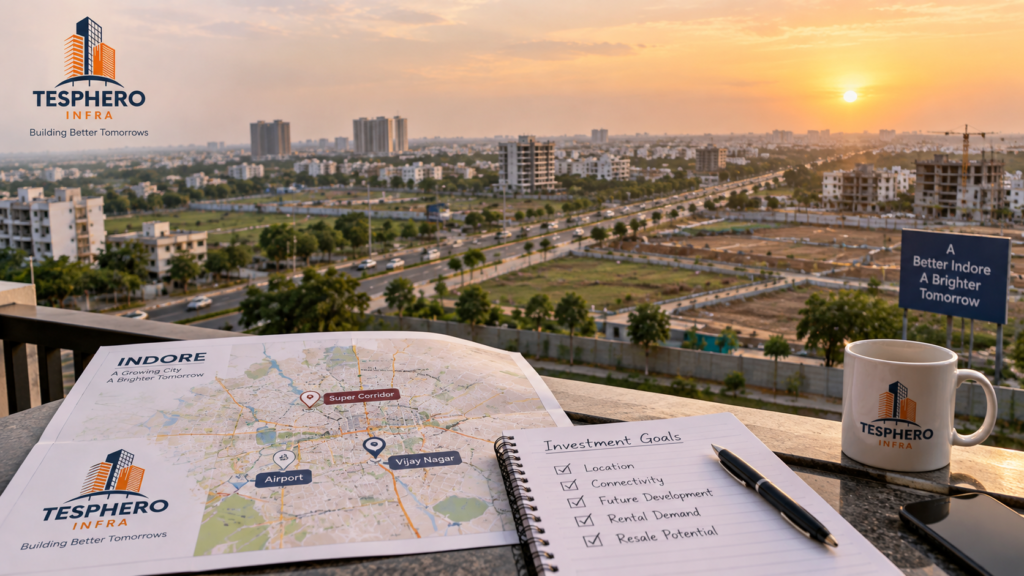
Future value depends on real demand, connectivity and development—not predictions alone.
Contact Tesphero Infra
Exploring real estate investment opportunities in Indore but unsure which location or property type fits your budget and long-term plans? Contact Tesphero Infra to discuss your requirements and compare suitable residential, plotted or commercial property options. A property decision should begin with understanding your objective—not simply choosing whichever project is being promoted most aggressively.