

Selling gets you the order. A consistent experience helps customers remember the brand.
Getting your products listed on Amazon, Flipkart, Meesho, or another online marketplace can put your business in front of thousands of potential customers.
But there is one problem.
Your competitors are standing on the same digital shelf.
A customer searches for a product, compares several similar options, checks prices and reviews, places an order—and may completely forget the seller’s name a few days later.
That is the difference between selling a product and building a brand.
Marketplace sales can help you generate revenue, but long-term e-commerce growth requires something more: customers should recognise your business, understand what makes it different and have a reason to choose it again.
You don’t need to become a national brand overnight. However, you do need to start building an identity that exists beyond one listing, one discount or one marketplace.
If customers remember the product but forget who sold it, you may be making sales—but you haven’t fully built the brand yet.
Stop Thinking Like Only a Marketplace Seller
1. Marketplace Visibility Is Not the Same as Brand Recognition
Marketplaces are powerful because customers already visit them with buying intent.
Someone searching for a storage organiser, mobile accessory, kitchen product, or personal-care item may be ready to purchase.
This creates opportunity.
However, the customer may see dozens of competing listings within seconds.
Similar specifications.
Similar reviews.
Similar photographs.
Similar delivery timelines.
You may win the order.
But will the customer remember your brand three months later?
That is a different challenge.
Visibility helps people find your product. Branding gives them something to remember after they find it.
2. Decide What You Want Your Brand to Stand For
Before choosing colours or redesigning packaging, answer a more important question:
What should customers associate with your brand?
Perhaps you want to be known for affordable everyday products.
Maybe your focus is premium quality.
Perhaps you solve practical household problems through simple, useful products.
Or your brand may target a very specific customer group.
Without clear positioning, businesses often create random product catalogues.
Today they sell kitchen organisers. Tomorrow they add mobile accessories. Next month they introduce beauty products simply because those categories appear popular.
The store may generate orders, but customers have little reason to understand what the brand represents.
You don’t necessarily need to remain in one narrow product category forever.
But your product range should ideally have enough logic that customers can understand the business behind it.
3. Give Customers a Reason to Choose You
Imagine five marketplace listings offering almost the same product.
The specifications look almost identical. Customer reviews are equally competitive, the photographs feel similar, and even the delivery timelines offer little difference.
Why should a customer choose yours?
The only answer is “because ours is ₹30 cheaper”; the business may become dependent on discounts.
Another seller can reduce their price tomorrow.
Strong brands gradually compete on more than price.
Your difference could come from better materials, useful features, stronger packaging, clearer instructions, thoughtful bundles, dependable quality or a better understanding of a particular customer need.
It doesn’t always require inventing something completely new.
Sometimes the opportunity is simply to take a familiar product and deliver a more thoughtful customer experience around it.
4. Make Your Product Listings Feel Like One Brand
Look at several products from your catalogue together.
Do they feel as if they come from the same company?
Or does every listing look unrelated?
Brand consistency can be reflected through product photography, packaging presentation, visual communication, and the way product information is written.
This does not mean placing a giant logo on every image.
The objective is recognition, not distraction.
For example, your secondary images could follow a consistent visual approach. Product benefits could be communicated in a similar style. Packaging could carry recognisable design elements.
Over time, these details can help customers associate multiple products with the same brand.
Even a strong product can be overlooked when its listing fails to communicate its value. Our guide “Your Product Is Good, But Is Your Listing Selling It? 8 Ways to Improve Product Listings” explains how better product presentation can improve the way customers understand your offer.
5. Your Product Quality Is Part of Your Branding
Marketing can create the first impression.
The actual product determines whether that impression survives.
If your listing promises premium quality but the customer receives poor finishing, weak packaging, or an item that looks significantly different from the photographs, branding cannot solve the problem.
In fact, strong marketing combined with a disappointing product can make the negative experience even stronger because expectations were higher.
Before investing heavily in brand promotion, make sure the basics work.
Product quality should be reasonably consistent.
Packaging should protect the item.
Descriptions should set realistic expectations.
And common customer complaints should be taken seriously.
Your brand is not only what you say about the product. It is also what the customer experiences after opening the package.
Build the Brand Around the Customer Experience
A memorable brand isn’t created only before the sale.
What happens after the customer clicks “Buy” can be equally important.
6. Packaging Is More Than a Shipping Requirement
For many online businesses, the package arriving at the customer’s home may be the first physical interaction they have with the brand.
That moment matters.
Packaging doesn’t need to be expensive or luxurious.
It needs to be appropriate for the product, protective, and consistent with the experience you want to create.
The practical everyday brand may use simple, clean packaging.
The premium product may require a more refined presentation.
Most importantly, the product should arrive safely and as expected.
A beautiful box that fails to protect the item isn’t good branding.
Likewise, excessive packaging that adds unnecessary cost may not make business sense.
Aim for packaging that balances protection, presentation, and economics.
7. Use Customer Reviews as Brand Research
Reviews aren’t only ratings.
They are customer research available directly from the market.
Read your positive reviews to understand what customers appreciate.
Then read the negative ones even more carefully.
Do customers repeatedly mention sizing?
Packaging?
Durability?
Instructions?
Product expectations?
These patterns can help you improve both the product and the listing.
Competitor reviews can also reveal gaps in the category before you launch a new product.
For example, if customers consistently complain that competing products are difficult to assemble, clearer instructions or a simpler design could become part of your advantage.
A brand that listens and improves becomes stronger over time.
8. Build Consistency Across Your Product Range
Imagine a customer likes your first product and clicks on your brand or seller catalogue to explore more.
What do they find?
A collection of complementary products?
Or twenty completely unrelated items?
A coherent range can make it easier to build stronger brand association.
Suppose your business begins with desk organisation products.
You may later expand into cable organisers, laptop stands, document storage and other workspace accessories.
Now the customer can understand what your brand is about.
This also creates opportunities for cross-selling and future purchases.
Instead of asking only:
“What else can we sell?”
ask:
“What else would this customer naturally need from us?”
That small change in thinking can lead to a much stronger catalogue.
9. Don’t Depend Entirely on Marketplace Discounts
Discounts can help generate attention, especially in competitive categories.
But constant discounting can create a problem.
Customers may begin to associate your product with its discounted price rather than its actual value.
If sales fall immediately whenever the discount disappears, you may not yet have created enough reason for customers to choose the product at its normal price.
Focus on strengthening the offer.
Better presentation, useful features, quality, customer feedback, and clear positioning can all contribute.
Price will always matter in e-commerce.
It simply shouldn’t be the only reason your product wins.
10. Build a Presence Beyond the Marketplace
Marketplaces can remain an important sales channel while your brand develops other digital touchpoints.
Depending on your business stage, these could include a professional website, social media presence, or other suitable customer communication channels.
The purpose isn’t to open every channel immediately.
It is to give customers ways to understand your brand beyond a single marketplace listing.
For example, social media can show product use cases, behind-the-scenes processes, educational content, and new launches.
A website can explain your broader product range, brand story, and positioning.
These touchpoints help customers see a business behind the listing.
Any customer communication or data collection should, of course, follow applicable marketplace rules and relevant requirements.
As India’s digital-commerce ecosystem continues to develop, businesses can also explore official resources from the Open Network for Digital Commerce (ONDC) to understand how open digital commerce is evolving beyond traditional marketplace models. The objective isn’t to join every available channel, but to understand the different ways customers and sellers can participate in digital commerce.
11. Make Customer Service Part of the Brand
Customers remember how businesses respond when something goes wrong.
A damaged item, missing component, or confusing instruction can create frustration.
How the issue is handled can influence the customer’s final perception of the brand.
Clear communication and a practical approach to customer concerns matter.
At the same time, customer service shouldn’t merely solve the same problem repeatedly.
If ten customers raise the same issue, look for the root cause.
Maybe the listing needs clarification.
Maybe packaging needs improvement.
Maybe the product itself needs modification.
Good customer service solves today’s issue. A good brand uses that issue to improve tomorrow’s experience.
Move From Individual Sales to Long-Term Brand Growth
The transition from seller to brand doesn’t happen in one campaign.
It happens through repeated decisions.
The products you launch, customers you target, packaging you use, and experiences you create all contribute to the brand customers eventually remember.
12. Know Who Your Best Customer Is
As orders increase, you begin collecting valuable information.
Which products receive stronger responses?
What problems do customers mention?
Which features matter most?
Which products generate repeat interest?
Use these insights to sharpen your positioning.
Trying to appeal to everyone can make the brand generic.
A clearer customer focus can influence product development, pricing, imagery, and communication.
When you understand who you’re building for, brand decisions become easier.
13. Turn One Successful Product Into a Product Strategy
A bestselling product is useful.
A product strategy is stronger.
If one item performs well, understand why.
Was it the price?
A specific feature?
The design?
A customer problem it solved particularly well?
Once you identify the reason, consider how that insight could influence future products.
Instead of randomly chasing the next trending item, build around what your business is already learning.
This is how an online catalogue can gradually become a recognisable brand range.
Building a memorable brand becomes much easier when the products themselves fit a clear market opportunity and customer need. If you’re still deciding what should become part of your catalogue, read our guide “What Should You Sell Online? A Practical Guide to Choosing the Right E-commerce Product” for a practical framework covering demand, competition, margins and growth potential.
14. Measure More Than Marketplace Revenue
Revenue is important, but it doesn’t tell you everything about brand health.
Also pay attention to customer ratings, review themes, returns, repeat demand, and performance across your product range.
When sales are increasing, but returns are also rising sharply, something needs attention.
At the same time, one successful product doesn’t necessarily mean your overall product strategy is working.
For example, when new launches repeatedly struggle, it may be time to review your product selection and positioning.
Positive customer comments about quality or packaging can also reveal strengths worth reinforcing.
Use marketplace data as business intelligence rather than simply checking the daily order count.
Common Mistakes That Keep Sellers From Building a Brand
One common mistake is launching too many unrelated products because they appear profitable.
Another is copying competitor listings so closely that the business develops no identity of its own.
Sellers can also weaken brand building through inconsistent quality, poor packaging, constant discounting, weak listings, and ignoring customer feedback.
Perhaps the biggest mistake is waiting until the business becomes “big enough” before thinking about branding.
You don’t need a massive advertising budget to start.
Brand building begins with small decisions: what you sell, who you sell it to, what you promise, and whether you consistently deliver that promise.
How Tesphero Ecom Can Help
Moving from marketplace selling to brand building requires a wider view of e-commerce.
At Tesphero Ecom, we work with businesses across different stages of their online journey—from sellers preparing to enter marketplaces to existing businesses looking for more structured growth.
Depending on the requirement, this can include product selection guidance, seller account setup, product listing and optimization, marketplace strategy, branding, and e-commerce growth consulting.
For an existing marketplace seller, the priority may be improving listings and creating stronger product positioning.
At a manufacturer, it may involve identifying which products can form the foundation of an online brand.
For a growing D2C business, the challenge may be creating greater consistency across products, presentation, and channels.
The objective isn’t simply to increase the number of listings.
It is to help build an e-commerce presence that customers can understand, trust, and remember.
Final Thoughts
Marketplaces can help you reach customers faster.
But access to customers doesn’t automatically create customer loyalty.
Suppose your business competes only on price; another seller can always offer a lower price.
If it depends on one bestselling product, customer preferences can change.
And if customers never remember your name, every future order may require winning their attention from the beginning again.
Start thinking beyond the transaction.
Create a clear position.
Build a logical product range.
Improve quality through customer feedback.
Make packaging and listings consistent.
Develop useful digital touchpoints beyond marketplace product pages.
Most importantly, give customers a reason to associate your name with a particular experience.
Because the long-term question isn’t simply:
“How many orders did we receive today?”
It is:
“For example, these customers need a similar product tomorrow; will they remember us?”
That is when a marketplace seller starts becoming a brand.
Frequently Asked Questions
About the Author
Tesphero Ecom works with sellers, manufacturers, retailers, and growing brands that want to build a more structured presence across online marketplaces. The focus goes beyond simply creating seller accounts or uploading products; it includes understanding product opportunities, improving listings, strengthening marketplace positioning and planning for sustainable e-commerce growth.
For businesses that want to move from individual marketplace sales toward a more recognisable online brand, Tesphero Ecom focuses on practical strategies built around products, customers, and long-term business goals. To learn more about our approach and e-commerce services, visit Tesphero Ecom.
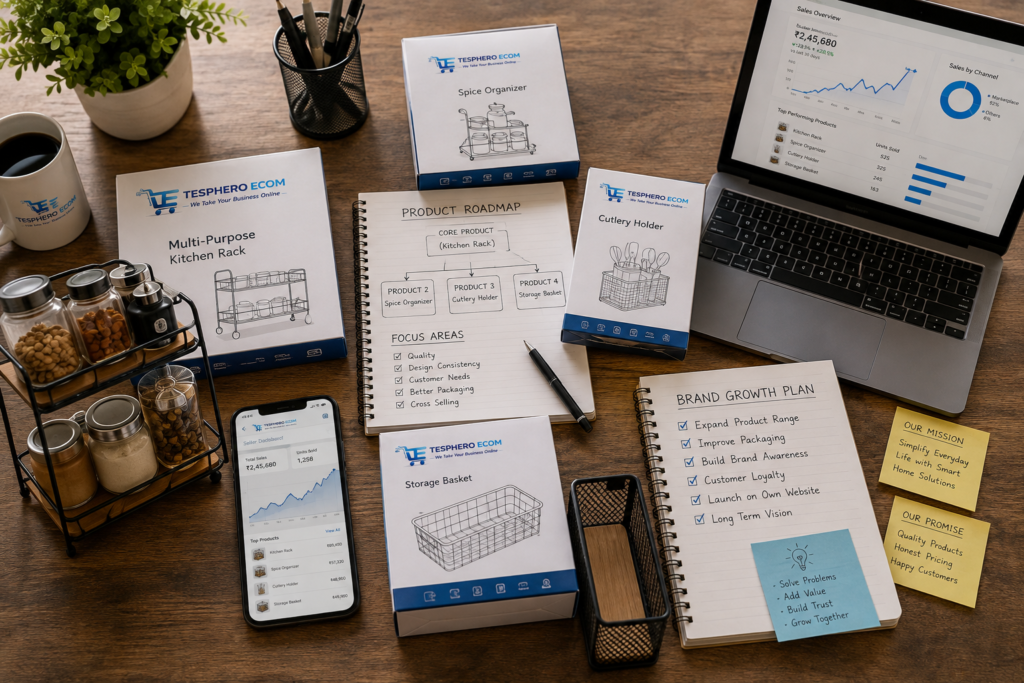
A successful product can become the starting point for a stronger brand.