
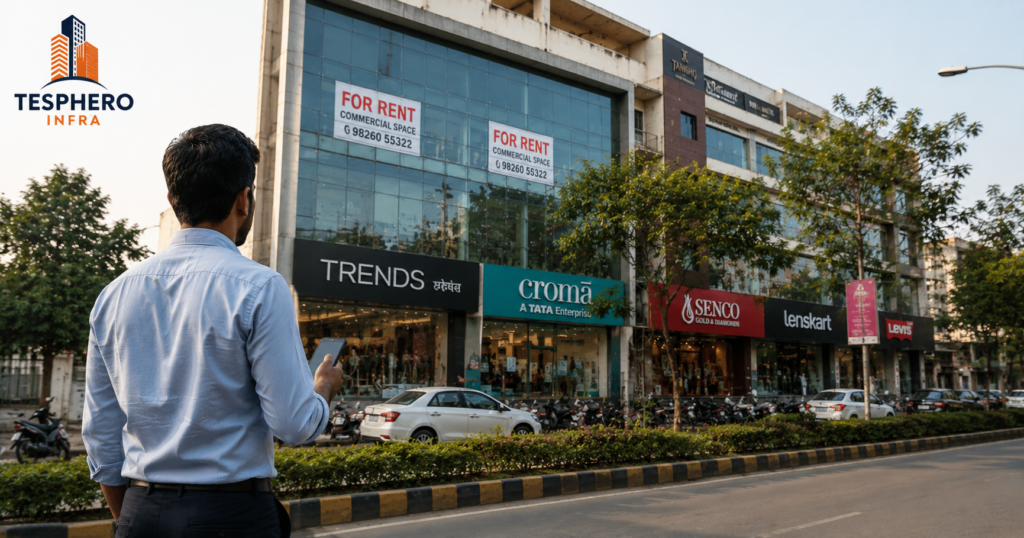
A commercial property’s surroundings can matter as much as the space itself.
A commercial property may look perfect on paper.
The rent fits your budget. The space looks professional. The building is new, and the owner is ready to close the deal quickly.
But six months later, customers struggle to find you. Employees complain about the commute. Parking becomes a daily problem. Deliveries take longer than expected, and moving to another property suddenly looks expensive.
This is why the wrong commercial location can cost your business more than just rent.
For a business in Indore, choosing a commercial property isn’t simply about finding a shop, office, showroom, or warehouse within budget. The location can influence customer access, visibility, employee convenience, logistics, operating expenses, and even your ability to expand.
A cheaper property in the wrong place can eventually become more expensive than a slightly higher-priced property that supports your operations.
So before asking, “How much is the rent?”, ask a more important question:
“What will this location help—or prevent—my business from doing?”
Your Location Is a Business Decision, Not Just a Property Decision
1. Start With Your Business Model
There is no single “best commercial location” in Indore for every business.
The right location depends on what your business actually does.
A retail store may benefit from visibility and customer footfall.
A corporate office may prioritise connectivity, professional surroundings, and employee accessibility.
A warehouse may care more about road access, loading space, and movement of goods.
A clinic may need easy customer access, parking, and a convenient surrounding area.
A manufacturing business may have completely different requirements again.
This is why choosing a commercial property based only on whether an area is popular can be misleading.
Before visiting properties, define your operational requirements.
Think about who needs to reach the property, how frequently they visit, what activities happen there, and what infrastructure those activities require.
Choose the property around the business—not the business around the property.
2. Customer Accessibility Can Influence Revenue
Imagine finding an attractive showroom at a very competitive rent.
The problem?
Customers have difficulty reaching it.
The approach road is inconvenient, parking is limited, and the property is difficult to notice from the main route.
That lower rent may no longer feel like a bargain.
For customer-facing businesses, convenience can directly influence whether someone visits.
Consider where your customers are coming from and how they are likely to reach you.
Will they travel by car, two-wheeler, or public transport?
Is the property easy to identify?
Is there suitable parking nearby?
Does reaching the location require unnecessary detours?
A destination business with loyal customers may be able to operate successfully away from a high-footfall road.
A new retail store depending on walk-ins may not have that flexibility.
The right answer depends on customer behaviour.
3. Visibility Matters—but Not for Every Business
A prominent main-road property usually commands attention.
But does your business actually need that visibility?
For a café, retail store, salon or showroom, visible frontage can be valuable.
For a back-office operation, consulting team, or business that receives customers primarily through appointments, paying a significant premium purely for main-road visibility may not always be necessary.
This distinction can save money.
Instead of automatically choosing the most visible commercial property available, ask:
“Does visibility contribute directly to how we acquire customers?”
If yes, frontage and signage opportunities deserve serious consideration.
If not, you may be able to prioritise better space, parking or accessibility within the same budget.
4. Look Beyond Today’s Traffic
A busy road can appear attractive during a property visit.
However, traffic volume alone doesn’t guarantee useful customer movement.
You need to understand who is moving through the area and why.
Is the surrounding population relevant to your business?
Are there offices nearby?
Residential communities?
Educational institutions?
Hospitals?
Retail clusters?
Industrial activity?
The presence of complementary businesses can sometimes be more valuable than raw traffic numbers.
For example, a business serving corporate clients may benefit more from proximity to commercial clusters than from a crowded residential market.
Spend time around the location before deciding.
Observe the area during the hours when your business will actually operate.
5. Employee Convenience Is Part of the Location Cost
Commercial property decisions often focus entirely on customers.
But your employees may travel to the location hundreds of times each year.
If the workplace is difficult to reach, everyday inconvenience can add up.
Consider commute routes, public transport availability, road connectivity, parking, and nearby basic amenities.
This becomes even more important if you employ a larger team or operate multiple shifts.
You don’t need to choose a location that is equally convenient for every employee.
That may be impossible.
But accessibility should be considered before signing a long-term commitment.
A location that saves ₹15,000 in monthly rent but creates significant commuting and staffing challenges may not represent the savings you initially expected.
Calculate the Real Cost of a Commercial Location
The monthly rent is one of the easiest costs to compare.
Unfortunately, it isn’t the only one.
A commercial property can create additional expenses through transportation, parking, maintenance, utilities, logistics, fit-outs, and inefficient operations.
That’s why businesses should compare total occupancy and operational impact, not rent alone.
6. Cheap Rent Can Become Expensive
Consider two commercial properties.
Property A costs ₹60,000 per month and offers good connectivity, parking, and convenient customer access.
Property B costs ₹45,000.
At first, Property B appears to save ₹15,000 every month.
But what if it increases delivery expenses, requires additional customer directions, has limited parking, and adds significant travel time for employees?
The real difference may be much smaller.
This doesn’t mean you should always choose the expensive property.
It means rent should be evaluated in context.
Create a simple comparison that includes rent, maintenance, parking, utilities, transportation, and other predictable location-related expenses.
Then consider the operational impact that is harder to put into a spreadsheet.
7. Parking Can Become a Business Problem
Parking may seem like a small detail during a property visit.
It becomes much more important when customers and employees arrive every day.
For a showroom, clinic, restaurant, training centre, or customer-facing office, difficult parking can create friction before the customer even enters the property.
Businesses with larger teams also need to understand employee parking arrangements.
Don’t simply ask:
“Parking available hai?”
Understand what “available” actually means.
Is there dedicated parking?
Shared parking?
Roadside parking?
Is it usually available during business hours?
Visit during a busy period and observe the reality yourself.
8. Check Loading, Delivery and Logistics Access
If goods regularly move in and out of your property, logistics should be evaluated separately from customer accessibility.
Can delivery vehicles reach the building comfortably?
Is there space for loading and unloading?
Are there timing restrictions or congestion problems?
How far is the location from important transport routes?
These questions are particularly important for warehouses, distributors, wholesalers, manufacturers, restaurants, and businesses handling physical inventory.
A beautiful commercial space can become operationally frustrating if every delivery turns into a logistical problem.
9. Understand the Surrounding Business Ecosystem
Sometimes a location becomes valuable because of what surrounds it.
A commercial cluster can create natural business advantages.
Customers may already visit the area for related products or services.
Suppliers may be nearby.
Employees may find transportation easier.
Complementary businesses can generate useful movement.
However, clustering also means competition.
If several businesses offering almost identical services operate within a small area, understand whether the local demand is strong enough.
Competition isn’t automatically a reason to reject a location.
In some categories, customers actively prefer areas where multiple options are available.
The important thing is to understand why customers visit that particular commercial zone.
10. Check the Property’s Practical Infrastructure
Location is not only about the neighbourhood.
The property itself needs to support your operations.
Depending on your business, check factors such as electricity requirements, water availability, internet connectivity, ventilation, washrooms, lift access, security, signage possibilities, and usable floor layout.
A property may have enough square footage but still use space inefficiently.
For example, awkward pillars, narrow entrances or poor floor planning can reduce the amount of space your business can practically use.
If specialised equipment will be installed, verify whether the property can accommodate it before committing.
11. Think About Future Growth Before Moving In
Moving a commercial business isn’t easy.
New interiors may be required.
Customers need to be informed.
Signage changes.
Equipment moves.
Operations may be disrupted.
So don’t evaluate the property only according to your current team or customer volume.
Ask what happens if the business grows over the next two or three years.
Can you add workstations?
Can inventory increase?
Is additional space available nearby?
Can the location handle higher customer traffic?
You don’t need to rent twice the space you need today.
But a property with some room for growth may prevent an expensive relocation too soon.
Evaluate the Location Before You Commit
A commercial property decision can affect your business for years.
That makes due diligence more important than excitement.
12. Visit More Than Once
Never judge a commercial location from one short visit.
If possible, observe it at different times.
A road that looks easy to access at 11 AM may be heavily congested at 6 PM.
Parking that appears empty on Sunday may be completely occupied on weekdays.
A quiet building may become busy during normal office hours.
Visit when your future customers and employees are most likely to use the property.
Real observation can tell you things that photographs and property descriptions cannot.
13. Understand the Property Before Signing
Before finalising a commercial property, make sure you understand the relevant ownership or leasing documentation, agreed commercial terms and permitted use of the space.
If you’re renting, clarify rent, deposit, maintenance responsibilities, notice period, escalation terms and fit-out-related conditions.
If you’re purchasing, the due-diligence process becomes even more important.
Commercial property transactions can involve legal, financial and regulatory considerations, so appropriate professional advice should be sought where required.
Don’t rely entirely on verbal assurances for something that materially affects your business.
If you’re considering purchasing the commercial property rather than leasing it, our guide “Buying Property in Indore? 7 Things You Should Check Before Making the Final Decision” covers some of the broader checks buyers should consider before committing to a property.
When evaluating property-related documentation and registration requirements in Madhya Pradesh, businesses can also refer to the official resources provided by the Madhya Pradesh Registration and Stamps Department. These resources can be useful for general information, while property-specific legal or documentation questions should be reviewed with an appropriate professional.
14. Compare Locations With a Business Scorecard
Emotions can influence property decisions.
A modern building or impressive interior can make one option feel immediately better.
A simple scorecard can bring the decision back to business fundamentals.
Rate shortlisted properties based on customer accessibility, visibility, parking, employee convenience, logistics, total cost, infrastructure, and future expansion.
Then give greater weight to the factors that matter most for your business.
A retail store may score visibility heavily.
A warehouse may give logistics far more importance.
A corporate office may prioritise employee access and professional surroundings.
The best property isn’t the one with the highest score for everything. It’s the one that scores highest on what matters to your business.
Common Commercial Property Mistakes
Businesses often make avoidable mistakes by selecting solely on low rent, choosing a prestigious address without checking practical requirements, or underestimating parking and traffic.
Other common issues include ignoring employee commute, failing to inspect the property during peak hours, overlooking additional occupancy costs, and choosing a space with no realistic room for growth.
Another mistake is falling in love with the property before evaluating the location.
Beautiful interiors can be changed.
A poor location is much harder to fix.
How Tesphero Infra Can Help
Finding commercial property should begin with understanding the business requirements.
At Tesphero Infra, we help businesses evaluate commercial property options in Indore based on practical factors such as location, budget, accessibility, property type, and long-term requirements.
The requirements for a retail shop can be very different from those for an office, showroom, warehouse, or investment property.
That is why the focus should not simply be on showing available spaces.
It should focus on narrowing down options that make sense for how the business actually operates.
Whether you’re starting a new business, relocating an existing operation, or exploring commercial property for future growth, a more structured property search can help you make a better-informed decision.
Looking for a commercial space in Indore but unsure which location fits your business requirements? Contact Tesphero Infra to discuss your preferred property type, budget, location and operational needs.
Final Thoughts
Your commercial property is more than an address.
It becomes part of how your business operates every day.
Customers need to reach it.
Employees need to work there.
Suppliers may need access.
Deliveries need to move efficiently.
And the space should continue supporting you as the business grows.
That’s why the cheapest property isn’t automatically the most economical, and the most premium address isn’t automatically the best.
Start with your business model.
Understand customer behaviour.
Evaluate accessibility.
Check parking and logistics.
Calculate the real cost.
Visit more than once.
And think about where your business is going—not only where it is today.
Because ultimately:
The wrong commercial location can cost your business more than just rent. The right one can give your business room to operate, compete, and grow.
Frequently Asked Questions
About the Author
Tesphero Infra helps individuals, investors, and businesses explore property opportunities in Indore with a focus on practical requirements rather than simply available inventory. For commercial clients, this means considering factors such as business type, location, accessibility, budget, and long-term space requirements before narrowing down suitable options.
Whether you’re looking for residential property, commercial space, or exploring an investment opportunity, the aim is to make the property search more informed and requirement-focused. To learn more about our approach and property services, visit Tesphero Infra.
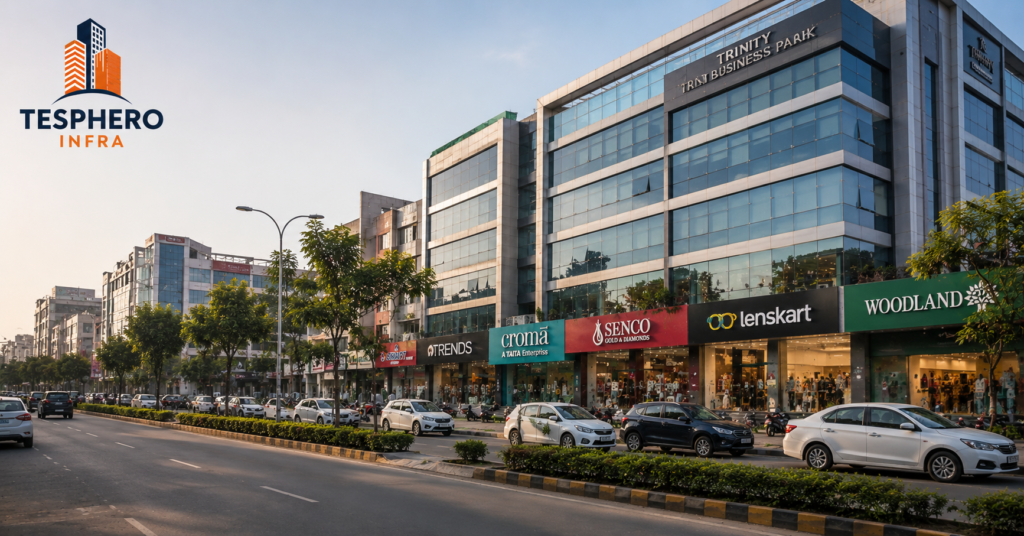
The right location should continue supporting the business as it grows.