
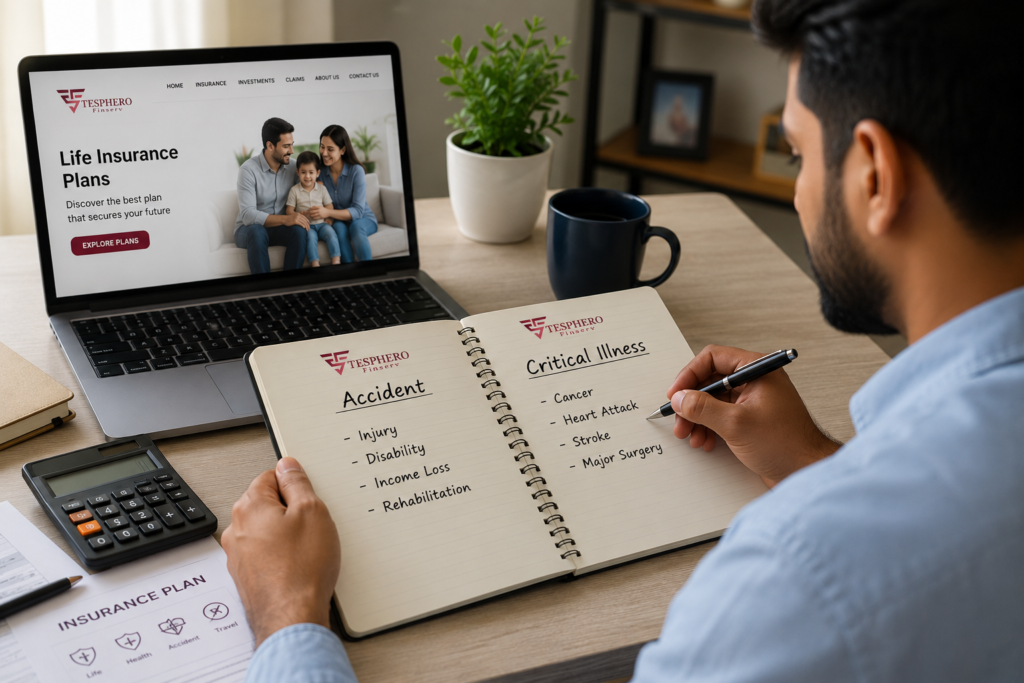
Different risks need different types of financial protection.
Two Different Risks, Two Different Types of Protection
Insurance planning often starts with one simple question:
“Mere paas health insurance hai, kya itna enough hai?”
For many people, the answer isn’t always straightforward.
Health insurance can help cover eligible hospitalisation and medical treatment expenses, but other financial risks can arise from a serious accident or illness.
This is where Personal Accident Insurance and Critical Illness Insurance come into the picture.
At first, they may seem similar.
Both provide financial protection when something unexpected happens. Both can be useful additions to an overall insurance plan. And both are often discussed alongside health insurance.
But they actually work in very different ways.
A personal accident policy is primarily designed around accidental events and their consequences, while critical illness insurance focuses on the diagnosis of specified serious illnesses covered under the policy.
Understanding this difference matters because choosing insurance simply because someone recommended it may leave you with protection that doesn’t match your actual needs.
So, should you have both?
Before answering that question, let’s first understand what each type of insurance is designed to do.
What Is Personal Accident Insurance?
Personal Accident Insurance is designed to provide financial protection when an insured person suffers certain injuries or consequences because of an accident, subject to the policy’s terms and conditions.
Depending on the policy, benefits may be available for situations such as:
- Accidental death
- Permanent total disability
- Permanent partial disability
- Temporary disability
- Accident-related hospitalisation or other specified expenses
The exact coverage varies between policies, so the benefit structure, exclusions, and definitions should always be checked before buying.
The important point is this:
The trigger is generally an accident covered by the policy.
For example, imagine a 35-year-old working professional who depends heavily on their monthly income.
If a serious accident results in permanent disability and affects their ability to work, the financial impact may go far beyond the immediate medical bill.
There could be:
- Loss of income
- Ongoing household expenses
- Loan repayments
- Rehabilitation costs
- Changes required at home
- Long-term care requirements
A personal accident policy can provide financial support for certain covered consequences of the accident.
That makes it particularly relevant for people whose income depends on their ability to work.
What Is Critical Illness Insurance?
Critical Illness Insurance works differently.
Instead of being centred around an accident, it is designed to provide a benefit when the insured person is diagnosed with a specific critical illness covered under the policy, subject to the policy terms, definitions and waiting periods.
Depending on the policy, covered illnesses may include conditions such as certain cancers, heart-related conditions, stroke and other specified serious illnesses.
The exact list differs from one policy to another.
This is important because you should never assume that every serious illness is automatically covered.
The financial impact of a critical illness can also be significant.
Even if you already have health insurance, a serious diagnosis can create expenses beyond hospital bills.
You may need time away from work.
Your family may lose part of its regular income.
You may need follow-up treatment or lifestyle adjustments.
There may also be household expenses, children’s education costs, EMIs, and other financial commitments that continue regardless of your health situation.
A critical illness policy can provide a lump-sum benefit when a covered condition meets the policy’s definition.
The money can generally help the policyholder manage the financial impact of the illness, subject to the policy terms.
Personal Accident vs Critical Illness: The Basic Difference
The easiest way to understand the difference is to look at what triggers the benefit.
| Personal Accident Insurance | Critical Illness Insurance |
|---|---|
| Primarily covers specified consequences of covered accidents | Covers diagnosis of specified critical illnesses |
| Focuses on accidental injury, disability or death | Focuses on specified serious medical conditions |
| Useful protection against accident-related financial risks | Useful protection against financial impact of serious illness |
| Benefit depends on the type and severity of covered accident | Benefit depends on diagnosis meeting policy conditions |
| Particularly relevant for people exposed to higher accident risks | Relevant for people concerned about serious illness and financial disruption |
Neither policy is automatically “better” than the other.
They are designed for different risks.
Why Your Health Insurance Does Not Make These Policies Identical
This is where many people get confused.
A health insurance policy and a critical illness policy can both relate to medical situations, but they don’t necessarily work in the same way.
A regular health insurance policy generally helps cover eligible healthcare or hospitalisation expenses according to the policy terms.
Critical illness insurance, on the other hand, can provide a lump-sum benefit after diagnosis of a covered critical illness, subject to the policy conditions.
Similarly, personal accident insurance focuses on covered accidental events and their consequences.
So instead of asking:
“Which one should I buy?”
a better question is:
“What financial risk am I trying to protect myself and my family against?”
That change in thinking can make insurance planning much clearer.
A Simple Example
Consider two people.
Person A: Rahul
Rahul works in a field where he travels frequently and spends considerable time on the road.
His biggest concern is:
“What happens to my family if an accident leaves me seriously injured or unable to work?”
For Rahul, personal accident protection may be an important part of his overall financial planning.
Person B: Neha
Neha works from home and has relatively low exposure to daily travel-related risks.
However, she is more concerned about the financial consequences of a serious illness that could require long-term treatment and time away from work.
For her, critical illness coverage may deserve greater attention.
Now consider a third situation.
Someone may have both kinds of risks.
They could face an accidental injury and also have a family history or other personal concerns related to serious illnesses.
In such a case, having both types of protection may make sense as part of a broader insurance strategy.
The key is not to buy policies simply because they exist.
Buy protection based on the financial risks you actually need to manage.
Do You Really Need Both?
Understanding the difference between Personal Accident and Critical Illness Insurance is only the first step.
The bigger question is:
If both policies protect against different risks, should you have both?
There is no single answer that works for everyone. Your age, income, lifestyle, family responsibilities, existing insurance, and financial commitments all matter.
Let’s look at the decision more practically.
When Personal Accident Insurance Can Be Important
Accidents can happen to anyone, but the financial impact can be very different from person to person.
For someone who travels frequently for work, drives regularly, works at a physically demanding job or depends heavily on their monthly income, accidental disability can create a serious financial problem.
Think about a self-employed business owner.
If an accident prevents them from working for a long period, the business may continue to have expenses even when their personal income is affected.
Similarly, a salaried employee may continue to have:
- Home loan EMIs
- School or college expenses
- Household bills
- Existing debt
- Family responsibilities
Medical treatment is only one part of the problem.
The loss of earning ability can be equally important.
This is why personal accident insurance can be particularly relevant when your family’s financial stability depends heavily on your ability to work.
However, don’t look only at the premium.
Check what the policy actually covers, how disability is defined, what benefits are available, and what exclusions apply.
A cheaper policy isn’t necessarily the better choice if the coverage doesn’t match your requirements.
When Critical Illness Insurance Can Make Sense
Serious illnesses can create a different kind of financial pressure.
Imagine someone is diagnosed with a covered critical illness.
Even with health insurance, their financial situation may change.
They may need to take an extended break from work.
A spouse may need to reduce working hours to provide support.
There could be additional treatment-related expenses.
Meanwhile, regular financial commitments don’t stop.
Rent or EMIs still need to be paid.
Children’s education continues.
Household expenses continue.
This is where a critical illness benefit can provide an additional financial cushion, subject to the policy conditions.
The lump-sum amount can help the family manage the financial disruption caused by a covered illness.
And that’s an important distinction.
Critical illness insurance isn’t simply about paying hospital bills.
It is about providing financial support when a serious covered illness affects your life and finances.
Why Having Both Can Sometimes Make Sense
Now consider what happens when you look at these policies together.
Personal Accident Insurance primarily addresses covered accident-related risks.
Critical Illness Insurance addresses specified critical illnesses covered under the policy.
They don’t replace each other.
For example, a person could be protected against certain accident-related consequences but still face a completely different financial challenge after being diagnosed with a covered critical illness.
Likewise, having critical illness coverage doesn’t automatically provide the same protection for accident-related disability or death.
This is why some people may choose to have both as part of their overall financial protection strategy.
Think of it like different layers of protection.
Health Insurance → Medical Expense Protection
Personal Accident Insurance → Accident-Related Financial Protection
Critical Illness Insurance → Financial Support After a Covered Critical Illness
Each layer addresses a different situation.
The objective isn’t to collect as many insurance policies as possible.
The objective is to identify the financial risks that could seriously affect your family and build appropriate protection around them.
Your Age and Life Stage Matter
Your insurance needs can change as your responsibilities change.
A young professional with limited financial commitments may have different priorities from a married person with children and a home loan.
Consider these broad situations.
Early Career
You may have fewer dependants and lower financial commitments.
At this stage, affordability and building a basic financial protection plan may be important.
Marriage and Family
Once you have a spouse and children depending on your income, the financial impact of an accident or serious illness can become much larger.
Your insurance planning may need to reflect these additional responsibilities.
Home Loan and Major Financial Commitments
A home loan can make income protection even more important.
If your ability to earn is affected, the family may still need to manage regular EMIs and household expenses.
This is where reviewing accident and critical illness protection can become more relevant.
Later Working Years
As you move closer to retirement, your financial priorities may change again.
Existing health coverage, savings, investments, and retirement planning should all be considered together.
The important lesson is simple:
Insurance planning shouldn’t remain unchanged while your life keeps changing.
Don’t Choose Coverage Only Because Someone Else Has It
A common mistake is copying someone else’s insurance plan.
A friend may have personal accident insurance.
A colleague may have critical illness cover.
A family member may recommend a particular policy.
But their financial situation may be completely different from yours.
Ask yourself:
- Who depends on my income?
- How much financial responsibility do I currently have?
- What existing insurance do I already have?
- What would happen if I couldn’t work for an extended period?
- Do I have enough emergency savings?
- Would a serious illness create a major financial gap for my family?
These questions can help you understand where your actual protection gaps may be.
What Should You Check Before Buying?
Before purchasing either policy, don’t stop at the premium.
Read the policy details carefully and understand:
Coverage: What events or illnesses are actually covered?
Definitions: How does the insurer define disability or a critical illness?
Waiting Periods: Are there applicable waiting periods?
Exclusions: What situations aren’t covered?
Benefit Amount: Is the potential benefit meaningful in relation to your financial responsibilities?
Claim Conditions: What documentation and conditions apply when making a claim?
Policy Terms: What other conditions, limitations, or exclusions should you know about?
Insurance is a financial commitment.
Taking a little time to understand the policy before purchasing can prevent unpleasant surprises later.
Before choosing an insurance policy, customers can also refer to information published by IRDAI to better understand insurance regulations and consumer-related guidance.
Making the Right Choice for Your Financial Plan
The question isn’t really “Personal Accident or Critical Illness?”
For many people, the better question is:
“What financial risks would create the biggest problem for my family if something unexpected happened?”
Once you look at insurance from that perspective, choosing the right protection becomes much easier.
Do You Need Both Policies?
You may benefit from both if your financial responsibilities are significant and you want protection against different types of risks.
For example, a working parent with children, a home loan and limited emergency savings may face financial pressure from both a serious accident and a covered critical illness.
However, having both isn’t automatically necessary for everyone.
Your decision should consider your existing health insurance, life insurance, savings, income, dependants, and overall financial situation.
The goal should be adequate protection—not collecting multiple policies simply because they are available.
Don’t Forget Your Existing Insurance
Before buying another policy, review what you already have.
You may already receive some accident-related benefits through an employer, existing insurance policy, or another financial product. Similarly, your health insurance may provide certain benefits that you should understand before purchasing additional coverage.
This doesn’t mean additional insurance is unnecessary.
It simply means you should know what you already have and where the gaps are.
A basic insurance review can help you avoid both underinsurance and unnecessary duplication.
Personal Accident ya Critical Illness Insurance consider karte waqt sirf ek policy ko alag se dekhna enough nahi hai. Aapki life insurance, health insurance aur other financial protection ko bhi overall picture mein consider karna important hai. For example, agar aap apne family’s financial responsibilities aur future needs ke according life cover review karna chahte hain, to hamara guide “Term Insurance at Different Stages of Life: How Much Cover Do You Really Need?” aapko ye samajhne mein help kar sakta hai ki different life stages par insurance needs kaise change ho sakti hain.
A Practical Way to Think About It
Instead of starting with the policy name, start with the risk.
Ask:
If an accident affects my ability to earn, how will my family manage?
If I am diagnosed with a covered critical illness, how will my finances be affected?
Would my current savings and insurance be enough to handle the disruption?
Your answers can help you identify where additional protection may be useful.
And remember, policy terms vary. Coverage, exclusions, waiting periods, definitions, and claim conditions should always be reviewed carefully before making a decision.
How Tesphero Finserv Can Help
Insurance planning becomes easier when you understand what you’re actually protecting.
At Tesphero Finserv, we help customers look at insurance from a broader financial perspective rather than choosing a policy based only on premium or a recommendation from someone else.
Whether you’re reviewing your existing protection or considering additional coverage, the first step is understanding your financial responsibilities and potential protection gaps.
The right insurance isn’t necessarily the policy with the lowest premium. It’s the protection that makes sense for your situation.
To understand more about our approach to insurance and financial services, visit the About Tesphero Finserv.
If you’re unsure about your current insurance protection, Contact Us to discuss your requirements.
Final Thoughts
Personal Accident and Critical Illness Insurance serve different purposes.
One focuses primarily on covered accident-related consequences, while the other provides a benefit when a specified critical illness covered by the policy is diagnosed.
For some people, having both can provide broader financial protection. For others, one may be a more relevant priority based on their circumstances.
There is no universal formula.
Understand your risks first. Compare the coverage carefully. Then choose accordingly.
Insurance works best when it is planned before you actually need it.
Frequently Asked Questions

The right insurance plan starts with understanding your family’s financial risks.