
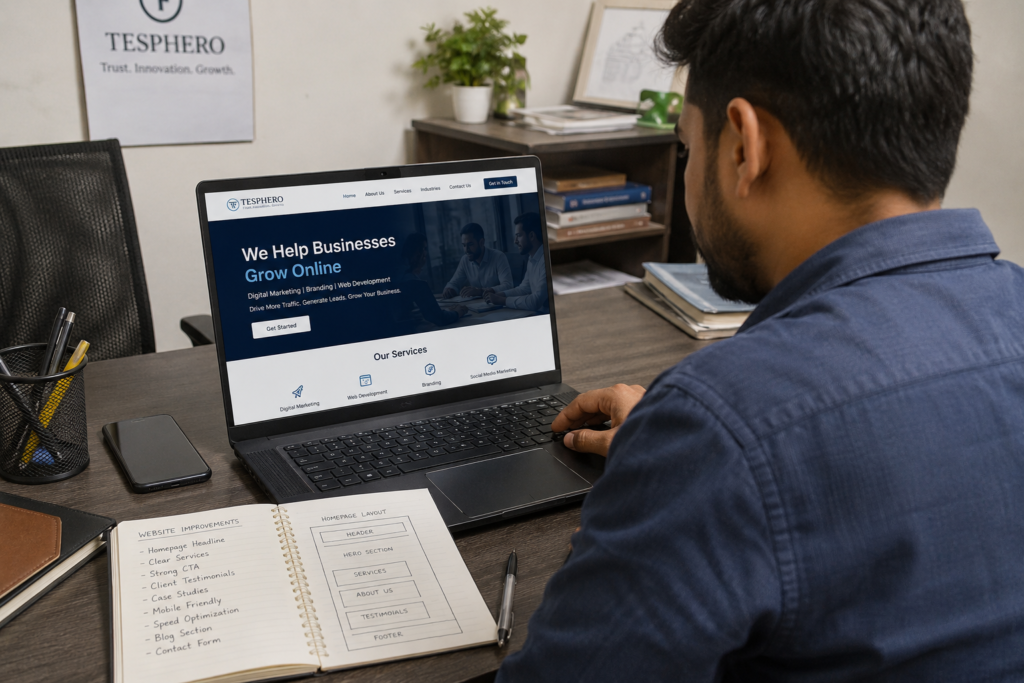
A website needs to communicate your value before it can generate enquiries.
Your Website May Be Getting Visitors—but Are They Taking Action?
You have a website.
It looks professional. Your services are listed. Your contact number is visible. You may even be getting visitors through Google, social media, or paid advertising.
But there is one problem.
The enquiries aren’t coming in.
This is more common than many business owners realise.
A website can receive traffic and still generate very few leads. The reason is simple: getting someone to visit your website and convincing them to contact your business are two different things.
Think about a physical store.
A person walks in, looks around, and leaves without asking anything.
You wouldn’t automatically assume that the person wasn’t interested. Perhaps the products weren’t clearly displayed. Maybe they couldn’t find what they needed. Maybe nobody explained the value.
A business website can face the same problem.
Your website may have visitors, but if the message is unclear, the navigation is confusing, the content doesn’t answer customer questions or there is no strong reason to take the next step, visitors can simply leave.
So before spending more money on advertising, it is worth asking:
Is your website actually designed to generate leads?
Let’s look at some of the most common reasons why business websites fail to convert visitors into enquiries.
1. Your Website Doesn’t Clearly Explain What You Do
One of the first things a visitor should understand when landing on your website is:
What does this business do, and can it help me?
Unfortunately, many websites make this harder than it needs to be.
The homepage may say things like:
“We deliver innovative solutions for a better tomorrow.”
It sounds professional, but it doesn’t tell the visitor much.
A better approach is to communicate the actual service clearly.
For example:
Digital Marketing Services That Help Local Businesses Generate More Qualified Enquiries
Now the visitor immediately has an idea of what the company does and who it helps.
Your website doesn’t need complicated language to look professional.
In fact, clarity often builds more trust than clever wording.
Your homepage should quickly communicate:
- What you offer
- Who you help
- What problem you solve
- Why customers should consider you
- What they should do next
If visitors need to scroll through three or four sections just to understand your business, you may already be losing potential leads.
2. Your Website Is Talking About Your Business—Not the Customer
This is another common problem.
Businesses often build websites around themselves.
“We are a leading company…”
“We have years of experience…”
“We provide the best solutions…”
These statements aren’t necessarily wrong.
But customers are usually thinking about something else:
“Can you solve my problem?”
Suppose someone is looking for accounting services.
They aren’t primarily interested in reading about how innovative your company is.
They want to know:
- Can you handle my type of business?
- What services do you provide?
- How does the process work?
- Can I trust you?
- How can I contact you?
Your website content should therefore connect your services with the customer’s actual problems.
Instead of simply saying:
“We provide SEO services.”
You could explain:
“Not getting enough enquiries from Google? Our SEO strategy focuses on improving your search visibility and attracting people actively looking for your services.”
The second version starts a conversation with the customer.
Your website should answer the visitor’s question, not just describe your company.
3. Your Call-to-Action Is Weak or Missing
Imagine a visitor reads your entire service page and decides:
“This company might be able to help me.”
What happens next?
If the page doesn’t make the next step obvious, the visitor may simply close the tab.
This is where a clear Call-to-Action (CTA) becomes important.
Instead of generic buttons such as:
Submit
or
Click Here
Use action-oriented language that tells the visitor what will happen next.
For example:
- Get a Free Consultation
- Discuss Your Requirement
- Request a Quote
- Talk to Our Team
- Book a Consultation
The CTA should also match the visitor’s stage in the buying journey.
Someone reading a detailed service page may be ready to enquire.
Someone reading an educational blog may simply want to learn more.
You don’t necessarily need to push everyone toward the same action.
The right CTA gives the visitor a clear next step without making them feel pressured.
Your Website May Be Losing Leads Before They Contact You
A visitor can understand your service and still leave without enquiring.
Why?
Because lead generation depends on more than content.
The user experience, website speed, trust signals, mobile experience, and overall presentation can all influence the decision.
4. Your Website Is Too Slow
Nobody likes waiting for a website to load.
If pages take too long to open, visitors may leave before they even see your offer.
This becomes especially important on mobile devices, where people often browse using mobile data or less stable connections.
A slow website can affect more than user experience. It can also make your business appear less professional.
Review elements such as:
- Large image files
- Unnecessary plugins
- Heavy animations
- Poor hosting
- Unoptimized code
- Too many external scripts
You don’t need a website filled with animations to impress customers.
A fast, clean website that loads quickly can often do more for conversions than a visually complicated one.
5. Your Mobile Website Isn’t Good Enough
A website may look excellent on a desktop and still provide a poor experience on a smartphone.
This matters because many potential customers will discover your business through:
- Google searches
- Online advertisements
And much of that traffic can come from mobile devices.
Check your website on an actual phone.
Can visitors read the text comfortably?
Are buttons easy to tap?
Does the enquiry form work properly?
Do images load correctly?
Can someone find your phone number or WhatsApp option quickly?
If the answer to these questions is no, you may be losing leads without realising it.
Your website needs to work for the customer—not just look good on your designer’s screen.
6. There Isn’t Enough Trust on the Website
People don’t usually submit their details to a business they don’t trust.
Especially when the service involves a significant amount of money.
Before contacting you, visitors may want to know:
“Has this company actually helped people like me?”
Your website can answer that through genuine trust signals.
Consider including:
- Client testimonials
- Case studies
- Relevant certifications
- Business experience
- Project examples
- Customer reviews
- Real photographs
- Clear company information
For example, instead of simply writing:
“We provide high-quality digital marketing.”
Show what that means.
You could present a real case study explaining the client’s challenge, the strategy used, and the outcome.
Specific evidence is usually more convincing than broad claims.
7. Your Contact Process Is Too Complicated
This is surprisingly common.
A visitor decides to enquire, clicks Contact Us, and finds a long form asking for:
- Full name
- Company name
- Address
- Industry
- Budget
- Website
- Multiple questions
- Detailed requirements
They may simply give up.
Your first contact form doesn’t necessarily need to collect everything.
Start with the information your team genuinely needs to respond.
For example:
Name + Phone/Email + Requirement
That’s often enough to begin the conversation.
You can collect additional information later.
Also make sure your contact options are easy to find.
Depending on your business, these could include:
Call | WhatsApp | Enquiry Form | Email
The easier you make the first step, the less friction you create.
8. Your Website Doesn’t Match Your Advertising
Imagine someone clicks a Google or Meta advertisement that says:
“Get Professional Website Design for Your Business.”
But the landing page talks mostly about social media marketing.
The visitor may wonder whether they clicked the wrong link.
This disconnect can reduce trust and waste advertising money.
Your advertisement, landing page, and CTA should tell a consistent story.
If an ad promotes one specific service, the visitor should ideally land on a page that clearly explains that same service.
Don’t make customers search for what they clicked to find.
Turn Your Website Into a Better Lead-Generation Tool
A website shouldn’t simply exist as your company’s online address.
It should support your sales process.
That doesn’t mean every visitor will become a customer immediately.
Instead, your website should make it easier for the right visitors to understand your offer, trust your business, and take the next step.
9. Your Content Isn’t Answering Customer Questions
People search online because they have questions.
Before contacting a business, they may want to know:
- What does the service include?
- How much does it generally cost?
- How long does the process take?
- Who is the service suitable for?
- What results can they realistically expect?
- How does your process work?
If your website doesn’t answer these questions, visitors may look elsewhere.
This is why useful service pages, FAQs, guides, and blogs can contribute to lead generation.
Good content doesn’t just bring traffic.
It helps potential customers become more informed before they contact you.
Your website is only one part of a successful digital strategy. You can also read our What Is SEO and Why Is It Important for Business Growth? to understand how different online channels can work together.
10. You’re Not Measuring Where Leads Are Being Lost
You cannot improve what you don’t measure.
If your website isn’t generating enough enquiries, don’t immediately assume that the entire website is the problem.
Look at the journey.
For example:
Visitors → Service Page → Enquiry Page → Form Submission
Where are people dropping off?
If traffic is low, you may have a visibility problem.
If traffic is good but people leave quickly, the issue may be content, relevance, or user experience.
If people visit service pages but don’t enquire, your offer, trust signals, or CTA may need improvement.
Analytics tools can help you understand these patterns.
The goal isn’t to collect hundreds of numbers.
It’s to answer useful questions.
Where are potential customers leaving, and why?
Businesses can use tools such as Google Analytics to better understand website traffic, user behaviour and conversions and identify where visitors may be dropping out of the journey.
11. Your Website Doesn’t Give Visitors a Reason to Choose You
There are probably many businesses offering services similar to yours.
So why should someone choose you?
Your website needs to communicate your real differentiator.
It could be:
- Industry experience
- Faster response
- Specialised expertise
- Local knowledge
- A particular process
- Strong customer support
- Proven results
- Specific product or service expertise
But don’t simply claim:
“We are the best.”
Explain what makes your approach different.
A strong value proposition gives visitors a reason to continue exploring your business.
Common Website Lead-Generation Mistakes
Before redesigning your entire website, check for these simple problems:
Too Much Information
More content doesn’t automatically mean better content. Keep important information easy to find.
Weak Headlines
Your first headline should communicate your core offer clearly.
Generic CTAs
“Submit” doesn’t tell customers much. Give them a clear next step.
No Social Proof
If you have genuine customer feedback or case studies, don’t hide them.
Poor Mobile Experience
Always test the website on actual smartphones.
No Clear Service Pages
If you offer multiple services, each important service should have enough information to stand on its own.
Ignoring Existing Traffic
Before spending more on advertising, check whether your existing visitors are converting.
How Tesphero Digi Can Help
A website should do more than look professional.
It should support your marketing and sales goals.
At Tesphero Digi, we look at the website from the customer’s point of view—how people discover it, what they see first, how easily they understand the offer, and what encourages them to enquire.
Depending on the business requirement, this may involve improving website content, landing pages, user experience, calls-to-action, SEO, conversion strategy, or the overall digital journey.
The objective isn’t to add unnecessary features.
It’s to make the website clearer, more useful and more capable of turning relevant visitors into genuine enquiries.
Think your website could be generating more enquiries? Contact Tesphero Digi to discuss your website and digital marketing requirements.
Final Thoughts
If your website isn’t generating enough leads, don’t immediately assume that you need more traffic.
Sometimes the problem is what happens after the visitor arrives.
Your website may have unclear messaging, weak CTAs, slow pages, poor mobile usability, limited trust signals, or a complicated enquiry process.
The good news is that these are areas you can review and improve.
Start by looking at your website from the customer’s perspective.
Can they understand what you offer within a few seconds?
Can they see why your business is worth considering?
Can they easily find the information they need?
And when they’re ready to talk, is it obvious what they should do?
Because ultimately, a successful business website isn’t the one that simply looks good.
It’s the one that helps the right people take the right next step.
Frequently Asked Questions
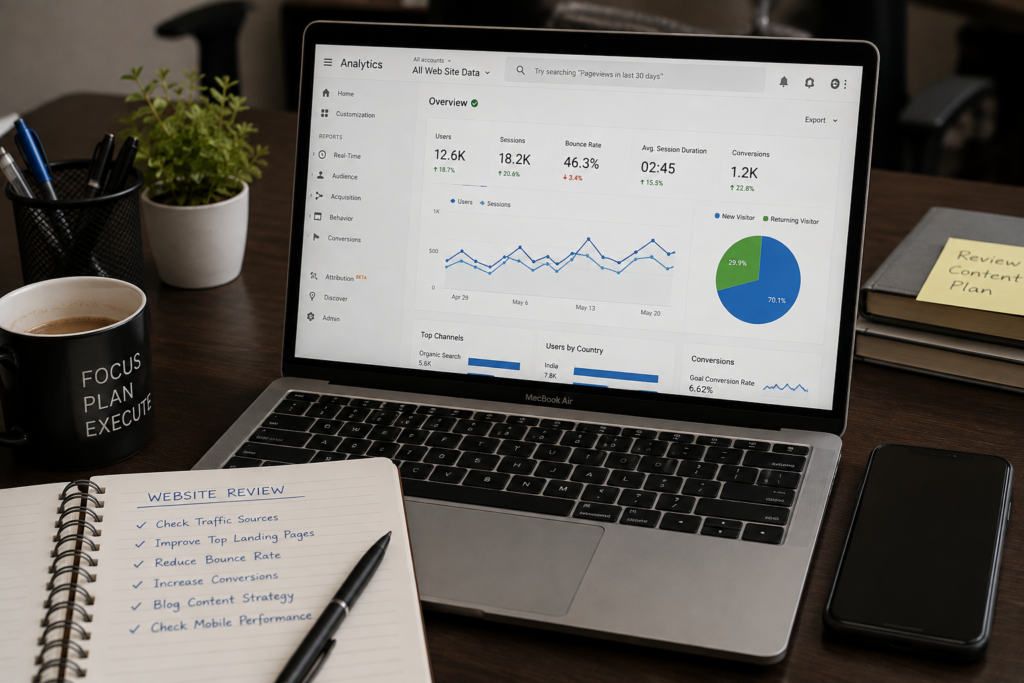
Data helps you understand where potential customers are leaving your website.
About Tesphero Digi
At Tesphero Digi, we believe digital marketing should be connected to real business goals—not just likes, impressions or website traffic. Our approach focuses on understanding the business, its audience, and its challenges before building a digital strategy. From SEO and content to social media, website optimization, and lead generation, we work towards creating a stronger and more meaningful online presence. To learn more about our approach, services, and the way we help businesses grow digitally, visit the About Us.