
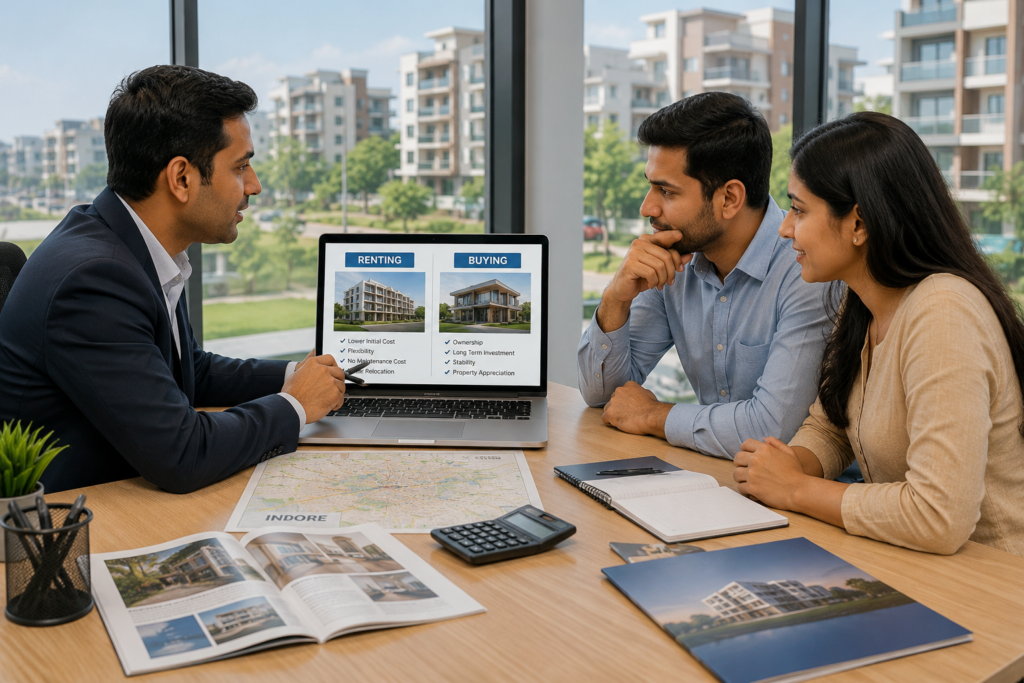
Renting or buying? The right property decision depends on your financial goals, lifestyle, and long-term plans.
For many people in Indore, finding the right property is not just about choosing a location or comparing prices. One of the first questions is much simpler:
Should you rent a property or buy one?
There is no universal answer.
For some people, renting offers flexibility and convenience. For others, buying a property can provide long-term stability and ownership. The right decision depends on your financial position, lifestyle, plans, and the type of property you need.
The decision can also be different for someone looking for a home compared to a business owner searching for commercial space.
With Indore continuing to attract professionals, families, students, entrepreneurs, and businesses, the city’s real estate market offers opportunities for both renters and property buyers.
So, which option makes more sense for you?
Let’s look at the key factors that can help you make a more informed decision.
If you’re planning to buy a property in Indore, it’s also important to look beyond the price tag. Read our guide on Why Buying Property Based Only on Price Can Turn Into an Expensive Mistake in Indore to understand the factors that deserve your attention before making a purchase.
Renting vs Buying: Understanding the Basic Difference
Before deciding what is right for you, it’s important to understand what renting and buying actually mean from a financial and practical perspective.
Renting a Property
When you rent a property, you pay a regular amount to use the space without becoming its owner.
For many people, renting offers:
- Greater flexibility
- Lower initial financial commitment
- Easier relocation
- The ability to explore different locations
- Access to properties that may currently be outside their purchase budget
Renting can be particularly useful when your plans are uncertain or when you don’t want to make a long-term financial commitment immediately.
However, rental payments do not create ownership of the property, and the terms of the tenancy may change over time depending on the agreement and applicable conditions.
Buying a Property
When you buy a property, you are making a long-term commitment toward ownership.
Buying a property can provide:
- Long-term stability
- Ownership of a physical asset
- Greater control over the property
- Potential for long-term value appreciation
- More freedom to use the property according to your needs, subject to applicable rules and regulations
At the same time, property ownership comes with responsibilities.
Buyers need to consider costs such as maintenance, property taxes, registration-related expenses, repairs, and financing costs where applicable.
This means buying a property should be viewed as a long-term financial decision rather than simply a monthly EMI comparison.
Consider How Long You Plan to Stay in Indore
One of the most important questions to ask before choosing between renting and buying is:
How long do I realistically plan to stay here?
If you’re a young professional who may relocate because of your career, renting could provide the flexibility you need.
Similarly, if you have recently moved to Indore and are still exploring different neighbourhoods, renting a property can give you time to understand the city before making a long-term purchase.
On the other hand, if you are confident that you want to settle in Indore for many years, buying a property may offer greater stability and a stronger sense of ownership.
Your expected timeline can make a significant difference to the decision.
Evaluate Your Current Financial Position
Buying a property usually requires a larger initial financial commitment than renting.
Depending on the property and transaction, a buyer may need to plan for:
- Down payment
- Home loan or other financing costs
- Registration expenses
- Stamp duty
- Maintenance
- Property taxes
- Other transaction-related expenses
Renting generally requires a smaller upfront commitment, although tenants may need to pay a security deposit and other applicable charges.
Before deciding to buy, look at your complete financial position rather than focusing only on whether you can manage the monthly EMI.
Consider your savings, regular expenses, emergency fund, existing financial commitments, and future goals.
A property purchase should ideally fit into your broader financial plan without putting unnecessary pressure on your finances.
Look Beyond the Monthly Rent or EMI
It’s easy to compare a monthly rent with a monthly home loan EMI and assume that the lower number is automatically the better option.
But the actual decision is more complicated.
If you rent, you may have expenses related to:
- Monthly rent
- Security deposit
- Maintenance, depending on the agreement
- Periodic rent revisions
If you buy, your financial commitments may include:
- EMI
- Down payment
- Registration and transaction costs
- Maintenance
- Property taxes
- Repairs and other ownership expenses
The right comparison is not simply “Rent vs EMI.”
Instead, consider the overall cost of renting versus the complete cost of owning a property over the period you expect to use it.
Think About Your Lifestyle and Future Plans
Financial considerations are important, but your lifestyle also plays a major role in the rent-versus-buy decision.
For example, a young professional who expects to change jobs or cities may value flexibility more than ownership.
A family with children, on the other hand, may prefer the stability of owning a home close to schools, healthcare facilities, and other daily conveniences.
Similarly, a business owner may want to rent a commercial space initially and consider buying only after the business becomes more established.
Your current situation and plans should both be part of the decision.
A Simple Question to Ask Yourself
Before making a decision, ask:
Am I looking for flexibility right now, or am I ready to commit to long-term ownership?
Your answer can help you understand which direction makes more sense.
Renting Offers Greater Flexibility
One of the biggest advantages of renting is the freedom to adapt to changing circumstances.
Life doesn’t always follow a fixed plan. Your job may change, your family may grow, or you may simply realise that another part of the city is better suited to your lifestyle.
In such situations, renting can make it easier to move without dealing with the responsibilities involved in selling a property.
Renting may be a practical option for:
- Young professionals
- Students
- People who have recently moved to Indore
- Employees who may relocate in the future
- Families still exploring different neighbourhoods
- Businesses testing a new commercial location
For example, if you’re new to Indore, renting a home in an area for a year or two can help you understand the neighbourhood, commute, connectivity, and daily conveniences before deciding whether you want to buy there.
This flexibility can be especially valuable when your long-term plans are still evolving.
Buying Can Offer Long-Term Stability
While renting provides flexibility, buying a property can offer a different kind of value—stability and ownership.
For families planning to settle in Indore for the long term, owning a home can provide a greater sense of permanence.
You have more control over the property and, subject to applicable rules and regulations, may have greater freedom to personalise the space according to your needs.
Homeownership can also provide a sense of security that comes from having a property of your own.
Over time, the property may become an important part of your overall assets. Depending on market conditions, location, and property characteristics, it may also have the potential to appreciate.
However, ownership also means taking responsibility for maintenance, repairs, taxes, and other property-related expenses.
So, buying should be considered not just as a way to have a home, but as a long-term financial and lifestyle commitment.
Location Matters—Especially When You’re Buying
Whether you’re renting or buying, location plays an important role.
However, when purchasing a property, the importance of location becomes even greater because you are making a long-term commitment.
Before choosing a property in Indore, consider factors such as:
- Connectivity to major roads and transport routes
- Access to schools and healthcare facilities
- Nearby markets and daily conveniences
- Distance from workplaces or business areas
- Overall neighbourhood development
- Infrastructure and accessibility
- Future growth potential of the surrounding area
A location that works perfectly for you today may not necessarily be ideal five or ten years from now.
That’s why buyers should look beyond the property itself and understand the broader development and connectivity of the area.
For renters, location can be tested more easily. If a particular area doesn’t suit your lifestyle, moving to another location may be relatively simpler when your rental agreement allows.
For buyers, choosing the right location becomes even more important because selling and purchasing another property involves time, effort, and additional costs.
Renting vs Buying a Commercial Property
The rent-versus-buy decision is not limited to residential properties.
Business owners also face this question when choosing an office, retail outlet, warehouse, or other commercial space.
Renting a Commercial Property
Renting may be suitable for businesses that:
- Are still in the early stages of growth
- Want to keep their initial investment lower
- Expect their space requirements to change
- Want flexibility to move as the business expands
- Are testing a new market or location
For a growing business, renting can allow the owner to invest more available capital into operations, employees, marketing, or expansion.
Buying a Commercial Property
Buying may be considered by businesses that:
- Have stable and established operations
- Plan to stay in the same location for the long term
- Want greater control over their premises
- Have sufficient capital or access to suitable financing
- See property ownership as part of their long-term business strategy
The decision should be based on the business’s cash flow, growth plans, operational requirements, and long-term objectives.
A business that is constantly changing may value flexibility, while an established company with a stable location may prefer ownership.
Consider the Opportunity Cost of Buying
When you purchase a property, a significant amount of money may become tied up in that asset.
For example, the funds used for a down payment and other purchase-related expenses could potentially have been used for:
- Business expansion
- Investments
- Education
- Emergency savings
- Other financial goals
This doesn’t mean buying a property is the wrong decision.
It simply means you should consider what else you could do with your available capital before committing to a purchase.
At the same time, renters should also think about how they are using the money they are not putting into property ownership.
If you’re renting, the difference between your rental expenses and what you might have spent on ownership could potentially be directed toward savings or other financial goals, depending on your individual circumstances.
The key is to look at the complete financial picture rather than focusing on one monthly expense.
What About Property Value Appreciation?
One of the reasons people consider buying property is the possibility of long-term appreciation.
However, property values do not increase at the same rate everywhere, and appreciation is never guaranteed.
Several factors can influence a property’s future value, including:
- Location
- Connectivity
- Infrastructure development
- Demand and supply
- Property type
- Neighbourhood development
- Broader economic conditions
This is why buying a property purely because you expect its price to rise can be risky.
If you’re purchasing a property for investment, you should carefully evaluate the location, property type, demand, and your expected investment horizon.
The way you evaluate a property for self-use may also be different from how you evaluate one purely as an investment.
For a home, factors such as comfort, lifestyle, schools, and accessibility may be more important.
For an investment, potential rental demand, liquidity, location, and long-term market prospects may receive greater attention.
Rent vs Buy: A Quick Comparison
| Factor | Renting | Buying |
|---|---|---|
| Initial Financial Commitment | Generally lower | Generally higher |
| Flexibility | High | Lower |
| Ownership | No | Yes |
| Long-Term Stability | Depends on rental arrangement | Generally higher |
| Relocation | Usually easier | More complicated |
| Maintenance Responsibility | Depends on agreement | Generally owner’s responsibility |
| Property Asset Creation | No ownership created | Property becomes an owned asset |
| Long-Term Commitment | Lower | Higher |
| Potential Appreciation | No direct ownership benefit | Possible, but not guaranteed |
| Best Suited For | People seeking flexibility | People seeking long-term ownership |
This comparison shows that neither renting nor buying is automatically the better choice.
The right decision depends on your financial position, lifestyle, plans, and property requirements.
A Simple Way to Think About the Decision
If your priority is flexibility, renting may be worth considering.
If your priority is stability and ownership, buying may be more suitable.
If you’re still unsure about where you want to live or operate your business, renting can give you time to explore.
If you’ve found the right location, have a stable financial position, and are ready for a long-term commitment, buying may make more sense.
The important thing is to avoid making the decision based on one factor alone.
Ask Yourself These Questions Before Deciding
Before choosing between renting and buying, take a step back and look at your current situation.
Ask yourself:
How long do I plan to stay in Indore?
If you’re likely to relocate within a few years, renting may offer the flexibility you need. If you plan to settle in Indore for the long term, buying may be worth considering.
Is my income and financial position stable?
Buying a property is a long-term commitment. Make sure your finances can comfortably handle the purchase and ongoing ownership costs.
Do I have enough savings for the initial purchase costs?
Don’t put all your available savings into a property. Consider maintaining an emergency fund and accounting for your other financial goals.
Do I want flexibility or stability?
If your lifestyle or career is likely to change, flexibility may be more valuable. If you’re looking for a permanent home or business location, stability may be more important.
Am I buying for personal use or investment?
The factors you consider may be different depending on your purpose. A home for your family may be evaluated based on comfort and convenience, while an investment property may require a closer look at rental demand, location, and potential returns.
What type of property do I need?
Residential and commercial properties have different requirements. Your decision should consider how the property will be used and what makes sense for your specific needs.
When Renting May Make More Sense
Renting may be a practical choice if:
- You are new to Indore and still exploring different locations.
- Your career or business plans may require you to relocate.
- You don’t want to make a large financial commitment at this stage.
- You want the flexibility to change your location.
- Your property requirements may change in the near future.
- You want to test a location before considering a purchase.
For someone who values flexibility and expects their circumstances to change, renting can provide greater freedom without committing to a long-term property purchase.
When Buying May Make More Sense
Buying may be worth considering if:
- You plan to stay in Indore for the long term.
- Your income and financial position are stable.
- You have sufficient funds for the initial purchase costs.
- You want long-term stability and ownership.
- You are comfortable with the responsibilities of maintaining a property.
- You want to build a property asset over time.
- You have identified a location and property that genuinely fits your requirements.
However, buying should always be based on careful evaluation rather than pressure or the assumption that property ownership is automatically the right choice for everyone.
Making the Right Decision for Your Future
The rent-versus-buy decision is ultimately a personal one.
There is no universal formula that can tell everyone which option is better.
A young professional who may move to another city could benefit from the flexibility of renting. A family planning to settle in Indore for many years may prefer the stability of owning a home.
Similarly, a growing business may choose to rent a commercial space while it establishes itself, whereas an established business with stable operations may consider purchasing its own premises.
The important thing is to understand your priorities before making a decision.
Think beyond today’s rent or EMI and consider your financial position, lifestyle, plans, location, and long-term goals.
Final Thoughts
The question isn’t simply:
“Is renting better than buying?”
The more important question is:
“Which option makes more sense for my current situation and future plans?”
Renting can provide flexibility, lower initial financial commitment, and the freedom to adapt to changing circumstances.
Buying can offer long-term stability, ownership, and the opportunity to build a property asset over time.
Both options have advantages and responsibilities.
If you’re considering a property in Indore, take the time to understand your requirements and explore your options before making a decision.
Whether you’re looking to buy, sell, rent, or invest in residential or commercial property, the right guidance can help you approach your real estate journey with greater clarity and confidence.
About Tesphero Infra
Tesphero Infra is the real estate division of the Tesphero Group, dedicated to helping clients buy, sell, rent, and invest in residential and commercial properties in Indore.
Our focus is on understanding each client’s requirements and helping them navigate real estate decisions with professional guidance and greater transparency.
Whether you’re searching for a home, exploring commercial property, planning to sell, or looking for an investment opportunity, Tesphero Infra aims to make your property journey more organised and informed.
Your Property Journey Starts with the Right Guidance.

Whether you choose to rent or buy, the right property decision starts with understanding your needs, goals, and options.
Frequently Asked Questions (FAQs)
📞 Looking for the Right Property in Indore?
Whether you’re planning to buy, sell, rent, or invest, the right property decision starts with understanding your needs and exploring the right options.
Connect with Tesphero Infra to explore residential and commercial property opportunities in Indore.